
Yes, you can treat Suboxone and depression or anxiety at the same time. In fact, treating both together often works better than treating one alone. Your doctor can pair Suboxone for opioid use disorder with the right mental-health care, so the two plans support each other instead of pulling in different directions.
Many people carry 2 struggles at once. The opioid use disorder is loud, so it gets noticed first. But underneath, depression or anxiety is often driving the pain. Below we explain why these two things travel together, why treating both matters, and how a personalized plan, sometimes guided by brain mapping, can help you feel steady again.
Why Depression, Anxiety, and Opioid Use Disorder Travel Together
These conditions rarely show up alone. They feed each other. Someone in pain from anxiety may reach for opioids to feel calm. Then the opioid use makes the anxiety worse, and the cycle tightens.
How often? More often than most people assume. Per the 2023 National Survey on Drug Use and Health, 35 percent of US adults with a mental disorder also have a substance use disorder. Roughly 1 in 3. When both sit side by side, doctors call it a co-occurring disorder, or dual diagnosis.
The mental-health side alone is common ground. NIMH puts major depressive episodes at 21.0 million US adults in a year, or 8.3 percent of adults, drawing on the 2021 survey. So the person reading this is not an unusual case, whatever it feels like at 2 in the morning.
The National Institute on Drug Abuse (NIDA) describes these conditions as sharing risk factors rather than one simply causing the other. So it makes sense to treat them as one story, instead of two separate problems.
Why Treating Both Matters

Treating only half the problem tends to backfire. If you calm the opioid use but leave the depression alone, the sadness stays. That untreated sadness can pull you back toward old habits. The same goes the other way.
Here’s a simple way to see the difference.
| What gets treated | What often happens |
|---|---|
| Only the opioid use disorder | The depression or anxiety lingers, and relapse risk stays high |
| Only the depression or anxiety | The opioid use keeps disrupting mood, sleep, and progress |
| Both, together, as one plan | Each part supports the other, and recovery holds better |
The bottom row is the goal. When your care team treats both at once, you’re not fighting two battles on two fronts. You’re fighting one, with a full plan.
How Suboxone and Mental-Health Care Work Together
Suboxone, the generic is buprenorphine-naloxone, quiets cravings and withdrawal. That calm is a foundation. When cravings fade, your mind has room to do the harder work of healing.
The steadiness is partly chemistry. Buprenorphine’s mean elimination half-life runs 24 to 42 hours, so one daily dose holds you through the whole day rather than peaking and crashing the way a short-acting opioid does. Maintenance usually sits between 4 mg/1 mg and 24 mg/6 mg per day. And the medicine is doing real work on survival, not only comfort. A 2017 meta-analysis in The BMJ pooled 3 buprenorphine cohorts covering 15,831 people. It found 4.3 deaths per 1,000 person-years during treatment, versus 9.5 after people stopped.
Mental-health care fills that room. It might include talk therapy, a mental-health medicine, or both. Here’s how the pieces fit:
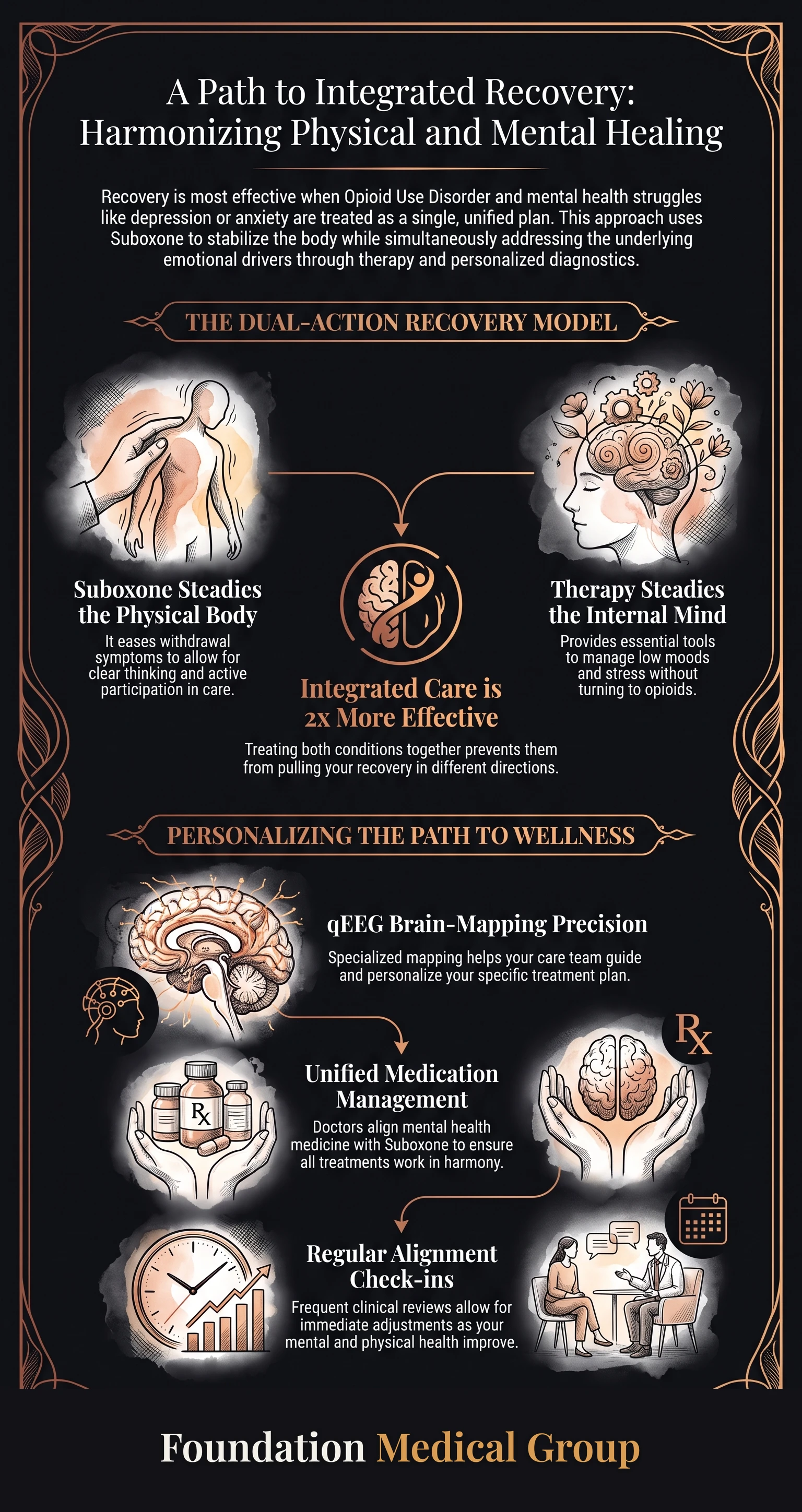
- Suboxone steadies the body. It eases withdrawal so you can think clearly and show up for the rest of your care.
- Therapy steadies the mind. It gives you tools to handle low moods, worry, and stress without turning to opioids.
- A mental-health medicine, if needed, can lift depression or calm anxiety so daily life feels manageable again.
- Regular check-ins keep it aligned. Your doctor watches how the parts work together and adjusts as you improve.
The key is coordination. 1 care team, 1 plan. That way nothing works against anything else.
How Brain Mapping Can Personalize Your Plan
Two people can have the same diagnosis and still need very different care. That’s where a brain-mapping assessment can help. A qEEG, short for quantitative electroencephalogram, records your brain’s electrical activity. It’s painless and needs no needles.
A clinical recording uses at least 21 sensors on an adult scalp, laid out on the international 10-20 system. The software then sorts the signal into bands. Delta sits below 4 Hz, theta at 4 to 7 Hz, alpha at 8 to 12 Hz, and beta at 13 to 30 Hz. Patterns linked to anxiety tend to look different from patterns linked to depression across those bands. Seeing that helps your care team match the plan to you, rather than to a generic template.
Worth saying plainly: the evidence for the neurofeedback that often follows a map is real but modest. A 2014 meta-analysis in Frontiers in Human Neuroscience pooled 5 randomized trials covering 263 children, 146 of them trained with EEG neurofeedback. Blinded teacher ratings improved inattention by 0.30 on a standardized mean difference. Total symptom scores did not reach significance.
You can learn how the process works on our brain mapping in Texas page. If cost is on your mind, our guide to qEEG brain mapping cost and insurance breaks it down in plain terms. Brain mapping doesn’t replace your doctor’s judgment. It’s one more tool that makes the plan more personal.
Medication Interactions to Discuss With Your Doctor

When you take more than one medicine, they can affect each other. This isn’t a reason to worry. It’s a reason to keep your doctor in the loop.
Some medicines used for anxiety, like benzodiazepines, need extra care when combined with Suboxone. Both can slow your breathing, so a doctor watches this closely. Certain antidepressants can interact too.
There’s a mechanism behind that, and it’s worth knowing the shape of it. Buprenorphine is broken down mainly by a liver enzyme called CYP3A4. Medicines that block that enzyme, for example macrolide antibiotics such as erythromycin, azole antifungals such as ketoconazole, and protease inhibitors such as ritonavir, can push your buprenorphine levels up. Medicines that speed the enzyme up can pull levels down and bring on withdrawal symptoms. So it isn’t a mystery, and it isn’t a reason to hide anything. Doctors manage these combinations every day, as long as they can see the full list.
So bring everything to your visit. Write down every medicine, supplement, and over-the-counter product you take. Then ask your care team these questions:
- Are any of my medicines a concern with Suboxone? Ask what to watch for.
- What side effects should I report right away? Know the warning signs.
- Should we adjust any doses? Sometimes a small change makes a big difference.
- Who do I call with questions between visits? Keep that number handy.
Don’t stop or change a medicine on your own. Coordinate with your care team first, even for something that seems small like a cold remedy.
Finding Care That Treats the Whole You
Good care sees the whole person, not just one label. A physician-led clinic can treat the opioid use disorder and the depression or anxiety under one roof, with one plan.
At Foundation Medical Group, care is led by a doctor and built to treat both sides together. If cost or coverage worries you, our Suboxone doctor in Texas that accepts Medicaid guide shows your options. The goal is steady, whole-person care you can stay with for the long run.
Infographic: How Suboxone and Mental-Health Care Work Together
Frequently Asked Questions
Can I take an antidepressant while on Suboxone?
Often, yes. Many people take an antidepressant alongside Suboxone with no trouble. Your doctor checks for interactions first and watches how you respond. Always share your full medicine list so the plan stays safe.
Does Suboxone treat depression or anxiety?
No. Suboxone treats opioid use disorder by easing cravings and withdrawal. It doesn’t treat depression or anxiety on its own. Those need their own care, which your doctor pairs with Suboxone for a complete plan.
Why treat opioid use disorder and mental health together?
Because they feed each other. Leaving one untreated can undo progress on the other. Treating both as one plan gives each part support, which helps recovery hold better over time.
Is it safe to take anxiety medicine with Suboxone?
It can be, with care. Some anxiety medicines, like benzodiazepines, can slow breathing when combined with Suboxone. A doctor manages this closely, so never mix them without medical guidance.
How does brain mapping help with a dual diagnosis?
A qEEG shows patterns in your brain’s activity. Those patterns can point to anxiety or depression, which helps your care team personalize the plan. It supports your doctor’s judgment rather than replacing it.
Key Takeaways and Next Steps
Here’s what to hold on to. Depression, anxiety, and opioid use disorder often travel together, and treating them together works better than treating one alone. Suboxone steadies the body while therapy and, if needed, a mental-health medicine steady the mind. A brain-mapping assessment can make your plan more personal, and every medicine you take belongs on one list your doctor can see.
- Ask for care that treats both the opioid use disorder and your mental health as one plan.
- Bring a full list of your medicines to every visit, and don’t stop or change one on your own.
- Ask if a qEEG brain-mapping assessment could help personalize your care.
- Keep your care team’s number close, and call with any question between visits.
Ready to feel steady again? Reach out to Foundation Medical Group and ask how a whole-person plan could work for you. One call can turn two separate struggles into one clear path forward.
Sources
- National Institute on Drug Abuse, Comorbidity: Substance Use and Other Mental Disorders.
- SAMHSA, Co-Occurring Disorders and Other Health Conditions.
- National Institute of Mental Health, Major Depression statistics.
- FDA prescribing information, Suboxone sublingual film.
- Sordo L, et al. Mortality risk during and after opioid substitution treatment. BMJ 2017;357:j1550.
- Micoulaud-Franchi et al., EEG neurofeedback treatments in children with ADHD, Frontiers in Human Neuroscience 2014.
- Electroencephalogram, StatPearls, NCBI Bookshelf.