
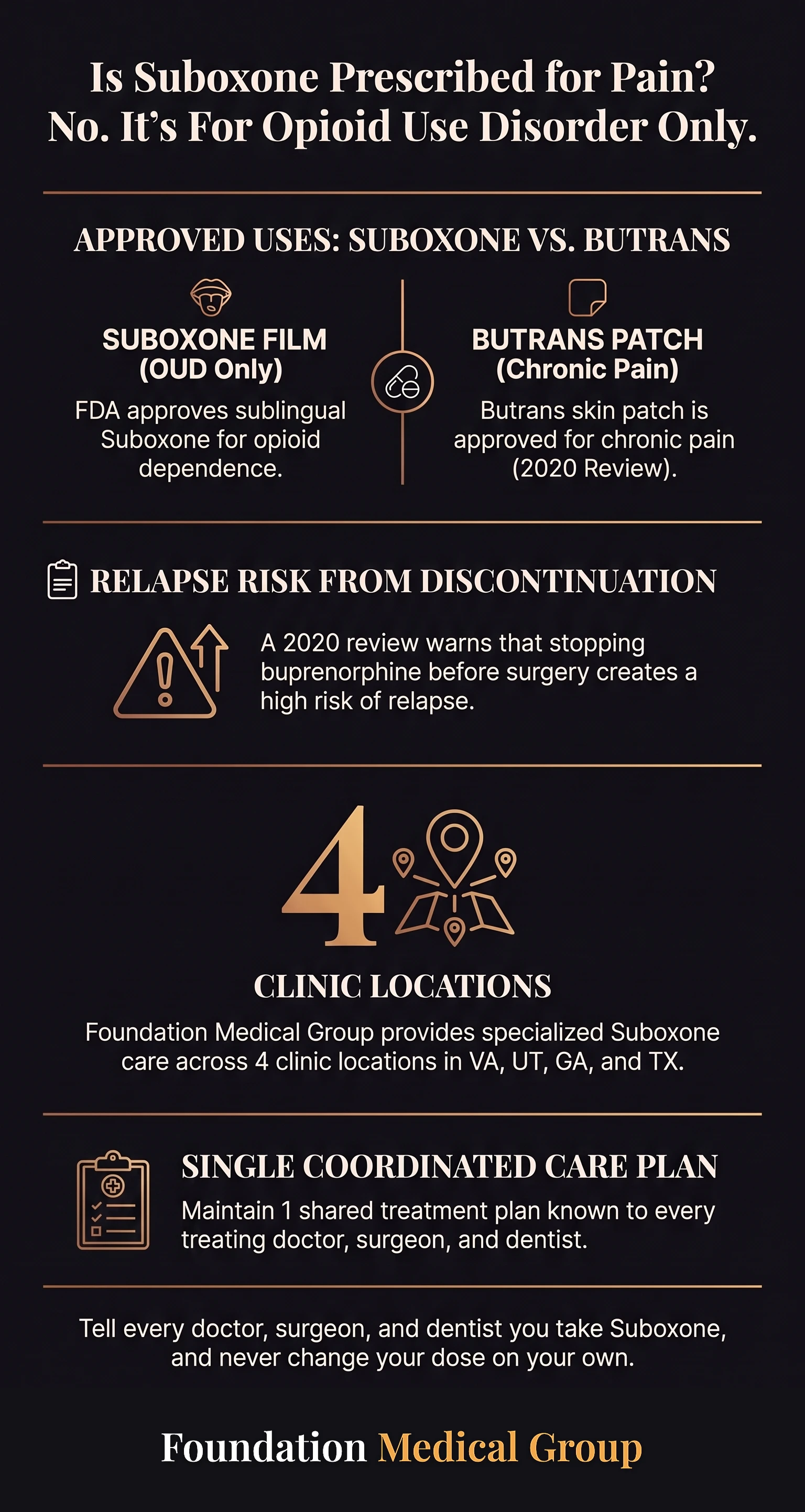
Suboxone (buprenorphine and naloxone) is approved to treat opioid use disorder, not pain. Buprenorphine can bring some relief, though. So with Suboxone and pain, the safest plan is usually the one you make with your prescriber and your care team. Tell every doctor, surgeon and dentist you take it. And never change your dose on your own.
What Is Suboxone, and Does Suboxone Help With Pain?
Suboxone is a prescription medicine that combines buprenorphine and naloxone. According to the FDA label on DailyMed, it treats opioid dependence as part of a complete plan that includes counseling. That approach is called medication assisted treatment for opioid addiction.
Does it help? A little. NIDA explains that buprenorphine and methadone can both reduce pain, so people with acute or chronic pain may be advised to keep taking them. Buprenorphine has some pain relieving properties. Still, Suboxone isn’t a painkiller. So why not just lean on it? Because the CDC’s 2022 opioid guideline notes that its pain relief fades sooner than its effect on withdrawal.
The label also describes a “ceiling effect” on its opioid effects. Why? It comes down to two terms, partial opioid agonist and opioid receptor, and our guide on how Suboxone works walks through both.
Can Suboxone Be Prescribed for Pain?
No. The label puts it plainly: “SUBOXONE sublingual film is not appropriate as an analgesic.” An analgesic is simply a pain medication. The label also reports deaths in people who were given buprenorphine as a painkiller without any opioid tolerance. Put simply, their bodies weren’t used to opioids. Honestly, that’s a sobering line to read.
A different buprenorphine drug does exist for that purpose. A 2020 review in the Journal of General Internal Medicine notes that sublingual Suboxone is FDA-approved for opioid use disorder only, whereas a skin patch called Butrans is approved for chronic pain. Whether that patch suits you is a separate decision for a pain doctor. At Foundation Medical Group, we prescribe Suboxone for opioid use disorder only. That holds at every one of our clinics, from Richmond to Dallas.
What Happens If You Take Opioid Pain Pills While on Suboxone?
NIDA says some medications for opioid use disorder may make other opioid pain medications less effective. A pill like that may have a weaker opioid effect than you expect. That’s frustrating when you’re hurting. Maddening, really, if you’ve been doing everything right in recovery and the pain just won’t quit.
The urge to take another one makes sense. But don’t take more. Extra opioid medications taken on your own are opioid misuse, and the stakes are high. SAMHSA warns that mixing large amounts of other medications with buprenorphine can lead to overdose or death. The FDA label says each patient should learn the risks of combining Suboxone with opioid analgesics, benzodiazepines, sedatives and alcohol.
What if buprenorphine is stopped instead? The CDC guideline says high doses of full opioid agonists, such as oxycodone, might then be needed for pain control, with a risk of too much sedation and slowed breathing. MedlinePlus adds that stopping suddenly causes opioid withdrawal symptoms.
Keep naloxone at home, too (think of it like a fire extinguisher you hope stays in the drawer). It’s an opioid antagonist, and the FDA says it reverses opioid overdose and can be given by people with or without medical training.
How Is Pain Managed After Surgery When You Take Suboxone?

Plan ahead. MedlinePlus says to tell your doctor or dentist you take buprenorphine before any surgery, including dental surgery, and to ask about having naloxone ready. Then ask the anesthesia team to talk with your Suboxone prescriber.
Nervous about being told to stop Suboxone before an operation? You’re not alone in that worry. A 2020 review found that stopping buprenorphine before surgery puts patients at high risk of relapse. For opioid dependent patients, it recommends continuing buprenorphine treatment within a multimodal pain management plan: nerve blocks, non-drug options, NSAIDs, acetaminophen, duloxetine and short-acting opioids when appropriate.
For acute pain management, the CDC guideline says clinicians can consider more frequent buprenorphine for a while. For severe pain after trauma or major surgery, they can consider extra buprenorphine or, in a supervised setting, adding a short-acting full agonist opioid. Notice the word “consider”. Whether to continue, adjust or pause treatment is your clinicians’ decision, made with you.
And if you’re pregnant, the FDA label adds that women on buprenorphine may need extra pain relief during labor.
What Pain Medication Can You Take While on Suboxone?
This part is more hopeful. Many pain plans for people on buprenorphine lean on non-opioid medication. The 2020 review lists NSAIDs (such as ibuprofen), acetaminophen (Tylenol) and duloxetine as part of its multimodal approach. The CDC guideline adds that nonopioid therapy is at least as effective as opioids for many common short-term painful conditions.
That doesn’t make every medication safe for you, though. Your health history matters, and so do your other drugs. SAMHSA advises against taking any other medication, even over-the-counter, without first talking to your doctor. Ask your prescriber or pharmacist whether it fits your treatment and your pain management plan.
Pain Relief Options on Suboxone: How They Compare
Here’s how the main options compare. Treat it as a list of questions for your care team, not a menu.
| Option | When clinicians may use it | Key caution | Source |
|---|---|---|---|
| Physical therapy, behavioral therapy | Try first, per ASAM | Works best within a plan | NIDA |
| Non-opioid medicines (acetaminophen, NSAIDs, duloxetine) | Multimodal plans; as effective as opioids for many short-term painful conditions | Ask before any medicine, even over-the-counter | 2020 review, CDC, SAMHSA |
| Nerve blocks | Around surgery | Planned by the surgical team | 2020 review |
| Extra or more frequent buprenorphine | Short-term pain | Never change your own dose | CDC |
| Short-acting full agonist added | Severe short-term pain, supervised settings | Higher risk; keep naloxone on hand | CDC, FDA |
| Stopping buprenorphine | Clinician decision only | Relapse risk; high opioid doses may be needed | CDC, 2020 review |
Which treatment is right for you? That depends on your type of pain and your health, and your Suboxone prescriber and other clinicians decide it with you.
How Is Chronic Pain Handled for People on Suboxone?

Chronic pain conditions need ongoing care, and that can feel exhausting when you’re also in recovery. Some weeks it’s like holding down two jobs. NIDA notes that many of the people in treatment for opioid use have acute or chronic pain that needs special consideration. According to NIDA, the American Society of Addiction Medicine (ASAM) recommends trying physical therapy, behavioral therapy or non-opioid medicines first.
The CDC guideline says people with pain and opioid use disorder need ongoing care with nonopioid and non-drug treatments as appropriate. Because buprenorphine and methadone can also ease some of that discomfort, staying on treatment may be advised.
For chronic pain management, plan on a pain or primary care doctor working alongside your Suboxone prescriber. In practice, the goal for chronic pain patients is one treatment plan every doctor knows about. Your pain therapy comes from that doctor, not from Foundation Medical Group. So if you get your Suboxone from us in Decatur or American Fork, your back or joint pain still goes to your own pain or primary care doctor. Our team does coordinate with your therapist and primary care, though.
Can Suboxone Cause Pain?
It can. A little ironic, right? The FDA label lists pain in general, plus back and abdominal pain, among its adverse events. Stomach pain can be one of the symptoms of a liver problem, so report it. MedlinePlus warns that stopping suddenly can cause opioid withdrawal symptoms, including muscle pain. Your doctor decides when and how to stop treatment. Report any new symptoms to your prescriber.
Suboxone Treatment at FMG: Working Alongside Your Pain and Surgical Doctors
Foundation Medical Group provides Suboxone treatment, a form of medication assisted treatment for opioid addiction, at all four of our clinics.
- Richmond, VA: 11600 Busy Street, Suite 203, Richmond, VA 23236.
- American Fork, UT: 456 E State Street, Suite 1400, American Fork, UT 84003.
- Decatur, GA: 160 Clairemont Ave, Suite 200, Decatur, GA 30030.
- Dallas, TX: 8390 Lyndon B Johnson Freeway, Suite 500, Dallas, TX 75243.
Maybe you’re driving in from the Richmond suburbs, coming to American Fork from elsewhere along the Wasatch Front, or heading to North Dallas off LBJ Freeway. Either way, the ground rules match. We’re not a pain clinic, we don’t prescribe Suboxone for pain, and we don’t offer detox. Your pain treatment still needs its own doctor, so ask your surgeon or dentist to talk with your FMG prescriber. In metro Atlanta, that’s the Decatur office, a few blocks from downtown Decatur.
Insurance by state:
- Virginia: Anthem, Aetna, Cigna and Virginia Medicaid (Cardinal Care). Call to confirm coverage. Medicare is not accepted in Virginia.
- Utah: Blue Cross Blue Shield, SelectHealth and Aetna. Call to confirm coverage.
- Georgia: Cigna. Call to confirm coverage.
- Texas: Aetna, Cigna, Blue Cross Blue Shield and Texas Medicaid plans. Call to confirm coverage.
Key Takeaways
- Suboxone is approved for opioid use disorder, not as a painkiller.
- Buprenorphine can ease some pain, but other opioid painkillers may work less well.
- Tell every doctor, surgeon, dentist and emergency team that you take Suboxone.
- Good pain management often starts with non-drug and non-opioid options, so ask before taking any medicine.
- Never stop or change your dose on your own, and keep naloxone at home.
FAQ
Can you take ibuprofen or Tylenol with Suboxone?
They are often part of pain plans for people on buprenorphine, but that does not make them always safe for you. SAMHSA advises asking your doctor before taking any other medication.
Does Suboxone help with pain?
Somewhat. The CDC’s 2022 guideline notes that buprenorphine’s pain relief wears off sooner than its effect on withdrawal, so clinicians sometimes change dose timing for acute pain. Never make that change yourself.
How is pain managed after surgery when you take Suboxone?
With a plan made before surgery. Do not stop Suboxone on your own. A 2020 review found that stopping puts patients at high risk of relapse. Your surgeon and Suboxone prescriber decide together with you.
What happens if you take opioid pain pills while on Suboxone?
They may work less well, and taking extra is dangerous. In an emergency, the FDA label says family should tell emergency room staff you take Suboxone. Keep naloxone at home, since anyone can give it.
Sources
- NIDA, How do medications to treat opioid use disorder work?.
- CDC via PubMed Central, CDC Clinical Practice Guideline for Prescribing Opioids for Pain, United States, 2022.
- Journal of General Internal Medicine via PubMed Central, Treating Perioperative and Acute Pain in Patients on Buprenorphine (2020).
- DailyMed, SUBOXONE (buprenorphine and naloxone) sublingual film prescribing information.
- MedlinePlus, Buprenorphine Sublingual and Buccal (opioid dependence).
- SAMHSA, Buprenorphine.
- FDA, Information about Naloxone and Nalmefene.