
A Suboxone clinic in Atlanta treats opioid use disorder with buprenorphine, under a doctor’s care. The medicine cuts cravings, lowers overdose risk, and holds people steady long enough for the rest of the work to land. Whether you get Suboxone or Subutex depends on your history, your pain, and your doctor’s read.
Most adults who search for a Suboxone clinic in Atlanta do it after work or family life starts to slip. Pills often come first, then dependence builds quietly. This guide walks through the treatment choices, the Medicaid steps, and what the first month actually looks like.
Introduction to Suboxone Clinics in Atlanta
This is written for adults across metro Atlanta, Fulton County included, who need opioid treatment they can trust. Finding care that takes Medicaid or private insurance is harder than it should be. Waitlists, short office hours, and murky rules push back the start date, and timing is the one thing you can’t get back.
A suboxone clinic in Atlanta gives you doctor-led care from a licensed prescriber. That can mean in-person visits, or an online suboxone doctor when that fits better. Telehealth helps if you work shifts or can’t drive. In-person helps if you need closer watching in week one. The choice comes down to how much monitoring you need early, not to any clinic’s marketing.
What a Suboxone Clinic in Atlanta Provides
An Atlanta suboxone clinic builds care around buprenorphine. It’s a partial opioid agonist. It eases withdrawal and cravings without the high of a full agonist. Its mean elimination half-life runs 24 to 42 hours, which is why one dose a day usually holds you.
The mortality gap is the number worth quoting. A 2017 meta-analysis in The BMJ pooled 19 cohorts and 15,831 people on buprenorphine. All-cause deaths ran 4.3 per 1,000 person-years while people stayed in treatment. After they left, 9.5. Overdose deaths went 1.4 against 4.6. That’s roughly a 70 percent drop in overdose risk, tied to staying in care rather than to any one clinic.
Each Atlanta suboxone doctor runs a full evaluation, writes the script when it fits, and tracks how you respond. Care can include urine testing, therapy referrals, and a relapse plan you actually helped write. These programs differ from a methadone clinic in one big way. Suboxone can be prescribed from an office, so you’re not driving in for a daily dose. Methadone still works well for some people, and that’s worth saying plainly.
Ongoing support is where recovery gets built. Regular visits let the doctor tune the dose, screen your mental health, and factor in your detox history. Many programs run suboxone maintenance plans for people with long-running dependence.
Suboxone vs Subutex for Opioid Use Disorder
Suboxone puts buprenorphine and naloxone in one film. The naloxone lowers misuse risk. It’s the most common outpatient option across Georgia.
Subutex is buprenorphine alone, used when naloxone isn’t a good idea. Both work when the right suboxone doctor prescribes them and you take them as written. The film comes in 4 strengths, from 2 mg/0.5 mg up to 12 mg/3 mg. Coming off methadone or another long-acting opioid? The label says use buprenorphine on its own for the first 2 days. Naloxone can deepen precipitated withdrawal, and that’s a rough day nobody needs.
Safety, history, and goals drive the pick. A search for a subutex clinic near me should end at a doctor, not a mailbox. Taking this medicine without oversight raises relapse risk.
When Subutex Is Clinically Appropriate
Subutex may be prescribed in pregnancy, or when a patient reacts to naloxone. Liver health, past reactions, and how hard withdrawal hits all feed the call.
Pregnancy has the clearest data behind it. A 2022 cohort study in the New England Journal of Medicine looked at 2,548,372 US pregnancies covered by public insurance. Among infants exposed in the 30 days before delivery, neonatal abstinence syndrome showed up in 52.0 percent of the buprenorphine group. In the methadone group it was 69.2 percent. Preterm birth ran 14.4 percent against 24.9 percent. Low birth weight, 8.3 percent against 14.9 percent. Maternal outcomes were similar either way. Subutex doctors taking new patients go through these numbers with you.
Doctor oversight protects the progress you make. Board-certified providers set the dose, watch the response, and change course when the data says to.
Finding a Suboxone Doctor in Atlanta Accepting Medicaid
Georgia Medicaid covers Suboxone treatment when the criteria are met. Coverage can include visits, medicine, and labs, though prior approval is common. It helps to know what the national ceiling looks like. NIDA puts the share of people with opioid use disorder who get any of these medicines at under 20 percent. Stigma, pharmacy stocking, and the supply of prescribers drive more of that gap than paperwork does. Which is a maddening thing to read when the medicine is sitting right there.

Free programs exist, but the slots are few. Private practices tend to book faster and offer more hours. The usual snags are paperwork, pharmacy stock, and how many prescribers are nearby.
A Georgia suboxone doctor who knows the Medicaid rules can save you weeks. Some people also use the SAMHSA treatment locator to line up options side by side, methadone services included.
Step-by-Step How Medicaid Patients Start Treatment in Georgia
- Screening first. You confirm eligibility and hand over your insurance details, and the clinic checks what’s covered.
- Then the first visit and induction. The doctor sizes up withdrawal, pain, and use history before any dose.
- Early follow-ups come close together while things settle.
- Scripts go to your pharmacy, and visits get booked out.
- As you steady, visits spread out and the focus shifts to the long game.
Telehealth Suboxone Options vs In-Person Care
Online suboxone doctors that take insurance handle medication management and counseling referrals by video. The rules kept moving after 2023. A DEA and HHS rule published 17 January 2025 lets a prescriber start buprenorphine over an audio-only visit. They can issue up to a 6-month supply, split across several prescriptions, after checking the state drug monitoring database. A fourth temporary extension issued 31 December 2025 keeps the wider pandemic-era flexibilities running through 31 December 2026.
The outcome data is reassuring rather than dramatic. One study covered 41,266 Kentucky and 50,648 Ohio Medicaid enrollees. Telemedicine starts were tied to slightly better 90-day retention, at adjusted odds ratios of 1.13 and 1.19. Nonfatal overdose showed no difference. Modest. But it points the same way.

In-person care buys you a physical exam and a closer look. Anyone with a recent relapse or a complex history tends to do better starting in a clinic. A suboxone doctor online medicaid setup works when the follow-ups hold.
Telehealth Coverage Across States
Coverage shifts by state. Some clinics serve north Atlanta and the towns near it. Others run multi-state care. The SAMHSA treatment locator is a fast way to compare licensed options and check that a practice is what it claims to be.
Role of Board-Certified Physicians in Buprenorphine Treatment
Doctor-led care is safer care. Board-certified providers handle drug interactions, manage a methadone transition when one is needed, and adjust the plan as you change. The pool of prescribers is wider than it used to be. Section 1262 of the Consolidated Appropriations Act, 2023 scrapped the old X-waiver, so any DEA-registered clinician can now write for buprenorphine.
Good doctors also treat the anxiety, depression, or trauma sitting underneath. Strong programs run on structure, not on quick fixes. In practice that means a written plan, booked follow-ups instead of vague check-ins, and a clinician who tells you why a dose is changing. Ask to see that plan at visit one. If a practice can’t produce one, or if the person adjusting your dose is different every month and hasn’t read the last note, that’s the point to keep looking rather than to hope it settles.
Integrating Counseling, Behavioral Care, and Brain Mapping
Medicine does more when counseling sits next to it. Therapy is where you work on triggers, stress, and the habits wrapped around use.
Good programs also update their protocols against current guidance, like the American Society of Addiction Medicine national practice guideline, rather than local habit. Tools such as brain mapping virginia or qEEG can support a more tailored plan when the standard route stalls.
What to Expect During Your First Suboxone Clinic Visit in Atlanta
Visit one covers your history and an honest talk about opioid use. The doctor asks about past detox attempts and current risks. Clear agreements on day one save arguments later.
Induction follows a set order. The first dose waits for objective withdrawal signs, and not less than 6 hours after the last short-acting opioid. Clinics score that on the 11-item Clinical Opioid Withdrawal Scale, where 5 to 12 reads as mild and 13 to 24 as moderate. Day 1 tops out at 8 mg/2 mg in split doses about 2 hours apart. Day 2 can go to a single 16 mg/4 mg dose. Maintenance usually lands between 4 mg/1 mg and 24 mg/6 mg a day.
Early visits come thick and fast while you stabilize. As things hold, the focus moves to the long run and to independence.
Infographic: Suboxone Treatment Timeline
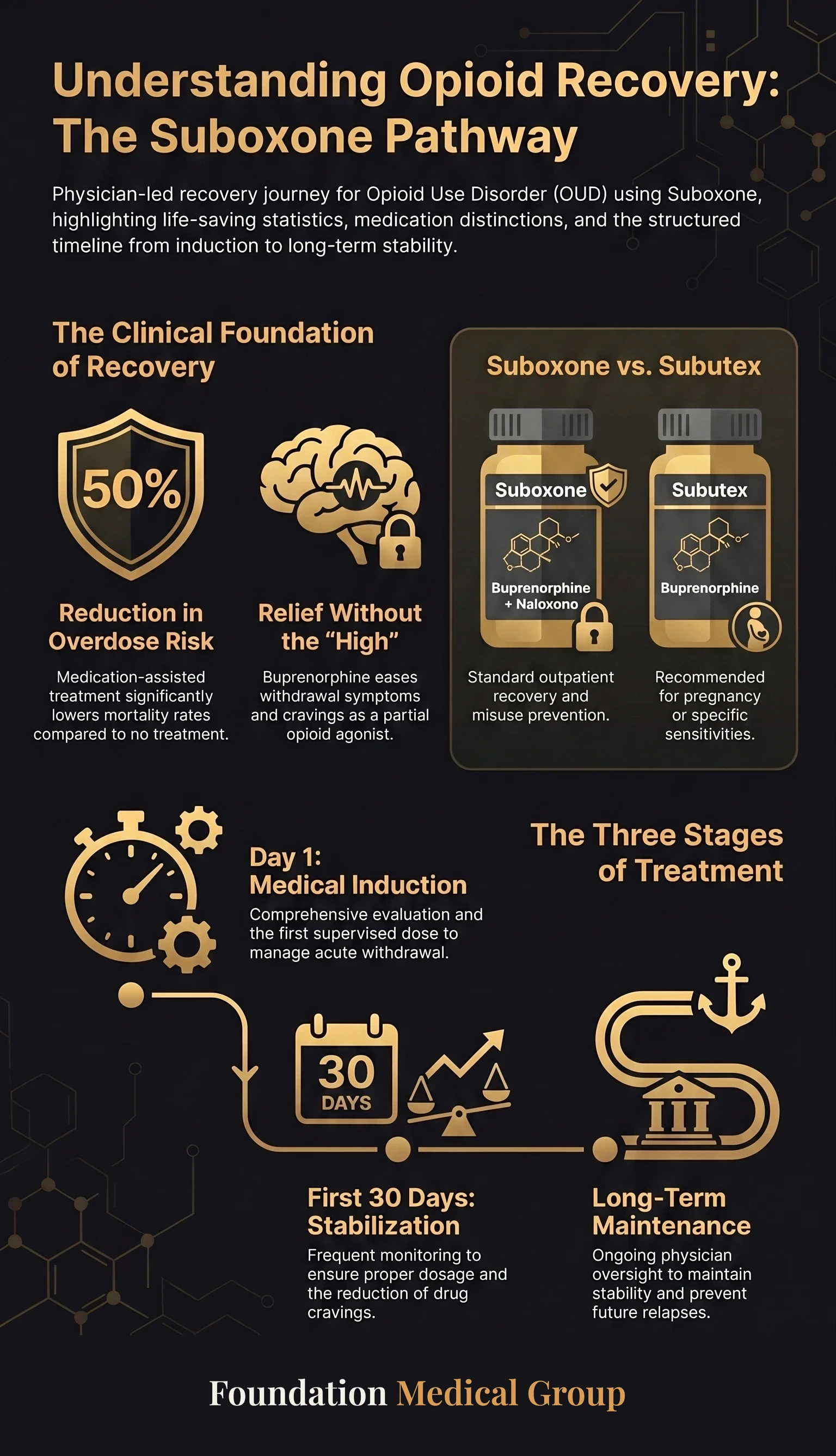
Day one is induction. The first 30 days are about stabilizing. After that, maintenance carries the recovery, and a taper is weighed only when the clinical picture supports it.
FAQ
How quickly can I start treatment at a suboxone clinic atlanta?
Many programs book intake within days. Medicaid approval can add time, though front-desk staff often move it along.
Does Medicaid cover telehealth suboxone treatment?
Yes. It hinges on provider enrollment and your eligibility.
Is Suboxone safer than methadone?
Both work. Suboxone carries lower overdose risk, while methadone may suit more severe cases.
Can I switch medications later?
Yes. A doctor supervises the switch so recovery isn’t put at risk.
How long does treatment last?
There’s no fixed clock. Many people stay on the medicine, and the evidence supports that choice.
Key Takeaways and Final Thoughts
- Buprenorphine cut overdose deaths from 4.6 to 1.4 per 1,000 person-years in the BMJ meta-analysis, while people stayed in care.
- Georgia Medicaid covers visits, medicine, and labs, though prior approval is common.
- The 17 January 2025 federal rule allows an audio-only start and up to a 6-month initial supply.
- Subutex is the safer pick in pregnancy, with lower rates of neonatal abstinence syndrome, preterm birth, and low birth weight.
- Day 1 caps at 8 mg/2 mg, day 2 can reach 16 mg/4 mg, and maintenance usually runs 4 mg/1 mg to 24 mg/6 mg.
The care team you pick shapes how the year goes. Medicaid and private plans cover both clinic and video care, so cost is rarely the wall people expect. Doctor-led treatment is the part that holds it together.
Sources
- Suboxone (buprenorphine and naloxone) sublingual film prescribing information, DailyMed, National Library of Medicine.
- Sordo L, et al. Mortality risk during and after opioid substitution treatment. BMJ 2017;357:j1550.
- Suarez EA, et al. Buprenorphine versus methadone for opioid use disorder in pregnancy. N Engl J Med 2022;387(22):2033-44.
- Hammerslag LR, et al. Telemedicine buprenorphine initiation and retention in opioid use disorder treatment for Medicaid enrollees. JAMA Netw Open 2023;6(10):e2336914.
- Drug Enforcement Administration and HHS, Expansion of Buprenorphine Treatment via Telemedicine Encounter, 90 FR 6504.
- Opioid Withdrawal, StatPearls, NCBI Bookshelf.
- National Institute on Drug Abuse, Medications for Opioid Use Disorder.
- Substance Abuse and Mental Health Services Administration, Buprenorphine.