
To qualify for Texas Medicaid so it can cover Suboxone care in Dallas, you usually need to be a Texas resident, be a U.S. citizen or an eligible immigrant, and fall within your program’s income and household rules. Once you’re enrolled, Medicaid covers this medicine for opioid use disorder. The fastest way to know for sure is to apply and let the state check.
Here’s the good news. Qualifying is often simpler than people fear, and you don’t have to figure it out alone. Below we walk through who tends to qualify, how to apply step by step, what papers to gather, and what to do while you wait. For what treatment looks like day to day, see our Suboxone doctor in Dallas page.
Who Usually Qualifies for Texas Medicaid
Texas Medicaid isn’t one single door. It’s a set of programs, and each has its own rules. You might qualify through one path even if another doesn’t fit.
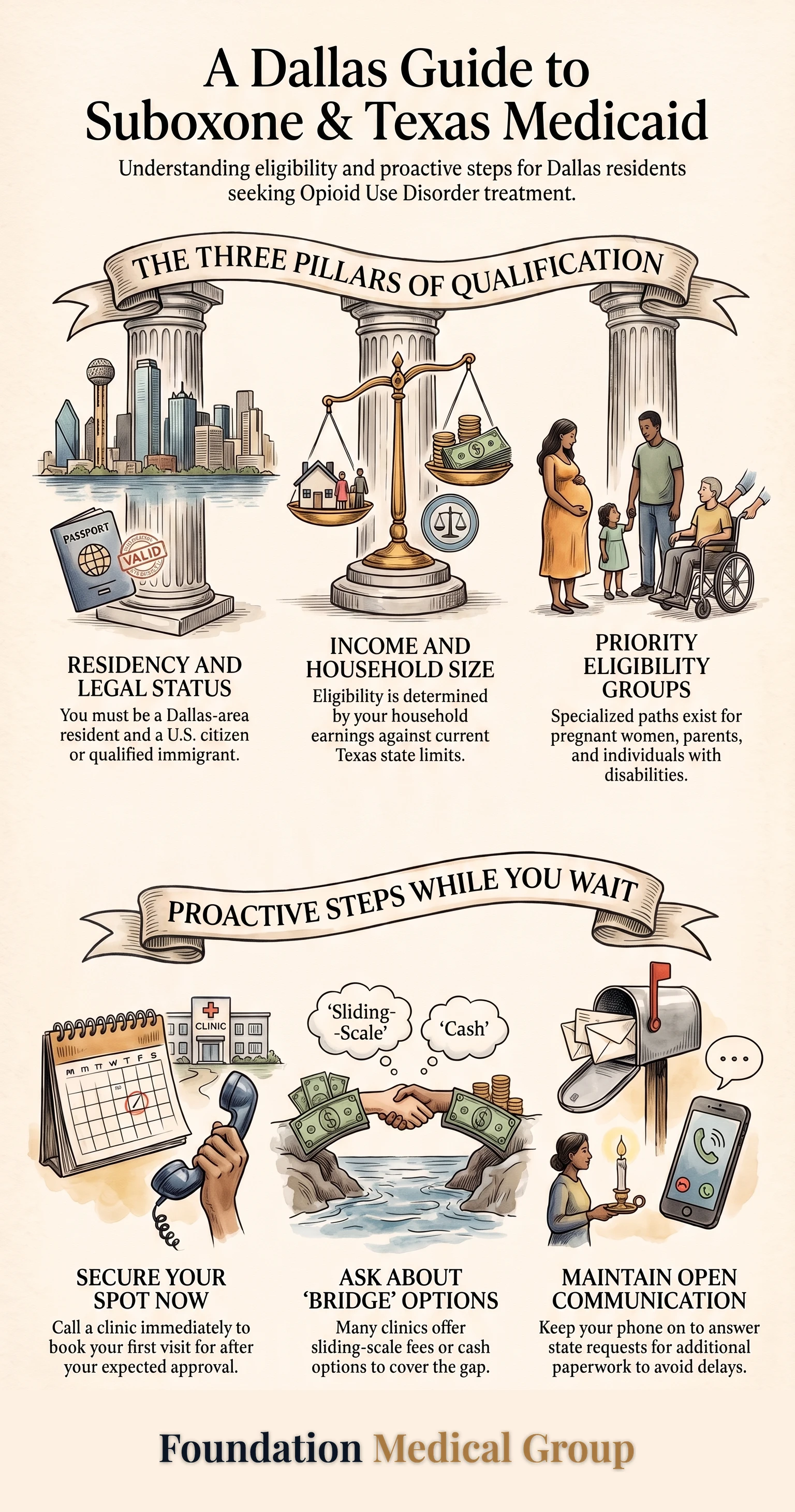
- Income and household size. The state looks at what your household earns against its limits, and in Texas those limits are tight. KFF’s state tracker puts the Section 1931 parent limit at 15% of the federal poverty level and the limit for other adults at 0%. Limits do change, so check the current ones with Texas Medicaid rather than guessing.
- Who you are. Some paths focus on pregnant women, parents with kids, or people with a disability. Others are broader.
- Where you live. You need to be a Texas resident, so a Dallas address counts.
- Your status. You’ll usually need to be a U.S. citizen or a qualified immigrant.
According to the Substance Abuse and Mental Health Services Administration (SAMHSA), medicine like buprenorphine-naloxone is the standard care for opioid use disorder. That’s why, once you’re covered, this treatment is included.
It’s worth knowing why Texas feels harder than a neighbouring state. As of KFF’s August 2026 tracking, 41 states plus DC have adopted the Affordable Care Act’s Medicaid expansion, which covers adults up to 138% of the federal poverty level, about $21,597 a year for one person in 2025. Texas is one of the 10 that has not. Virginia, by contrast, adopted expansion on 1 January 2019. That single policy difference is why a Dallas resident and a Richmond resident on identical incomes can get opposite answers.
Documents to Gather Before You Apply

Applying goes faster when your papers are ready. You won’t need everything, but having the basics on hand saves days of back and forth. Gather what you can, then apply even if one piece is missing.
| What to bring | Why it helps |
|---|---|
| Photo ID (driver’s license or state ID) | Proves who you are |
| Proof of Texas residence (a bill or lease) | Shows your Dallas address |
| Social Security numbers for the household | Confirms your status |
| Proof of income (pay stubs or a letter) | Lets the state check your income rules |
| Immigration papers, if they apply | Confirms eligible status |
If a document is missing, don’t stop. Apply anyway. The state will tell you what’s still needed, and you can send it after.
How to Apply, Step by Step
The application itself is short once you know the path. Follow these steps in order and you’ll avoid the common snags.
- Pick how you’ll apply. You can apply online, by phone, by mail, or in person. Online is usually fastest.
- Set aside your documents. Keep the papers from the table nearby so you can answer questions in one sitting.
- Fill out one application. You give your household, income, and contact details. Answer honestly, since the state verifies your answers.
- Submit and save your confirmation. Write down your case number the moment you get it.
- Watch for follow-up requests. The state may ask for one more document. Reply quickly so your case keeps moving.
- Get your decision. If you’re approved, you’ll receive your Medicaid details and can start using them right away.
There’s a real deadline on the state’s side, which most applicants never hear about. Federal rules at 42 CFR 435.912 cap eligibility decisions at 45 days for most applicants, and 90 days for anyone applying on the basis of disability. If you’re past that with no answer, you’re entitled to ask why. Speed matters here for a clinical reason as well. In the 2017 BMJ meta-analysis by Sordo and colleagues, all-cause mortality ran 4.3 per 1,000 person-years for people on buprenorphine, against 9.5 per 1,000 for people off it.
What to Do While You Wait
Waiting for a decision is the hardest part. But waiting doesn’t mean doing nothing. You have real options that keep you moving toward care.
- Call a clinic now. Ask if they’ll see you before your Medicaid is active. A good number will, and some can start your plan. Ask specifically whether they can bill retroactively once your case is approved.
- Ask about a bridge. Some clinics offer a short-term cash or sliding-scale option to cover the gap.
- Keep your phone on. The state may call or write asking for one more paper. A missed message can delay you.
- Line up your first visit. Book it for after your expected approval so there’s no lost time.
At Foundation Medical Group, care is led by a physician who treats you with respect, not judgment. If cost is on your mind while you wait, our Suboxone treatment cost in Dallas guide breaks down every part in plain terms.
If You Qualify vs If You Don’t

Plenty of people don’t qualify, and that’s okay. There’s a clear path either way. This table shows what each road looks like so you know your next move.
| If you qualify for Medicaid | If you don’t qualify |
|---|---|
| Suboxone care is covered, often at little or no cost | You still have solid, affordable options |
| See any Dallas clinic that takes Medicaid | Ask about sliding-scale or flat monthly fees |
| Keep your info current so coverage stays active | Look into the health insurance marketplace |
| Renew when the state asks, usually once a year | Ask about community and state programs that help |
The takeaway is simple. Qualifying makes care nearly free. Not qualifying still leaves you with real ways to get the same treatment.
And the medicine itself is not the barrier people assume. In Medicaid’s own National Average Drug Acquisition Cost file effective 17 December 2025, generic buprenorphine-naloxone 8 mg/2 mg film was $1.94 a film, and the sublingual tablet version $0.72. That’s roughly $58 or $22 for a 30-day supply at what the pharmacy pays. Visits and labs, not the prescription, are where a cash bill gets heavy.
Backup Options If You Are Not Eligible
If Medicaid says no, take a breath. A no from one program isn’t a no from care. Plenty of people get Suboxone treatment without it.
Start by asking the clinic about a sliding scale, where your fee is set by what you can afford. Ask if they charge one flat monthly fee that covers your visits. Look into the health insurance marketplace, since a plan there may cover this medicine too. Marketplace open enrolment runs from 1 November each year, though a job loss or a move can open a special enrolment window of 60 days outside it. And ask about local programs that help people pay for addiction care. Our does Medicaid cover Suboxone guide explains the coverage rules in more detail.
Infographic: How to Qualify for Texas Medicaid to Cover Suboxone in Dallas
Frequently Asked Questions
Who qualifies for Texas Medicaid to cover Suboxone in Dallas?
You’ll usually need to be a Texas resident, be a U.S. citizen or eligible immigrant, and fit your program’s income and household rules. Since the limits change, check the current ones with Texas Medicaid and then apply so the state can confirm.
What documents do I need to apply for Texas Medicaid?
Bring a photo ID, proof of your Dallas address, Social Security numbers for your household, and proof of income. If some immigration papers apply, bring those too. Missing one piece is fine, so apply anyway and send it after.
How do I apply for Texas Medicaid in Dallas?
Pick a method, online, by phone, by mail, or in person, then fill out one application with your household and income details. Save your case number, reply fast to any follow-up, and wait for your decision. Online is usually the quickest way.
What can I do while I wait for a Medicaid decision?
Call a Dallas clinic now and ask if they’ll see you before coverage starts. Ask about a short-term bridge option, keep your phone on for state messages, and line up your first visit for right after your expected approval.
What if I don’t qualify for Texas Medicaid?
You still have options. Ask your clinic about a sliding scale or a flat monthly fee, look into a marketplace insurance plan, and check community and state programs. Many people get Suboxone care in Dallas without Medicaid.
Key Takeaways and Next Steps
Here’s what to hold on to. Qualifying for Texas Medicaid usually comes down to your residence, your status, and your household’s income against the current limits. Gather your ID, address proof, Social Security numbers, and income proof, then submit one application and save your case number. While you wait, call a clinic so care can start the moment you’re covered.
- Check the current income limits with Texas Medicaid before you apply, since they change.
- Apply even if one document is missing, and send the rest after.
- Don’t wait idle. Call a Dallas clinic so your first visit is ready to go.
- If you don’t qualify, ask about sliding-scale fees, marketplace plans, and community programs.
Ready to start? Reach out to Foundation Medical Group and ask how they can help you get covered and into care. One call turns a confusing process into a clear, doable plan.
Sources
- Substance Abuse and Mental Health Services Administration (SAMHSA), Buprenorphine.
- KFF, Status of State Medicaid Expansion Decisions.
- KFF, Medicaid Income Eligibility Limits for Adults as a Percent of the Federal Poverty Level.
- 42 CFR 435.912, Timely determination of eligibility, eCFR.
- Medicaid.gov, National Average Drug Acquisition Cost (NADAC) 2026 file.
- Sordo et al., Mortality risk during and after opioid substitution treatment, BMJ 2017.