
Is Suboxone safe? For most people with opioid use disorder, yes. It’s an FDA-approved medicine, and doctors have used it for years. Mild side effects like headache or nausea are common at first and often fade. Serious problems are rare. Still, you should know the warning signs and always talk to your care team.
This safety guide covers what to expect. We’ll walk through the common side effects and how to ease them. We’ll explain precipitated withdrawal and how to avoid it. We’ll cover the medicines you must tell your doctor about. And we’ll list the warning signs that mean you should call right away. If you’re just getting started, our Suboxone doctor in Texas that accepts Medicaid guide walks through your first steps.
Is Suboxone Safe in Texas?
Yes, and the reason matters. Suboxone holds 2 ingredients: buprenorphine and naloxone. Buprenorphine is a partial agonist, so its opioid effects level off instead of climbing. The FDA label puts that ceiling between 8 mg/2 mg and 16 mg/4 mg, which is exactly why a bigger dose doesn’t produce a bigger high. Naloxone helps guard against misuse. Together they make the medicine safer to take at home.
The track record is long, too. The FDA approved Suboxone and Subutex on 8 October 2002, so this isn’t new medicine. Suboxone film now comes in 4 strengths, from 2 mg/0.5 mg to 12 mg/3 mg, with a usual maintenance range of 4 mg/1 mg to 24 mg/6 mg a day. Buprenorphine’s mean elimination half-life runs 24 to 42 hours, compared with 2 to 12 hours for naloxone, which is why once-daily dosing holds you steady. Safe use comes down to one habit: take it exactly as your doctor says, and speak up when something feels off.
Common Side Effects and How to Ease Them

Most side effects are mild. They tend to show up early, then settle as your body adjusts. None of these should replace advice from your doctor, but a few simple steps often help.
- Headache. Drink water and rest. Ask your care team which pain reliever is safe for you.
- Nausea or upset stomach. Take the medicine with a little food if allowed, and eat smaller meals.
- Constipation. Add fiber, drink more water, and stay active. Tell your doctor if it lasts.
- Trouble sleeping. Keep a steady bedtime, and skip caffeine late in the day.
- Sweating. Wear light clothing and stay cool. This one often fades on its own.
The safety case rests on outcomes, not adjectives. A BMJ meta-analysis of 19 cohorts, covering 15,831 people on buprenorphine, found all-cause mortality of 4.3 per 1,000 person-years during treatment against 9.5 after leaving it, with overdose mortality at 1.4 versus 4.6. The riskier state, in other words, is being off it. If a mild side effect drags on or gets worse, don’t just wait it out. Call your care team.
Precipitated Withdrawal and How to Avoid It
This is the one to understand well. Precipitated withdrawal is a fast, rough return of withdrawal symptoms. It can happen if you take Suboxone too soon, while other opioids are still active in your body.
The fix is timing. SAMHSA’s guidance is to stay off opioids for at least 12 to 24 hours and be in early withdrawal first. The FDA label is blunter still. Start only when objective and clear signs of withdrawal are evident. Clinics usually score that with the Clinical Opiate Withdrawal Scale, an 11-item checklist, rather than going on how you say you feel. The label then keeps day one small on purpose, a 2 mg/0.5 mg or 4 mg/1 mg start, stepped up by 2 mg or 4 mg roughly every 2 hours, to a day-one ceiling of 8 mg/2 mg. Day 2 can go to 16 mg/4 mg. That gap matters, because starting early is what triggers the problem. This careful start is called induction, and our Suboxone withdrawal and induction timeline guide explains what to expect hour by hour.
Never guess on timing. Follow your doctor’s exact instructions for your first dose. If you feel worse fast after starting, call your care team right away.
Drug Interactions to Tell Your Doctor About
Some mixes are risky. Certain medicines can slow your breathing or make you very drowsy when combined with Suboxone. The FDA label carries a specific warning for benzodiazepines and other CNS depressants, and separate warnings for hepatitis and hepatic events, adrenal insufficiency, and neonatal opioid withdrawal syndrome in pregnancy. That last one is why liver tests are usually checked before you start. Your doctor needs the full picture to keep you safe.
Tell your care team about everything you take. That means prescriptions, over-the-counter medicines, supplements, and alcohol. Be honest, even about things that feel embarrassing. Your doctor isn’t there to judge you. They’re there to protect you.
- Benzodiazepines like Xanax or Valium, used for anxiety or sleep.
- Other opioids or strong pain medicines.
- Sleep aids and muscle relaxers that make you drowsy.
- Alcohol, which adds to the risk.
Common vs Serious: What to Do

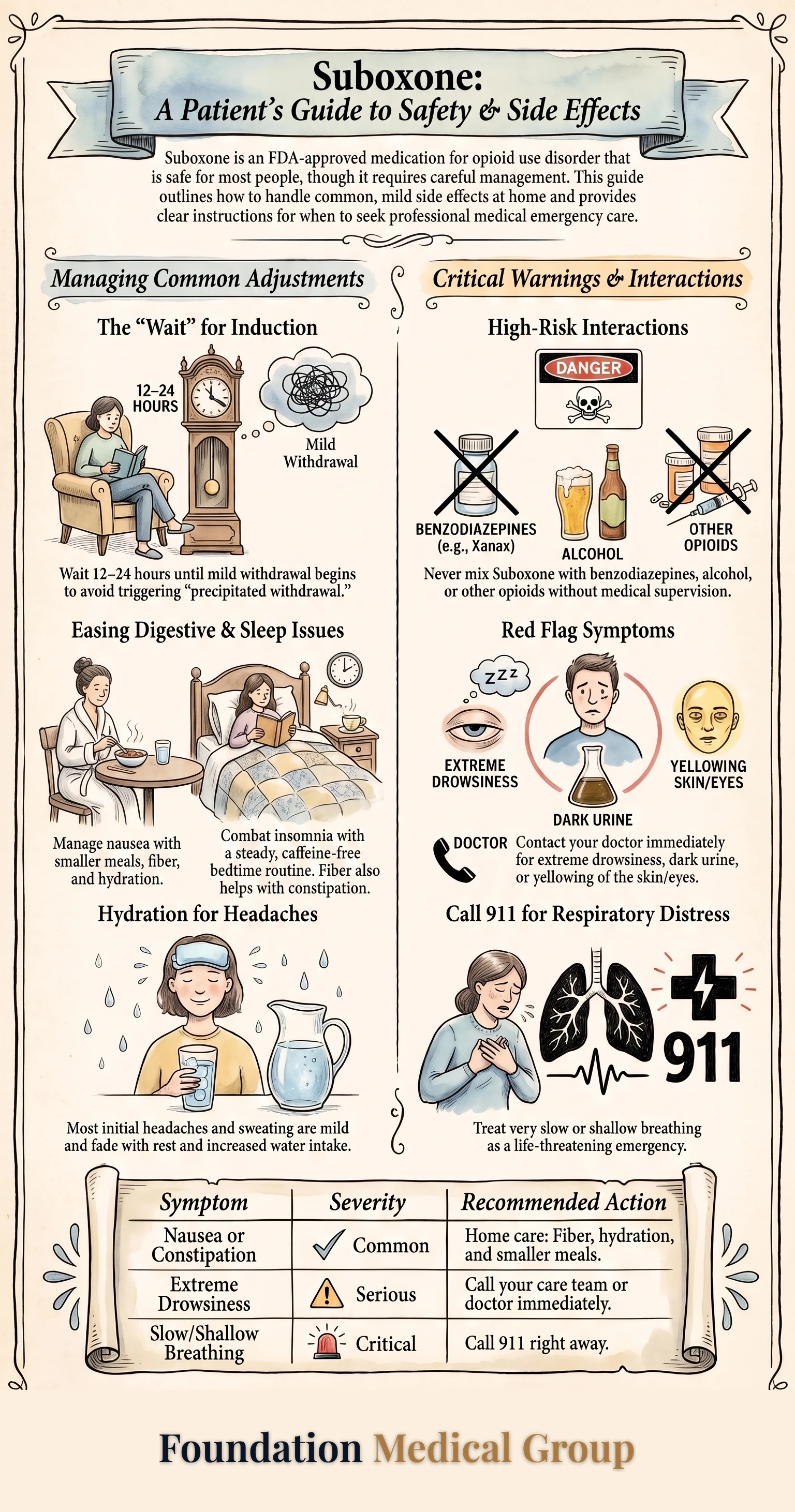
Here’s a quick guide. Use it to tell a normal side effect from one that needs a call. When in doubt, always reach out to your care team.
| What you notice | Common or serious | What to do |
|---|---|---|
| Mild headache or nausea | Common, often early | Ease it at home, mention it at your next visit |
| Constipation | Common | Add water and fiber, call if it lasts |
| Trouble sleeping | Common | Adjust your routine, tell your doctor if ongoing |
| Very slow or shallow breathing | Serious | Call 911 right away |
| Severe drowsiness or hard to wake | Serious | Get emergency help now |
| Yellow skin or eyes, dark urine | Serious | Call your doctor the same day |
| Signs of allergic reaction, like swelling | Serious | Seek emergency care |
Warning Signs That Need a Call
Trust your gut here. Most days on Suboxone are steady and calm. But a few signs mean you should reach out to your care team without waiting. Here’s why staying in care is worth it. Texas recorded 4,491 drug overdose deaths in the 12 months ending December 2025, down from 5,727 two years earlier. Opioid-involved deaths fell from 3,133 to 1,934 over the same period. Better. Still 5 people a day.
Call your doctor if a side effect is severe, or if it just won’t quit. Call if you feel far more sleepy or foggy than normal. Watch for yellowing skin or eyes, since that can signal a liver issue. And if your breathing turns slow or shallow, treat it as an emergency and call 911. For ongoing care questions, our Suboxone doctor in Dallas team is one call away.
Infographic: Suboxone Safety at a Glance
Frequently Asked Questions
What are the most common Suboxone side effects?
The most common ones are mild. Think headache, nausea, constipation, trouble sleeping, and sweating. They often show up early and fade as your body adjusts. If any side effect gets worse or lingers, call your care team.
How do I avoid precipitated withdrawal on Suboxone?
Timing is everything. Your doctor will have you wait until you’re in mild to moderate withdrawal before your first dose. Starting too soon is what triggers it. Follow your doctor’s exact instructions, and never guess on your own.
What medicines are dangerous to mix with Suboxone?
Tell your doctor about everything you take. Benzodiazepines, other opioids, sleep aids, muscle relaxers, and alcohol can be risky combined with Suboxone. Some slow your breathing. Your care team needs the full list to keep you safe.
When should I call my doctor while taking Suboxone?
Call if a side effect is severe or won’t stop. Call for extreme drowsiness, yellow skin or eyes, or dark urine. If your breathing is slow or shallow, call 911. When in doubt, reach out anyway.
Is Suboxone safe to take long term?
For most patients, yes. In the POATS trial, 49.2 percent had a successful outcome at week 12 while still taking buprenorphine-naloxone, compared with 8.6 percent 8 weeks after tapering off it. How long is right for you is a decision to make with your doctor.
Key Takeaways and Next Steps
Let’s recap the safety basics. Most Suboxone side effects are mild and fade with time. Precipitated withdrawal is avoidable with careful timing at your first dose. A few drug mixes are risky, so tell your doctor everything you take. And a short list of warning signs deserves a quick call.
- Ease mild side effects at home, and mention them at your next visit.
- Wait for the right moment before your first dose to avoid precipitated withdrawal.
- Share your full medicine and alcohol list with your care team.
- Call right away for slow breathing, extreme drowsiness, or yellowing skin.
Have questions about your own care? Reach out to Foundation Medical Group and ask. Our physician-led team will help you stay safe and feel steady, one visit at a time. You don’t have to figure this out alone.
Sources
- DailyMed. SUBOXONE (buprenorphine and naloxone) sublingual film prescribing information, Indivior Inc.
- U.S. Food and Drug Administration. Drugs@FDA, NDA 020733 (Suboxone sublingual tablet, approved 8 October 2002).
- Substance Abuse and Mental Health Services Administration. Buprenorphine.
- Sordo L, et al. Mortality risk during and after opioid substitution treatment. BMJ. 2017;357:j1550.
- Weiss RD, et al. POATS. Arch Gen Psychiatry. 2011;68(12):1238-46.
- CDC National Center for Health Statistics. VSRR Provisional Drug Overdose Death Counts (Texas).