
There’s no fixed clock on Suboxone. You taper when your life feels steady and your doctor agrees, then you lower the dose slowly over time. A safe taper is gradual, planned, and never rushed. Some people are ready in 1 year. Others stay on for 2 or 3 years, and that’s a healthy choice too.
If you’re thinking about coming off Suboxone, a good Suboxone clinic in Utah Valley won’t push you out the door. The goal isn’t to finish fast. The goal is to protect the recovery you’ve built. Below we explain when you might be ready, how a slow taper works, what it feels like, and why staying on can be the right call.
When You Might Be Ready to Taper
Being ready is about your whole life, not a number of months. A steady job, calm days, and strong support all matter more than the calendar.
According to the Substance Abuse and Mental Health Services Administration (SAMHSA), this medicine treats a real medical condition. So stopping is a medical choice, made with your doctor, not a test of willpower.
And it’s a choice with numbers attached. The POATS trial followed 653 patients across 10 US sites who were dependent on prescription opioids. At week 12, while they were still taking buprenorphine-naloxone, 49.2 percent had a good outcome. Eight weeks after finishing the taper, that dropped to 8.6 percent. An earlier arm of the same trial, which used a 2-week stabilization and a 2-week taper, produced a 6.6 percent success rate. Adding counseling changed neither figure.
Ask yourself a few honest questions. Do you feel stable most days? Have your cravings quieted down? Do you have people who support you? If you answered yes, bring it up at your next visit. Your doctor will help you decide together.
Signs You May Be Ready vs Reasons to Wait

Both columns are normal. Neither means you’ve failed. This table is a starting point for a talk with your doctor, not a decision on its own.
| Signs you may be ready | Reasons to wait a while |
|---|---|
| You feel steady most days | Big stress at home or work right now |
| Cravings are rare and quiet | Cravings still show up often |
| Your support system is strong | You feel alone or unsupported |
| Life has settled into a routine | A recent move, job loss, or loss |
| You and your doctor both feel confident | You feel unsure or pressured to stop |
If most of your answers land on the right, that’s fine. Waiting is not a setback. It just means now isn’t the moment, and later can be.
How a Slow, Doctor-Guided Taper Works
A taper means lowering your dose in small steps over time. Your doctor drops it a little, you settle in, then you drop again when you feel ready. Slow is the whole point.
The label gives a sense of the step size. Doses get adjusted up or down in increments of 2 mg/0.5 mg or 4 mg/1 mg, from a maintenance range that usually sits between 4 mg/1 mg and 24 mg/6 mg a day. Buprenorphine’s mean elimination half-life is 24 to 42 hours, so your blood level takes roughly a week to settle after each change. That pharmacology is exactly why a taper measured in months beats one measured in weeks.
Here’s what the process usually looks like:
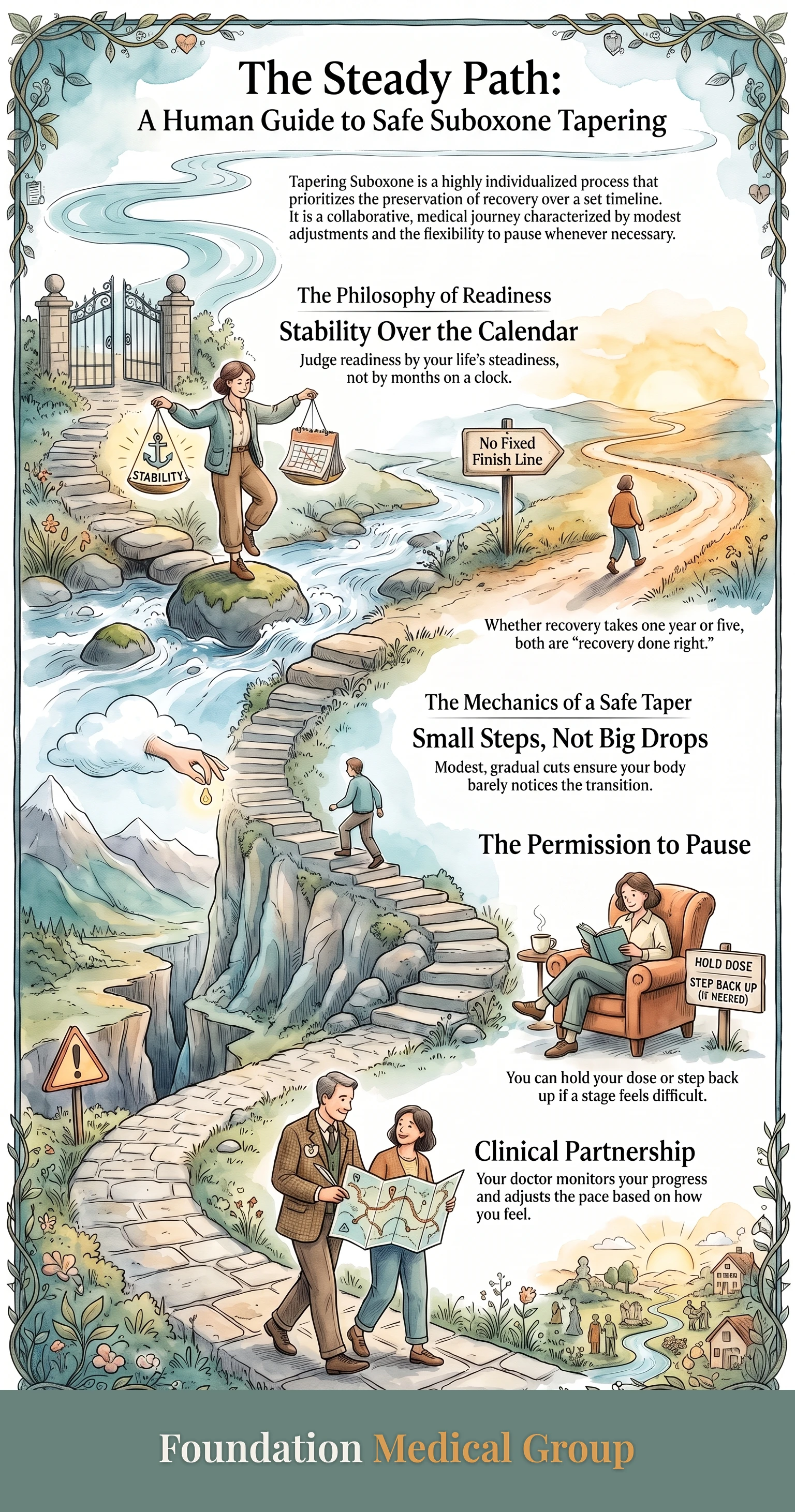
- Small steps, not big drops. Each cut is modest, so your body barely notices.
- Time to settle. You stay at each new level until you feel steady before the next step.
- Regular check-ins. Your doctor watches how you feel and adjusts the pace.
- Room to pause. If a step feels hard, you can hold or even step back up. That’s allowed.
- No fixed finish line. The taper ends when you and your doctor agree, not on a set date.
Please, only taper with your doctor. Cutting doses on your own can bring back cravings or withdrawal, and it raises your risk of relapse. Your care team keeps the whole thing safe.
What a Taper Actually Feels Like
Done right, a slow taper is usually gentle. Most patients feel almost normal between steps. You might notice mild changes for a few days after a drop, then you settle back in. Clinics track that with the same 11-item Clinical Opioid Withdrawal Scale used at induction, where 5 to 12 counts as mild and 13 to 24 as moderate. If a step pushes you into the moderate band, that’s the signal to hold or step back up.
If a step feels rough, that’s important information, not a failure. Tell your doctor. They can slow the pace, hold you at one level longer, or step back up for a bit. There’s no shame in any of that. A taper is meant to flex around your life.
The mind matters as much as the body. Some people feel nervous about letting go of the medicine. That’s normal. Lean on your counselor, your group, and your people. Steady support makes every step easier.
Staying On Suboxone If That’s Best for You

Here’s a truth that gets lost too often. Staying on Suboxone can be the healthiest choice. For a lot of patients, the medicine is a long-term treatment, like medicine for blood pressure or diabetes. There’s no prize for stopping.
The mortality data makes that concrete. A 2017 BMJ meta-analysis pooled 19 cohorts covering 15,831 people on buprenorphine. All-cause deaths ran 4.3 per 1,000 person-years while patients stayed in treatment, versus 9.5 per 1,000 after they left. Overdose deaths ran 1.4 versus 4.6 per 1,000. The riskiest stretch of the whole journey is the period right after you stop, which is worth weighing against any deadline you’ve set for yourself.
SAMHSA supports treatment for as long as it helps you. If the medicine keeps you steady, keeps cravings away, and lets you live your life, staying on is smart, not weak. You and your doctor decide what’s right for you, and you can change your mind anytime.
Letting Go of Shame About Timing
1 year, 2 years, 5 years, it doesn’t matter. How long you take medicine says nothing about your strength or your worth. Recovery isn’t a race, and there’s no gold star for finishing first.
Some people taper early. Some stay on for years. Both are doing recovery right. The only wrong move is stopping suddenly on your own or letting shame push you into a rushed taper. Go at your pace, with your doctor, and be proud of every steady day. For more on finding the right care, see our Subutex clinic in Utah Valley guide.
Infographic: How a Safe Suboxone Taper Works
Frequently Asked Questions
How do I know when I’m ready to taper off Suboxone?
You’re likely ready when life feels steady, cravings are quiet, and your support is strong. There’s no set date. Talk it over with your doctor, and decide together rather than rushing to a deadline.
Can I stop taking Suboxone on my own?
No, please don’t. Stopping on your own can trigger withdrawal and raise your risk of relapse. Always taper with your doctor, who can adjust the pace and keep you safe and comfortable through each step.
How long does tapering off Suboxone take?
There’s no fixed timeline, because everyone is different. A safe taper is slow and guided by how you feel, not a calendar. Your doctor sets the pace with you, and you can pause or slow down anytime.
Is it okay to stay on Suboxone long term?
Yes, absolutely. For many people, Suboxone is a long-term treatment, much like medicine for other health conditions. If it keeps you steady, staying on is a healthy, smart choice you make with your doctor.
What if a taper step feels too hard?
Tell your doctor right away. That’s useful information, not a failure. They can slow the pace, hold you at one level, or step your dose back up for a while. A good taper flexes around you.
Key Takeaways and Next Steps
Coming off Suboxone is a choice you make with your doctor, when your life feels steady and your support is strong. A safe taper is slow, gentle, and flexible. There’s no rush, no set finish line, and no shame in how long you take. And staying on the medicine is a healthy path too, if that’s what keeps you well.
- Taper only with your doctor, never on your own, so each step stays safe.
- Judge your readiness by your whole life, not by months on the calendar.
- Slow down, pause, or step back up anytime a step feels too hard.
- Drop the shame. 1 year or 5, both are recovery done right.
Wondering if now is your time, or whether to stay on a while longer? Reach out to Foundation Medical Group and start the conversation. One honest talk with a caring doctor is the safest first step, whichever way you go.
Sources
- Weiss RD, et al. Adjunctive counseling during brief and extended buprenorphine-naloxone treatment for prescription opioid dependence. Arch Gen Psychiatry 2011;68(12):1238-46.
- Sordo L, et al. Mortality risk during and after opioid substitution treatment. BMJ 2017;357:j1550.
- Suboxone (buprenorphine and naloxone) sublingual film prescribing information, DailyMed, National Library of Medicine.
- Opioid Withdrawal, StatPearls, NCBI Bookshelf.
- National Institute on Drug Abuse, Medications for Opioid Use Disorder.
- Substance Abuse and Mental Health Services Administration, Buprenorphine.