
Choosing a medication for opioid use disorder comes down to your body, your daily life, and your goals. Suboxone, methadone, and Vivitrol all work, and all are backed by strong science. The right one for you depends on where you are in recovery and how much daily structure you need. A good Suboxone clinic in Utah will help you weigh the 3 options and pick the best fit.
You don’t have to figure this out alone. This guide explains each medication in plain words, side by side. Then it shows you how to choose, and what to ask before you book. For a doctor who can walk you through it, see our Suboxone doctor in Utah page.
Why Medication Matters in Recovery
Opioid use disorder is a medical condition, not a lack of willpower. Medication treats it the way insulin treats diabetes. It calms cravings, steadies your brain, and gives you room to rebuild your life.
According to the Substance Abuse and Mental Health Services Administration (SAMHSA), medication combined with counseling is the standard of care for opioid use disorder. The 3 main medicines are Suboxone, methadone, and Vivitrol. Each works in a different way, so let’s look at them one at a time.
What Suboxone Is

Suboxone is buprenorphine-naloxone, a partial opioid agonist. That means it gently activates the same brain receptors opioids use, but only part of the way. It eases cravings and withdrawal without the strong high.
The big plus is access. A certified doctor can prescribe it from a regular office, and many clinics offer it by telehealth. So you don’t need daily visits. Most people pick up their medicine at a pharmacy, like any other prescription. That makes Suboxone a good fit for people who want to keep working and stay close to home.
What Methadone Is
Methadone is a full opioid agonist. It fully activates those brain receptors, which makes it very strong at stopping cravings and withdrawal. For people with a long or heavy history of opioid use, that strength can be a real help.
The trade-off is structure. Methadone is dispensed only at certified opioid treatment programs, not regular pharmacies. At first, you visit the clinic daily to take your dose there. Over time, as you stay stable, you may earn take-home doses. Methadone suits people who do well with close, daily support.
What Vivitrol Is
Vivitrol is naltrexone given as a monthly injection. It works in the opposite way from the other two. Instead of activating opioid receptors, it blocks them. If you use an opioid while on Vivitrol, you feel nothing, so the reward is gone.
There’s one key rule. You must be fully detoxed first, usually 7 to 10 days off all opioids, before your first shot. Starting too soon can trigger sharp withdrawal. Because it’s just 1 injection a month, Vivitrol appeals to people who are past detox and want a simple, opioid-free plan.
Suboxone vs Methadone vs Vivitrol at a Glance

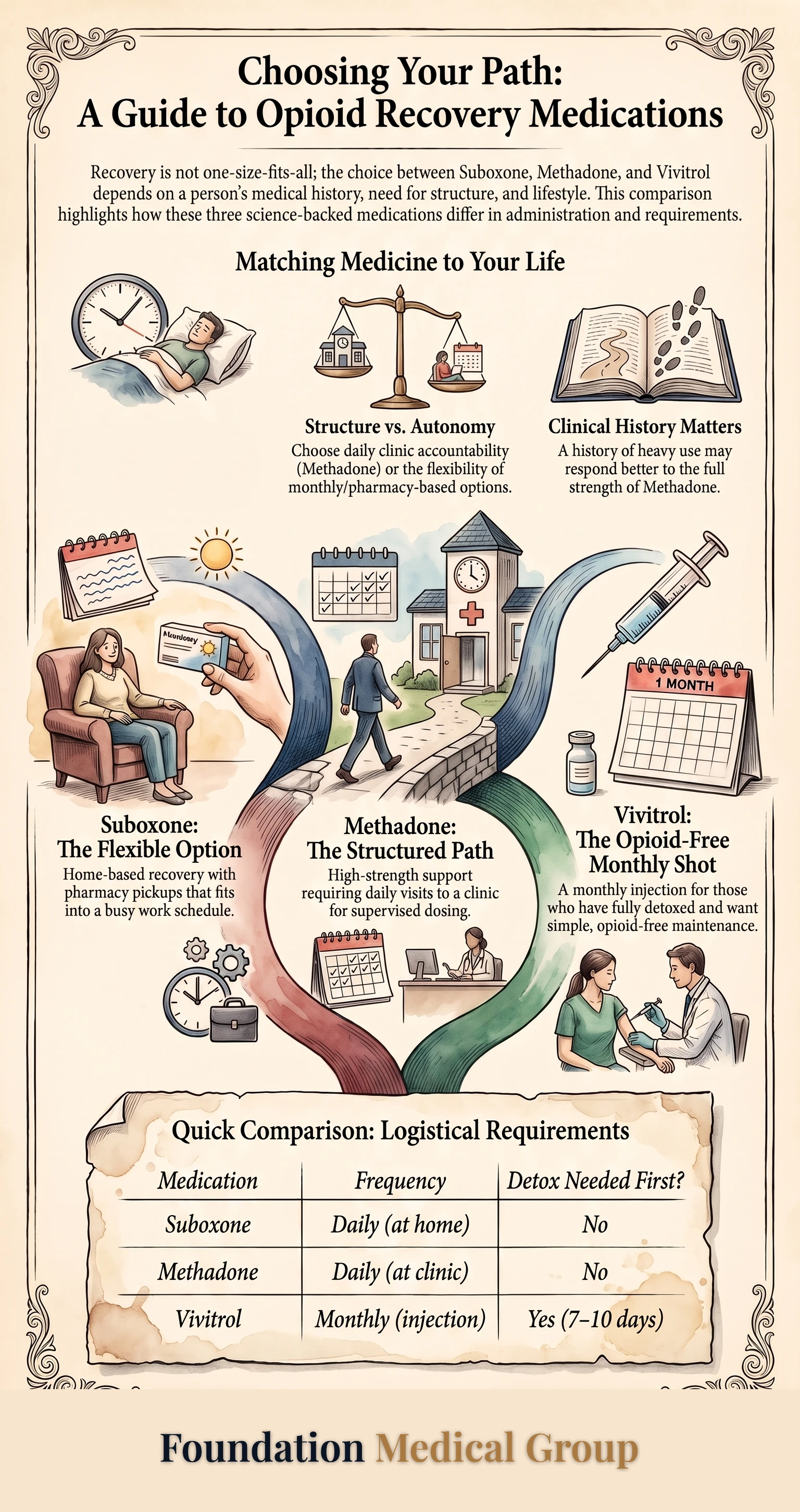
Seeing them side by side makes the choice clearer. Here’s a simple comparison of the 3 medications.
| Medication | How it works | Where you get it | Best for |
|---|---|---|---|
| Suboxone (buprenorphine-naloxone) | Partial agonist that eases cravings without a strong high | Doctor’s office or telehealth, filled at a pharmacy | People who want flexible, at-home care and no daily visits |
| Methadone | Full agonist that strongly blocks cravings and withdrawal | Certified opioid treatment program, daily visits at first | People with heavy use who do well with daily structure |
| Vivitrol (naltrexone) | Monthly injection that blocks opioids so they have no effect | Clinic injection once a month, after full detox | People already detoxed who want an opioid-free monthly plan |
Notice there’s no “best” row here on purpose. The best medication is simply the one that fits your body and your life.
What the Research Actually Shows
Numbers help when you’re weighing 3 options. A 2017 meta-analysis in The BMJ pooled cohorts of people moving in and out of treatment, and the gap is hard to ignore. On methadone, all-cause deaths ran 11.3 per 1,000 person-years while people stayed in treatment and 36.1 once they left. On buprenorphine, the medicine inside Suboxone, it was 4.3 in treatment against 9.5 out. Overdose deaths followed the same shape, 1.4 in care and 4.6 out of it.
Read that twice. Leaving care is the dangerous part, not the medicine.
The X:BOT trial in The Lancet compared buprenorphine-naloxone with extended-release naltrexone in 570 people. Once both groups were started, outcomes looked similar. Starting was the hard part. Only 6 percent of the buprenorphine group failed induction, against 28 percent on naltrexone. Naltrexone administration needs a full detox window first, and that window is where people drop out. It’s a big reason Utah suboxone providers often begin with buprenorphine treatment and keep Vivitrol among the additional treatment options.
A 2020 analysis in JAMA Network Open followed 40,885 people with opioid addiction. Only buprenorphine and methadone lowered overdose risk, by 76 percent at 3 months and 59 percent at 12 months compared with no medication. Detox alone did not, and neither did counseling on its own.
How to Choose the Right One
The right choice is a conversation between you and a doctor, not a guess. A few honest questions point you in the right direction.
- How much structure do you want? Daily clinic visits (methadone) or a pharmacy pickup at home (Suboxone)?
- Have you already detoxed? Vivitrol needs a full week or more off opioids first. The other two do not.
- How heavy was your use? A long, heavy history may respond best to methadone’s full strength.
- What’s your daily life like? A busy work schedule often fits Suboxone or Vivitrol better.
- Do you want any opioid activity at all? Vivitrol is fully opioid-free, since it only blocks.
Research from the National Institute on Drug Abuse (NIDA) shows all 3 medicines cut the risk of overdose and help people stay in recovery. There’s no shame in any of them. What matters is that you stay in care.
What Your First Days of Treatment Look Like
Here’s the part most people want spelled out. The FDA label for Suboxone sublingual film sets the timing, and a careful suboxone doctor follows it closely.
You start in early withdrawal, never before. The label says induction begins no less than 6 hours after your last short-acting opioid, and only once clear, objective withdrawal symptoms are showing. Start too early and you can trigger a sharp, avoidable crash.
- Day 1. You begin with 2 mg or 4 mg, then step up in 2 mg or 4 mg increments about every 2 hours, usually reaching 8 mg by the end of the day.
- Day 2. Most people take a single dose of up to 16 mg.
- Settling in. The label’s target maintenance dose is 16 mg a day, with a usual range of 4 mg to 24 mg.
- Staying steady. Buprenorphine has a long half-life, roughly 38 hours, so once you’re stable a single daily dose carries you through.
Follow-up is weekly at first, then spaced out as things settle. Suboxone maintenance can run for months or years, and there’s no prize for stopping early. Buprenorphine maintenance and relapse prevention work best when the medicine stays in place while the rest of your life rebuilds.
What Suboxone Treatment Actually Costs
Money stops a lot of people before they start, so here are real figures. CMS publishes a national average drug acquisition cost, which is what pharmacies pay, and it’s the closest thing to an honest sticker price.
In the December 2025 file, generic buprenorphine-naloxone 8 mg / 2 mg sublingual tablets averaged about $0.72 each. At the standard 16 mg daily dose that’s roughly $1.44 a day, or about $43 for 30 days before any insurance. The film form runs higher, about $1.94 each, or near $116 a month.
Those are drug costs, not visit costs. Utah Medicaid and most commercial plans cover the medicine and the office visits for opioid addiction treatment, because it’s the standard of care. An affordable suboxone clinic tells you your share before your first appointment, not after. Ask.
What a Suboxone Clinic in Utah Offers
A good Suboxone clinic in Utah does more than write a prescription. It looks at your whole situation and helps you land on the right medication, even if that turns out not to be Suboxone.
Utah’s numbers explain the urgency. CDC provisional data counted 427 opioid-involved overdose deaths in Utah in the 12 months ending December 2025, down from 497 two years earlier. That’s real progress, and still more than 1 death a day.
You’ll get a real evaluation, an honest talk about your options, and a plan built around your life. Here’s what that usually includes.
- A full assessment. Your history with opioids, any past medically assisted detox, and the mental health conditions that so often sit alongside drug addiction.
- A same-week suboxone prescription. Most people don’t need a long wait to begin treatment.
- Mental health support. Depression and anxiety travel with opioid dependence, and treating one without the other rarely holds.
- A referral when it fits you better. To a methadone clinic if daily structure suits you, or for a Vivitrol shot once you’re fully detoxed.
- Follow-up that keeps pace. Weekly early on, then spaced out as your recovery steadies.
Many visits happen by video, which saves you the drive across the valley. Online suboxone clinics made that normal, and Utah suboxone providers now mix in-person and virtual addiction treatment freely. Our American Fork, UT suboxone doctor sees patients from across Utah County either way.
Addiction medicine has moved past the old idea that you have to hit bottom first. A suboxone clinic Utah patients can actually reach beats a perfect match on paper. If you’re weighing your choices locally, our guides to Suboxone clinics in Utah Valley and Subutex doctors accepting new patients are a helpful next step. Whether you choose a large treatment center or a private suboxone clinic, the goal is treatment you can stay in, month after month.
Infographic: Suboxone vs Methadone vs Vivitrol at a Glance
Frequently Asked Questions
Which is better, Suboxone or methadone?
Neither is better for everyone. Suboxone offers flexible, office or telehealth care with pharmacy pickup, which fits busy lives. Methadone is stronger and needs daily clinic visits at first, which helps people with heavy use who want close support.
Do I need to detox before starting these medications?
It depends on the medicine. Suboxone and methadone are started while you still have opioids in your system, with a doctor guiding you. Vivitrol is different, since you must be fully detoxed, usually 7 to 10 days, before your first injection.
Is Vivitrol as effective as Suboxone?
Both work well once you’re stable, but they suit different people. Vivitrol is a monthly shot that blocks opioids, and it needs full detox first. Suboxone eases cravings daily without detox, so it’s often easier to start.
Can I get MAT medication through a Suboxone clinic in Utah?
Yes. A Suboxone clinic in Utah can evaluate you, prescribe Suboxone, and refer you to a methadone program or Vivitrol option if that fits you better. Many visits can be done by telehealth across the state.
Will my insurance cover these medications?
Most insurance plans and Utah Medicaid cover medication for opioid use disorder, because it’s the standard of care. What you pay depends on your plan and the medicine, so ask the clinic and your insurer before your first visit.
Key Takeaways and Next Steps
Here’s what to hold on to. Suboxone, methadone, and Vivitrol are all proven medications for opioid use disorder, and none is “the best” for everyone. Suboxone gives you flexible, at-home care. Methadone gives you strong, daily-structured support. Vivitrol gives you a monthly, opioid-free shot after detox. The right one depends on your history, your schedule, and your goals.
- Match the medicine to your life: home flexibility, daily structure, or a monthly shot.
- Remember Vivitrol needs full detox first, while Suboxone and methadone do not.
- Ask a doctor to review your history before you decide, since the choice is medical.
- Don’t wait to start. Staying in care with any of these medicines lowers your risk.
Ready to talk it through? Reach out to Foundation Medical Group and ask which medication fits you best. One honest conversation can turn a hard choice into a clear, doable plan.
Sources
- Suboxone (buprenorphine and naloxone) sublingual film prescribing information, DailyMed, National Library of Medicine.
- Sordo L, et al. Mortality risk during and after opioid substitution treatment. BMJ 2017;357:j1550.
- Lee JD, et al. Comparative effectiveness of extended-release naltrexone versus buprenorphine-naloxone (X:BOT). Lancet 2018;391(10118):309-18.
- Wakeman SE, et al. Comparative effectiveness of different treatment pathways for opioid use disorder. JAMA Netw Open 2020;3(2):e1920622.
- Buprenorphine, StatPearls, NCBI Bookshelf.
- Centers for Medicare and Medicaid Services, National Average Drug Acquisition Cost, 2025.
- CDC National Center for Health Statistics, VSRR Provisional Drug Overdose Death Counts.
- Substance Abuse and Mental Health Services Administration, Medications for Substance Use Disorders.
- National Institute on Drug Abuse, Medications for Opioid Use Disorder.