Looking for a Suboxone doctor in Dallas who takes Medicaid? Foundation Medical Group’s Dallas clinic prescribes Suboxone and accepts Texas Medicaid for medication assisted treatment of opioid use disorder. We’re at 8390 LBJ Freeway, Suite 500, in North Dallas, with same-day new-patient slots when they’re open and telehealth across Texas. Coverage varies by plan and state. Call our office at (469) 909-1312 to confirm your plan before your first visit.
If you typed “Suboxone doctor Dallas Medicaid” into a search bar at 2 a.m., you’re in the right place, and you’re far from the only one. Starting is simple. Call, tell us your Medicaid plan name from your card, and say whether you’re in withdrawal right now. We check your benefits, book your first visit, and a physician-led team takes it from there. The second half of this guide covers what to do once you’re on Suboxone, including the question we hear a lot: what happens if you miss a dose?
Which Suboxone clinic in Dallas accepts Texas Medicaid?
Ours does. The Dallas clinic treats opioid use disorder and other drug addiction with Suboxone (buprenorphine and naloxone), Vivitrol, and psychiatric and mental health care, all outpatient. Our Suboxone providers work under physician leadership, following the same treatment playbook used at our Virginia flagship clinic. Texas Medicaid is accepted for medication assisted treatment, and we also work with Medicare, Aetna, Cigna, Blue Cross Blue Shield, UnitedHealthcare, Humana and other major carriers. Coverage varies by plan and state. Call our office to confirm your plan before your first visit.
One honest note. We’re an outpatient Suboxone clinic, so we don’t run medically assisted detox, inpatient beds or residential rehab. For most people starting Suboxone that’s fine, because the first dose is taken in early withdrawal and managed as an outpatient. If you need a higher level of care, the SAMHSA treatment locator lists those programs by address.
How does Texas Medicaid work for Suboxone treatment?
Texas Medicaid is run by the Texas Health and Human Services Commission (HHSC), and most members get their benefits through a managed care plan. The plan name on your card is the one that sets the pharmacy rules and any prior authorization for Suboxone treatment and other prescription drug benefits. Here’s how the main programs break down, in plain words:
| Texas Medicaid program | Who it’s for | What it means for Suboxone |
|---|---|---|
| STAR | Many children and adults, the largest Texas Medicaid managed care program | Suboxone treatment and office visits go through your STAR health plan |
| STAR+PLUS | Adults 65 and older or with disabilities | Covers outpatient chemical dependency and psychiatry services through your plan |
| STAR Kids | Children and young adults under 21 with disabilities | Plan-specific rules, ask before the first visit |
| STAR Health | Young people in foster care (DFPS) | Full medical and behavioral health benefits through one plan |
| Medicare and Medicaid together | Dual-eligible members | Medicare usually pays first, Medicaid helps with the rest |
According to the HHSC STAR+PLUS handbook, behavioral health benefits in STAR+PLUS include outpatient chemical dependency services and psychiatry services. The Texas Works handbook describes STAR as providing “a full range of Medicaid-covered medical and other services for many children and adults.”
Texas is also one of the 10 states that hasn’t adopted the Affordable Care Act Medicaid expansion, according to KFF’s expansion tracker. That matters because plenty of working adults in Dallas don’t qualify for Medicaid at all. Which is frustrating, honestly. If that’s you, ask us about self-pay; our Suboxone treatment cost in Dallas guide lays out the numbers, and the Suboxone clinic Dallas Medicaid options page walks through who qualifies and how to apply.
How do you start Suboxone at our Dallas clinic?
Here’s the usual path for someone new to us with Texas Medicaid:
- Call (469) 909-1312. Have your Medicaid card ready. Same-day insurance verification is available, so you’ll know where you stand quickly.
- Book the first visit. Same-day new-patient slots are offered when they’re open. Telehealth video visits are available across Texas for many new patients, so online Suboxone treatment can be an option if getting to LBJ Freeway is hard.
- Come in during early withdrawal, if your doctor asks you to. Buprenorphine is a partial opioid agonist, and taking it too soon after a full opioid can trigger sudden withdrawal, called precipitated withdrawal. Your Dallas Suboxone doctor will walk you through the timing.
- Get your Suboxone prescription and a follow-up plan for your medication. Early visits sit close together. Later, suboxone maintenance visits spread out.
- Pick up naloxone too. Ask for a naloxone prescription for opioid overdose protection at home. It’s a small thing that can save a life.
Bring a photo ID, your Medicaid card, a list of every medication you take, and the name of any past addiction medicine doctors or clinics. That’s it. Nobody here expects you to have it all sorted out.
What should you do if you miss a Suboxone dose?

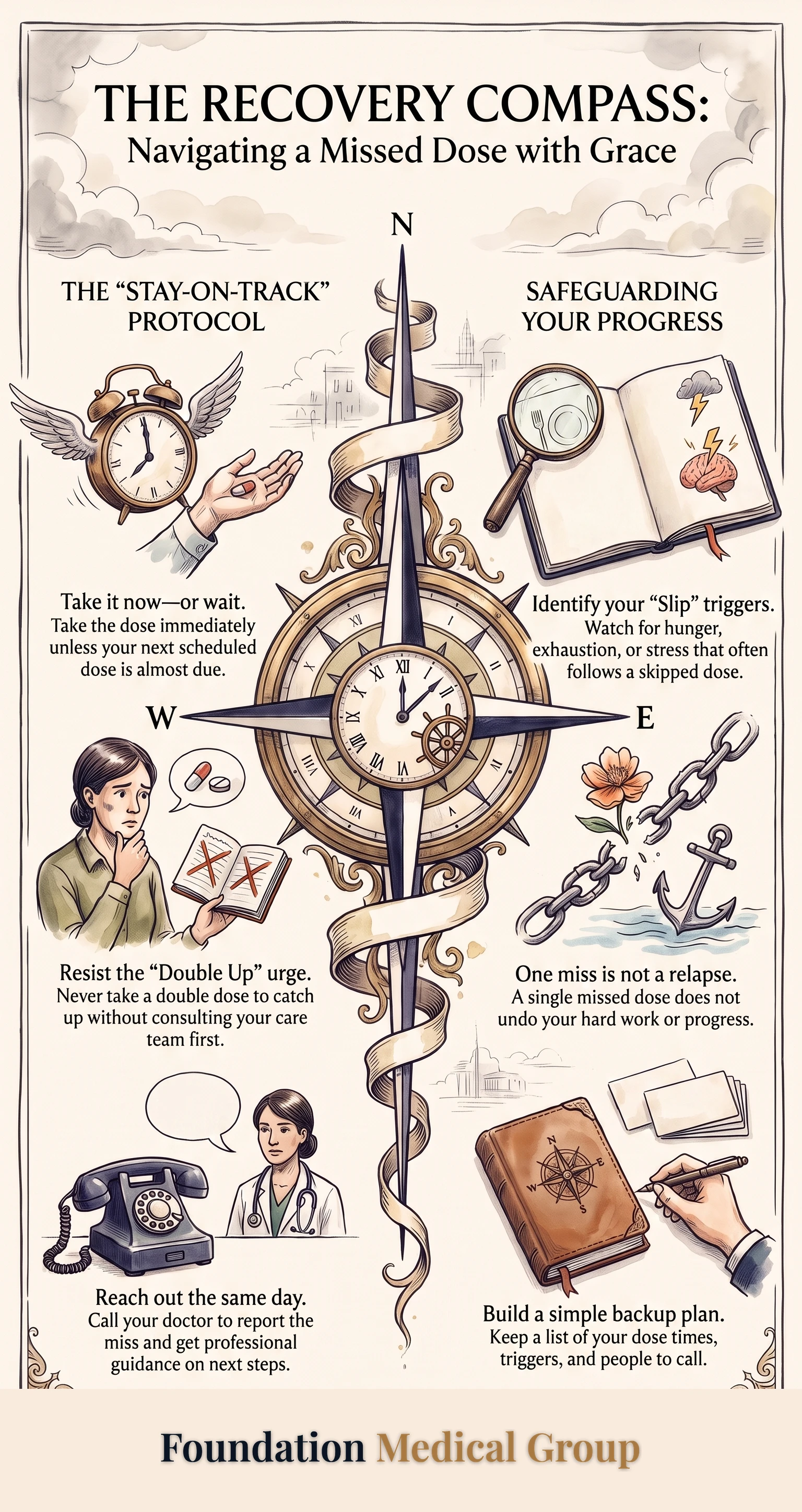
Don’t panic, and don’t double up on your own medication. Take the missed dose when you remember, unless it’s almost time for the next one. Then call your care team. One missed dose isn’t a failure, and it usually doesn’t undo your progress.
Why so calm about it? The FDA prescribing information for Suboxone film gives buprenorphine a mean elimination half-life of 24 to 42 hours. Naloxone, the second ingredient, clears much faster, in 2 to 12 hours. That long buprenorphine tail is the reason one late dose usually feels like very little, while three missed days feels like a lot.
| What happened | What to do | When to call your team |
|---|---|---|
| Missed by a few hours | Take it now if your next dose isn’t close | If you feel withdrawal coming on |
| Missed a full day | Take your next scheduled dose, don’t double up | The same day, to adjust your plan |
| Ran out of medicine early | Call the clinic for a refill | Immediately, before you skip more |
| Feeling strong cravings | Use a coping step and reach out | As soon as the craving hits |
There’s real range in what a dose can be, too. The label puts maintenance somewhere between 4 mg/1 mg and 24 mg/6 mg a day. Doubling a 12 mg/3 mg film is a very different event from doubling a 2 mg/0.5 mg one. Your prescriber is doing that arithmetic. You shouldn’t have to.
If you have Texas Medicaid, the refill call matters for a second reason, since your plan controls the medication refill timing. Pharmacy and prior authorization rules can add a day or two, so call for refills 3 to 5 days early, not the morning you run out.
How do you handle cravings and stay on track?
Cravings are normal, and they pass. Most last only a few minutes, even when they feel huge. Clinicians measure the physical side of withdrawal with the Clinical Opiate Withdrawal Scale (COWS), an 11-item checklist scored from 0 to 47: 5 to 12 counts as mild, 13 to 24 as moderate, 25 to 36 as moderately severe. Knowing it exists helps when you call. Instead of “I feel awful”, you can describe sweating, gooseflesh, restless legs or a runny nose, and your team can place you on it.
A short written plan helps more than willpower. Keep it on your phone:
- Your daily dose time, with an alarm set for the same minute each day.
- A refill reminder, 3 to 5 days before you run out.
- Your top three triggers, and one coping step for each (a walk works better than you’d think).
- Three people you can call, plus our clinic number.
The National Institute on Drug Abuse describes medications for opioid use disorder, buprenorphine included, as part of opioid addiction treatment that also involves counseling and support. That’s why our Suboxone treatment includes mental health care, not just a script. We agree with that. And honestly, the support part is where a lot of people quietly drop off.
Why does staying in treatment matter so much?

Because the numbers are stark, and opioids don’t give many second chances. A 2017 BMJ meta-analysis by Sordo and colleagues reported all-cause mortality of 4.3 per 1,000 person-years while people stayed on buprenorphine, against 9.5 per 1,000 once they stopped. Overdose deaths ran 1.4 versus 4.6. Staying in is the protective part, and coming back after a slip counts as staying in.
A slip isn’t the end of your recovery journey. Call us the same day if you can and be honest about what happened. Your doctor’s job is to help, not to judge. Finding the right Suboxone doctor matters, but staying with one matters more. If you’re comparing Dallas Suboxone providers or a virtual Suboxone clinic against in-person care, our Suboxone clinic in Texas page covers the bigger picture, and the Suboxone doctor in Dallas guide explains how Suboxone, Subutex and methadone clinic care compare.
Key Takeaways
- Foundation Medical Group’s Dallas clinic, at 8390 LBJ Freeway, Suite 500, prescribes Suboxone and accepts Texas Medicaid for medication assisted treatment.
- Same-day new-patient slots are offered when available, and telehealth is available across Texas if you’d rather see an online Suboxone doctor from home.
- Your managed care plan (STAR, STAR+PLUS, STAR Kids or STAR Health) sets the pharmacy and prior authorization rules. Coverage varies by plan and state, so call (469) 909-1312 to confirm.
- If you miss a dose, take it when you remember unless the next one is close, don’t double up, and call your team.
- Staying on buprenorphine is linked to roughly half the mortality seen after stopping, so coming back after a slip matters.
Sources
- Texas Health and Human Services, STAR+PLUS Handbook, 1100 Program Overview.
- Texas Health and Human Services, Texas Works Handbook, E-1010 General Policy (STAR and STAR Health coverage).
- KFF, Status of State Medicaid Expansion Decisions.
- Substance Abuse and Mental Health Services Administration (SAMHSA), Buprenorphine.
- FDA prescribing information for Suboxone sublingual film, via DailyMed.
- Opioid Withdrawal, StatPearls, NCBI Bookshelf (COWS scoring).
- Sordo et al., Mortality risk during and after opioid substitution treatment, BMJ 2017.
- National Institute on Drug Abuse, Medications to Treat Opioid Use Disorder.