
No, Suboxone does not just swap one addiction for another. It’s a medicine that steadies your brain so cravings ease and you can live a normal life. Taking a prescribed medicine as directed is treatment, not a new addiction. That’s the same reason we don’t call insulin an addiction.
If you live near Midlothian, Virginia, you’ve probably heard this myth and a few others. They sound convincing, and they keep good people from getting help. So let’s sort myth from fact in plain language. We’ll look at the 5 biggest Suboxone myths, 1 at a time, and show what the science and your daily life actually say.
Myth: Suboxone Just Trades One Addiction for Another
This is the myth we hear most, so let’s start here. Addiction means using a drug in a way that harms your life and feels out of control. Suboxone does the opposite. Taken as prescribed, it calms cravings and steadies your day so you can work, sleep, and think clearly.
According to the Substance Abuse and Mental Health Services Administration (SAMHSA), buprenorphine, the main ingredient in Suboxone, is a proven medication for opioid use disorder that supports lasting recovery. It’s medicine with a purpose, not a habit that runs your life.
Look at what the medicine actually does to your risk. A 2017 meta-analysis in The BMJ pooled 3 buprenorphine cohorts covering 15,831 people. All-cause deaths ran 4.3 per 1,000 person-years while people stayed in treatment, versus 9.5 after they stopped. Overdose deaths ran 1.4 versus 4.6. A swap for another addiction would not move numbers in that direction.
Yes, your body relies on it, the way a person with a thyroid problem relies on their pill. That’s called dependence, and it isn’t the same thing as addiction. One keeps you well. The other pulls you down.
Myth vs Fact: The Five Big Ones

Here they are side by side. Read across each row and you’ll see how far the myth sits from the truth.
| Common myth | The fact |
|---|---|
| It just replaces one addiction with another | It’s prescribed medicine that eases cravings so life gets stable |
| You’re not really in recovery on medication | Recovery means a full, healthy life, and medicine helps you get there |
| You can’t work or parent while on it | Most people work, drive, and raise kids just fine on it |
| You should white-knuckle a detox instead | Detox alone often ends in relapse, and relapse can be dangerous |
| More willpower is all you need | Opioid use disorder is a medical condition, not a moral failing |
Notice the pattern. Every myth blames the person. Every fact points to real medicine and real support.
Myth: You’re Not Really in Recovery If You Take Medicine
Some people think real recovery means zero medicine. That belief hurts more than it helps. Recovery isn’t about being drug-free on paper. It’s about getting your life back.
Research from the National Institute on Drug Abuse (NIDA) shows that medication for opioid use disorder helps people stay in treatment and lowers the risk of return to use. The X:BOT trial in The Lancet put a number on the “staying in” part. Of 570 people randomized, 270 of 287 assigned to buprenorphine-naloxone actually got started on it, or 94 percent. In the extended-release naltrexone group, only 204 of 283 did, or 72 percent. Relapse at 24 weeks landed at 57 percent versus 65 percent. In plain words, staying on the medicine keeps more people safe and steady.
So what does recovery really look like? Here are 4 clear signs of it.
- Showing up for work, family, and friends again.
- Sleeping through the night without cravings.
- Making plans and keeping them.
- Feeling like yourself instead of chasing a fix.
If Suboxone helps you do all that, you’re in recovery. Full stop.
Myth: You Can’t Work or Parent on Suboxone
This one keeps parents scared and quiet. Let’s clear it up. When it’s dosed right, Suboxone doesn’t leave you high or foggy. It brings you back to normal, which is the whole point.
Part of that is the timing. Buprenorphine has a mean elimination half-life of 24 to 42 hours, so a single daily dose holds steady across a workday instead of peaking and dropping the way a short-acting opioid does. Maintenance usually sits between 4 mg/1 mg and 24 mg/6 mg per day, and once you’re at the right number, you feel level rather than medicated.
That means you can drive, hold a job, and take care of your kids. Many patients in and around Midlothian do exactly that every day. In fact, feeling steady often makes them better at all three.
A quick reality check helps here. Untreated opioid use disorder is what pulls people away from work and family, not the treatment. The medicine is the thing that helps you show up.
Myth: You Should White-Knuckle a Detox Instead

Detox alone sounds tough and honest. It feels like the “harder” choice. But for opioids, going it alone is risky and often doesn’t last.
Here’s why. When you stop opioids cold, your tolerance drops fast. If a relapse happens, the old dose can be too much for your body to handle. That’s when overdoses happen. The BMJ analysis above shows it in the data: the risk sits in the gap between treatment episodes, not inside them. SAMHSA points to medication as the safer path for this exact reason.
If the worry is a doctor who won’t prescribe, that barrier is gone. The DATA-Waiver, the old X-waiver, was eliminated by the Consolidated Appropriations Act of 2023, so any clinician holding a standard DEA registration can prescribe buprenorphine for opioid use disorder.
Suboxone smooths that dangerous drop. It eases withdrawal, quiets cravings, and gives your brain time to heal. That’s not the easy way out. It’s the way that keeps you alive to keep going.
Myth: More Willpower Is the Answer
If willpower alone fixed addiction, no one would struggle. Opioids change the brain’s wiring, and no amount of grit rewires it on its own. That isn’t weakness. It’s biology.
Think of it like these other health conditions:
- High blood pressure needs medicine, not just a promise to relax.
- Diabetes needs insulin, not just willpower at the dinner table.
- Opioid use disorder needs treatment, not just a stronger backbone.
You still bring effort and courage. The medicine just gives that effort a fair fight. To learn how the medicine itself works, see our simple guide, what is buprenorphine.
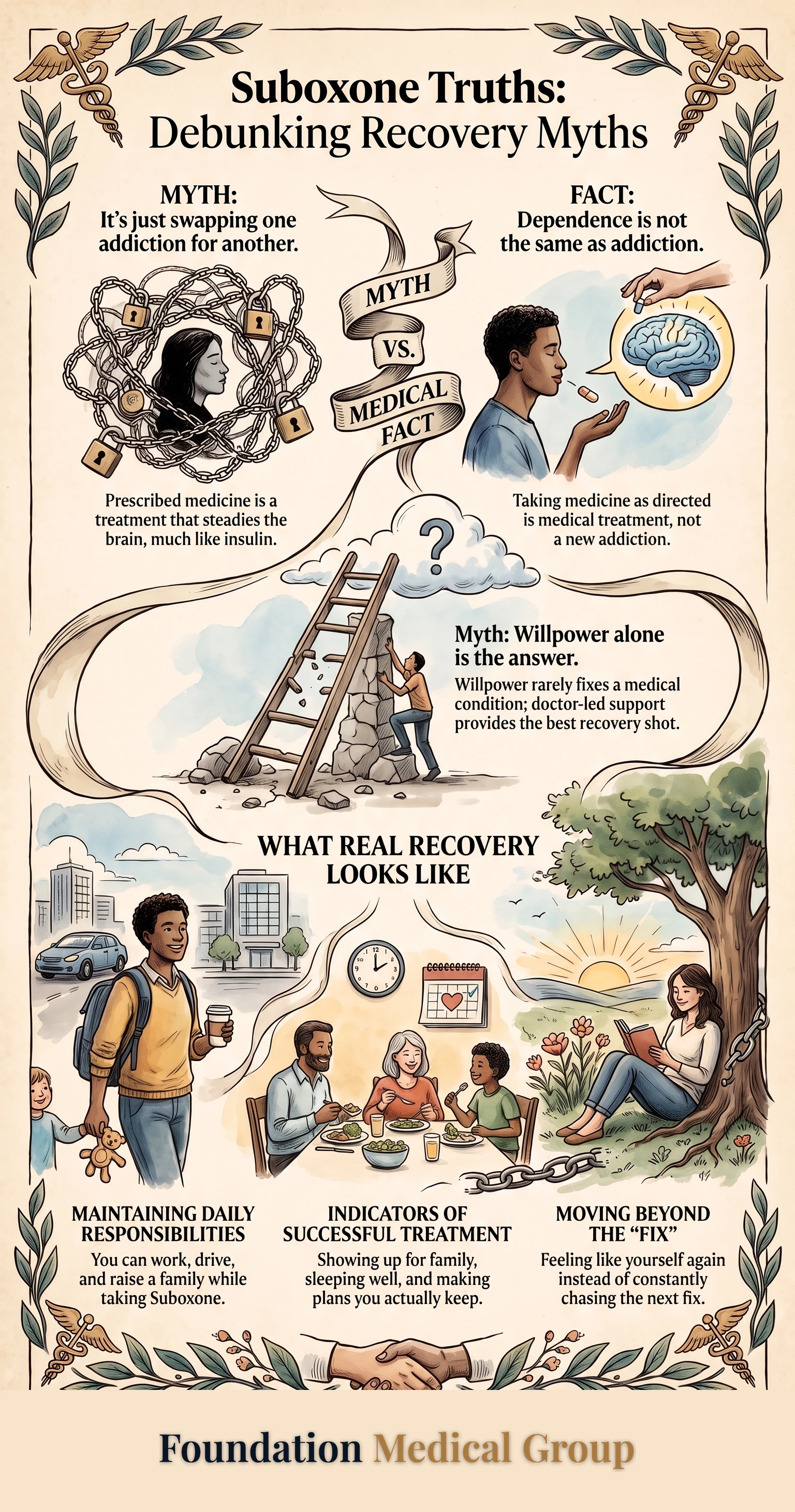
Infographic: Suboxone Myths vs Facts
Frequently Asked Questions
Does Suboxone just replace one addiction with another?
No. Suboxone is prescribed medicine that eases cravings so you can live a stable life. Relying on a medicine as directed is dependence, not addiction. Addiction harms your life, while treatment helps you rebuild it.
Can I work and raise my kids while taking Suboxone?
Yes. When it’s dosed correctly, Suboxone doesn’t make you high or drowsy. It helps you feel normal, so you can drive, work, and parent. Many people near Midlothian do all three every day.
Is medication-based recovery real recovery?
Yes. Recovery means getting your life back, not just being medicine-free. NIDA notes that medication helps people stay in treatment and avoid a return to use. A full, healthy life is the real goal.
Isn’t it better to just detox on my own?
Usually not. For opioids, detoxing alone often ends in relapse, and relapse can be very dangerous. Suboxone eases withdrawal and lowers that risk while your brain heals.
Does Virginia Medicaid cover Suboxone in Midlothian?
Often, yes. Many Virginia Medicaid plans cover this treatment for opioid use disorder. Coverage depends on your plan and clinic, so it helps to ask both before your first visit. Our Suboxone clinic in Virginia that accepts Medicaid guide can help.
For context, Virginia built a dedicated benefit for this. Addiction and Recovery Treatment Services, or ARTS, launched in April 2017. Over its first 15 months, the number of Medicaid members treated for opioid addiction rose 80 percent, from about 9,000 to nearly 16,400. Opioid prescriptions for members dropped 28 percent in that window. Its Preferred Office-Based Opioid Treatment model pairs the prescriber with a co-located licensed behavioral health clinician, so the medicine and the counseling sit in one place rather than two.
Key Takeaways and Next Steps
Let’s pull it together. The biggest Suboxone myths all blame the person, while the facts point to real medicine and real support. Suboxone doesn’t trade one addiction for another. It steadies your brain so you can work, parent, and live well. That’s recovery, not a swap.
- Dependence on prescribed medicine is not the same as addiction.
- You can work, drive, and raise a family while taking Suboxone.
- White-knuckle detox is risky, and willpower alone rarely fixes a medical condition.
- Medication plus caring, doctor-led support gives you the best shot at lasting recovery.
Ready to talk to someone who gets it? The team at Foundation Medical Group offers physician-led, judgment-free care for people across the Midlothian and Richmond area. One honest conversation can turn these myths into a real plan.
Sources
- Sordo and colleagues, Mortality risk during and after opioid substitution treatment, The BMJ (2017).
- Lee and colleagues, X:BOT comparative effectiveness trial, The Lancet.
- FDA prescribing information, Suboxone sublingual film.
- Virginia Department of Medical Assistance Services, Addiction and Recovery Treatment Services.
- Virginia Medicaid, Increasing access to opioid addiction treatment (March 2019).
- National Institute on Drug Abuse (NIDA), Comorbidity.