
A Suboxone doctor in Richmond treats opioid use disorder with buprenorphine, counseling, and follow-up that lasts. People in Richmond and Midlothian can go in person or meet by video, and most of those options take insurance or Virginia Medicaid. Either way the goal is the same: ease withdrawal, cut relapse risk, and hold the gains.
The right care can change the shape of a year. Not overnight, but it moves the direction. This guide covers how Suboxone care works, where to find a clinic in central Virginia, and how Medicaid and online care fit in.
Introduction to Suboxone Treatment in Richmond
Finding a suboxone doctor Richmond residents feel easy with starts with knowing what’s nearby. Richmond and Midlothian have doctor-led treatment centers, private practices, and telehealth programs built around addiction medicine.
A treatment center serving Richmond usually offers in-person visits, one-to-one counseling, group therapy, and medication management. Telehealth opens the door for people juggling shifts, kids, or no car. Both follow the same standards used across Virginia, from Richmond and Chesterfield County out to the Northern Neck.
What Suboxone and Subutex Are
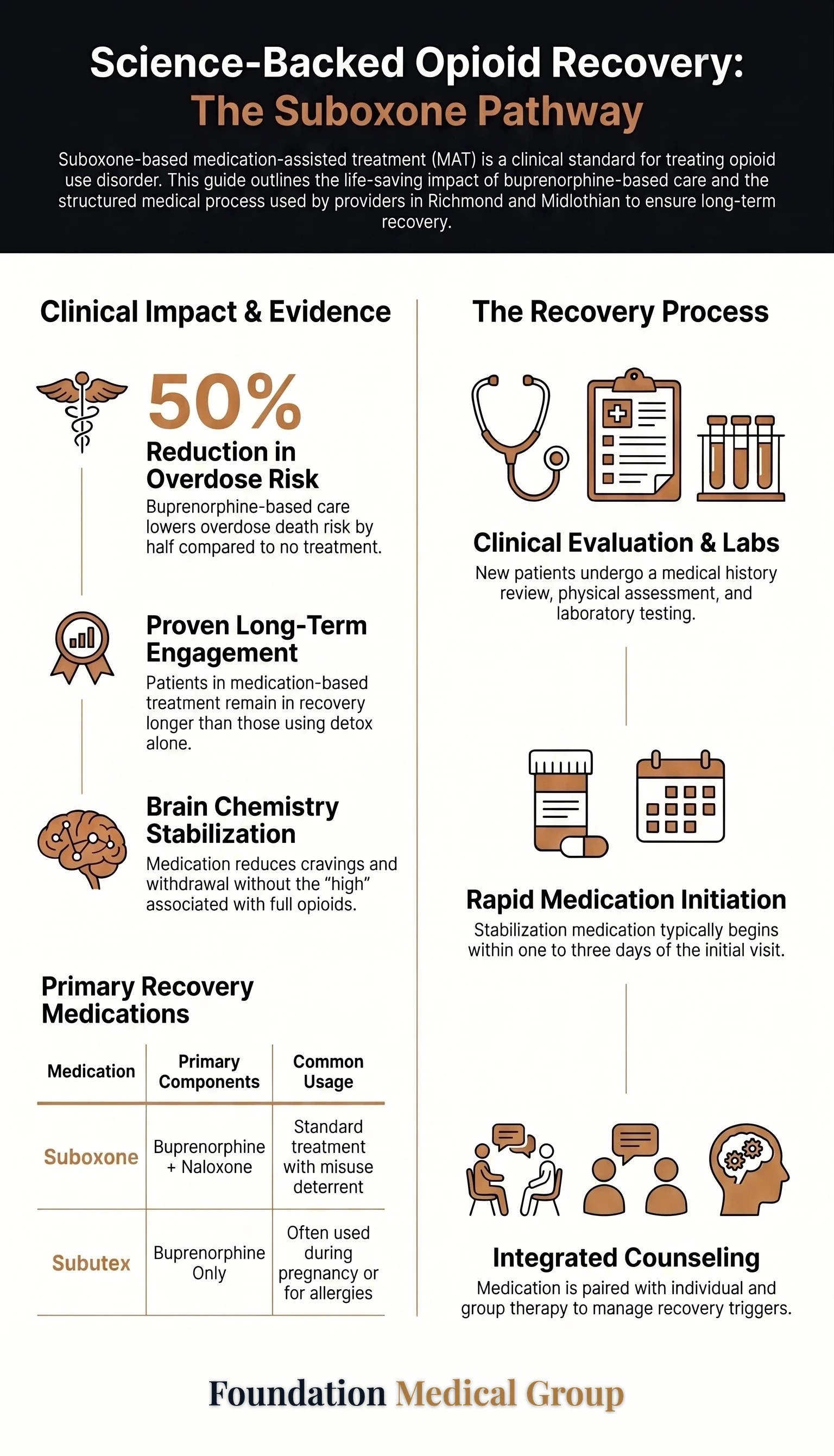
Suboxone pairs buprenorphine with naloxone to treat opioid use disorder. Buprenorphine is a partial opioid agonist. It cuts cravings and withdrawal without the high of a full opioid. Subutex is buprenorphine alone, used in specific cases.

MAT, short for medication-assisted treatment, puts medicine next to counseling and behavioral support. A BMJ meta-analysis of 19 cohorts covered 15,831 people on buprenorphine. All-cause deaths ran 4.3 per 1,000 person-years during treatment. After treatment stopped, 9.5. Overdose deaths went 1.4 against 4.6. The FDA approved Subutex and Suboxone on 8 October 2002, so this is a 20-plus year track record, not a new idea.
The medicine steadies brain chemistry and lowers relapse risk. The X:BOT trial makes a useful comparison. It randomized 570 people. Of those assigned buprenorphine-naloxone, 94 percent were successfully started on medication. For extended-release naltrexone it was 72 percent. Relapse at 24 weeks ran 57 percent against 65 percent. Detox on its own does worse than either. Staying on medicine also cuts the health risks that ride along with opioid use, hepatitis C included.
Suboxone vs Subutex Differences
Suboxone holds buprenorphine and naloxone. Subutex is buprenorphine only. The naloxone deters misuse by setting off withdrawal if the dose is injected. A Subutex-focused clinic may pick it for pregnancy, a naloxone allergy, or early induction.
Some people just don’t tolerate naloxone. That makes Subutex the better fit. A doctor reads your history, your current withdrawal, and your goals before choosing. Both work best beside counseling and real follow-up.
| Feature | Suboxone | Subutex |
|---|---|---|
| Active medication | Buprenorphine plus naloxone | Buprenorphine only |
| Misuse deterrent | Yes | No |
| Common use | Most patients | Pregnancy or allergy |
| Availability | Widely prescribed | More limited |
Finding Addiction Treatment in Richmond and Midlothian
Suboxone prescribers in Richmond work in treatment centers, private offices, and hospital programs. Richmond tends toward larger programs. Midlothian runs smaller and closer. Both can carry the same care.
Availability matters. Quality matters more. Strong programs include counseling, group therapy, and mental health support. Good clinicians also screen for other conditions and adjust as things change.
Most people end up weighing a local practice against a national telehealth brand. Five questions settle it faster than any brand name:
- Does the clinic take your Virginia Medicaid managed care plan?
- How many days until induction?
- Is counseling in-house or referred out?
- Who supervises dose changes?
- Can follow-ups happen by video?
SAMHSA’s locator at findtreatment.gov lets you filter licensed Virginia programs by ZIP code and by whether they offer buprenorphine. That’s a better shortlist than a search ad. Our Medicaid Suboxone clinic options page runs the same checklist. At Foundation Medical Group, Richmond and Midlothian care is led by Dr. Vincent Nardone, who is board-certified in Family Medicine and in Addiction Medicine.
Buprenorphine Programs in Midlothian
A buprenorphine program in Midlothian usually opens with an in-person assessment. The provider goes through your opioid history, past prescriptions, and what you want out of care. After that, visits focus on dose changes and counseling.
Many programs accept Medicaid and private insurance. Confirm your coverage before day one, not after. Regular visits are what hold recovery steady.
Suboxone Detox and Opiate Detox Options
Suboxone detox has largely replaced the older opiate detox route. It softens severe withdrawal and makes early recovery safer. Against going cold turkey, it lowers both relapse and overdose risk.
Timing decides how comfortable it feels. SAMHSA advises at least 12 to 24 hours off opioids, and early withdrawal, before the first dose. The FDA label then caps day one at 8 mg/2 mg. You get there in 2 mg or 4 mg steps, about every 2 hours. Day 2 can reach 16 mg/4 mg.
Some people need more support during detox. A licensed center may suggest short-term residential care or an intensive outpatient program. Those treatment options steady things before maintenance starts.
Medicaid Coverage and Insurance Support
Virginia Medicaid covers Suboxone and Subutex when the medical criteria are met. That usually includes the medicine, counseling, and follow-up visits. Many programs handle the prior authorization paperwork for you.
Medicaid managed care plans are common here. The Addiction and Recovery Treatment Services benefit is the reason Virginia has so many prescribers. After ARTS launched in 2017 and Medicaid expanded in 2019, the count of buprenorphine-waivered prescribers in Virginia rose 148 percent. Across southern states that did not expand, growth was 115 percent. That comparison comes from a 2024 analysis in the Journal of Substance Use and Addiction Treatment.
The overdose numbers have moved with it. CDC provisional counts put Virginia at 1,283 drug overdose deaths in the 12 months ending December 2025, down from 2,452 two years earlier. Opioid-involved deaths fell from 2,054 to 863. Still too many. But the line is going the right way.
Bring your insurance details and ID to the first visit. A clinic that answers its phone saves you a week.
Telehealth and Online Suboxone Care
Telehealth Suboxone lets you meet a provider online for evaluations and follow-ups. The rules firmed up in 2025. A DEA and HHS final rule published on 17 January 2025 allows an initial 6-month supply of buprenorphine through telemedicine, audio-only included. The prescriber has to check the state drug monitoring program first, and the pharmacist verifies your ID at pickup. The broader COVID-era flexibilities were extended a fourth time and run through 31 December 2026. Online suboxone doctors now carry a lot of Virginia patients.
Online care works well once you’re stable and not in need of close watching. An online Suboxone doctor reviews your history, your withdrawal risk, and which pharmacy you can reach before writing anything.
Online Suboxone Doctors and Medicaid
Online suboxone doctors who take Medicaid must verify coverage and licensure. Ask about counseling access, lab testing, and what happens in an emergency. Some buprenorphine networks pair video care with in-person referrals when a case needs it.
Whole Person Addiction Care
Good addiction care reaches past the prescription. Many centers offer one-to-one counseling, group therapy, and mental health support. That’s where stress, trauma, and triggers get worked on.
Brain mapping and qEEG show up in some plans. They can help, but set your expectations honestly. Aetna’s clinical policy bulletin treats quantitative EEG as medically necessary only as an add-on to a standard EEG, in 7 named situations, and calls it experimental for attention disorders, anxiety, and depression. So it supplements the medication plan. It doesn’t replace it.
How New Patients Can Start Treatment
Most people start by calling a local center or a telehealth program. Ask about openings, insurance, and how to reach a human when something goes wrong.
The first visit covers an evaluation, possibly labs, and a written plan. Medicine often starts within one to three days. Ask which product your pharmacy will actually fill, too. In 2024 Medicare Part D data, generic buprenorphine-naloxone averaged $122.89 per prescription against $473.05 for brand Suboxone film. Ongoing visits keep the dose right and deal with setbacks as they come.
FAQ
How do I start Suboxone care in Richmond?
Call a local treatment center, or use an online Suboxone program licensed in Virginia.
Is Suboxone detox safer than opiate detox?
Yes. It eases withdrawal and lowers overdose risk compared with a traditional opiate detox.
Do addiction medicine doctors offer counseling?
Many do. Most programs pair the medicine with one-to-one counseling and group therapy.
Can online Suboxone doctors prescribe medication?
Yes. A licensed provider can issue a Suboxone prescription by telehealth when it’s appropriate.
How long does addiction treatment last?
It varies. Many people stay in care for months or years, and the mortality data supports staying.
Key Takeaways and Final Thoughts
- Buprenorphine cut overdose deaths from 4.6 to 1.4 per 1,000 person-years while people stayed in treatment.
- In X:BOT, 94 percent of the buprenorphine-naloxone group started medication against 72 percent on naltrexone.
- Virginia’s prescriber count rose 148 percent after ARTS and Medicaid expansion, against 115 percent in non-expansion southern states.
- The 17 January 2025 federal rule allows a 6-month initial supply started by telemedicine.
- Generic buprenorphine-naloxone averaged $122.89 per prescription against $473.05 for brand film in 2024.
Richmond and Midlothian have real treatment options for opioid recovery, in a clinic or on a screen. Medicine, counseling, and follow-up that actually happens are what carry it. Making the call is usually the hardest part of the whole thing.
Sources
- Sordo L, et al. Mortality risk during and after opioid substitution treatment. BMJ 2017;357:j1550.
- Lee JD, et al. Extended-release naltrexone versus buprenorphine-naloxone for opioid relapse prevention (X:BOT). Lancet 2018;391(10118):309-318.
- Changes in buprenorphine waivered provider supply after Virginia Medicaid implements ARTS. J Subst Use Addict Treat, 2024.
- CDC National Center for Health Statistics, VSRR Provisional Drug Overdose Death Counts (Virginia).
- Drug Enforcement Administration and HHS, Expansion of Buprenorphine Treatment via Telemedicine Encounter, Federal Register, 17 January 2025.
- Drug Enforcement Administration and HHS, Fourth Temporary Extension of COVID-19 Telemedicine Flexibilities, Federal Register, 31 December 2025.
- Substance Abuse and Mental Health Services Administration, Buprenorphine.
- Aetna, Clinical Policy Bulletin 0221, quantitative EEG.
- Centers for Medicare and Medicaid Services, Medicare Part D Spending by Drug, 2024.