
Suboxone treatment is a Medicaid covered option for opioid addiction in Texas when the clinical rules are met. A Suboxone doctor Texas Medicaid approves can prescribe the medicine, monitor you, and keep you in care through a clinic or by video. What decides your start date is coverage rules, provider openings, and pharmacy stock.
Opioid addiction hurts thousands of Texans a year. Medicaid coverage often decides how fast treatment begins. This guide breaks down how Texas Medicaid handles Suboxone and Subutex, how to find doctors who are taking patients, and what care actually looks like. You’ll also learn about telehealth suboxone doctors, Dallas area clinics, and the support that keeps people in treatment.
Introduction
Opioid use disorder is a chronic medical condition. It needs ongoing treatment and steady follow up, the same as diabetes or high blood pressure. In Texas, Medicaid drives access to addiction care for adults with low incomes. Suboxone and Subutex both steady brain chemistry and cut opioid use.
The scale of the problem is worth stating plainly. CDC provisional counts recorded 3,133 opioid involved overdose deaths in Texas for the 12 months ending December 2023. That fell to 2,415 a year later, then to 1,934 for the 12 months ending December 2025. Better access to medicine is part of why the curve bent.
A suboxone doctor texas medicaid patients see must follow state coverage rules and federal law. This article explains how the medicine works, how Texas Medicaid covers it, and how to find a clinic that’s taking new patients.
What Suboxone Is and How It Treats Opioid Use Disorder
Suboxone combines buprenorphine and naloxone. Buprenorphine is a partial opioid agonist. It cuts cravings and withdrawal without a strong high. Naloxone is added to discourage misuse.
Suboxone treatment is a form of medication assisted treatment used by addiction medicine doctors nationwide. The evidence behind it is strong, and specific. A 2020 study in JAMA Network Open followed 40,885 people with opioid dependence. Buprenorphine or methadone cut overdose risk by 76 percent at 3 months and 59 percent at 12 months, against no medication at all. Detox alone did not. Neither did counseling by itself.
A 2017 review in The BMJ shows why staying in care matters. On buprenorphine, all cause deaths ran 4.3 per 1,000 person years during treatment and 9.5 after people left. Overdose deaths ran 1.4 in care and 4.6 out of it. Leaving is the risky part.
Doctors prescribe Suboxone inside a wider care plan with monitoring and counseling. The FDA requires a Medication Guide with every fill. Read it. For many patients, Suboxone makes ordinary life possible again.
What Subutex Is and When Doctors Prescribe It
Subutex is buprenorphine on its own, with no naloxone. Doctors reach for it in specific cases, like pregnancy or a documented naloxone intolerance. Subutex doctors near me often work in clinics that handle higher risk situations.
Medicaid approval for Subutex is tighter than for Suboxone treatment. A subutex clinic near me usually has to submit medical justification and detailed prescribing notes. Expect prior authorization and closer follow up. That stricter process exists for safety, not to block you.
Texas Medicaid Coverage for Suboxone and Subutex in 2026
Texas Medicaid covers buprenorphine based treatment when you meet clinical criteria. Coverage usually includes the medicine, lab testing, and counseling. Suboxone doctor texas medicaid rules require an enrolled provider and a documented care plan.
Suboxone is usually preferred, because the naloxone lowers misuse risk. Generic buprenorphine and naloxone products sit on most preferred drug lists. Prior authorization is common at the start, and early refills may be limited.
Subutex coverage is narrower. Texas Medicaid typically approves it for pregnancy or a documented reaction to naloxone. Providers submit detailed records, and approval windows are shorter. Expect more frequent reviews.
Here’s the practical comparison.
| What you’re comparing | Suboxone (buprenorphine and naloxone) | Subutex (buprenorphine only) |
|---|---|---|
| Usual Medicaid status | Covered, commonly preferred | Covered in narrower cases |
| Typical approval hurdle | Prior authorization at start | Prior authorization plus medical justification |
| Who it usually fits | Most adults starting treatment | Pregnancy, documented naloxone intolerance |
| Telehealth friendly | Yes, including audio only starts | Yes, with closer documentation |
| Cash price per day at 16 mg | About $1.44 in generic tablets | About $1.38 in generic tablets |
Knowing these differences helps you pick a lane and avoid slowdowns.
If a prior authorization is denied, don’t treat it as final. Most denials are paperwork problems, not clinical refusals. Read the letter, note the reason code, and call your managed care plan the same day. Your clinic can usually resubmit with the missing note attached. You also have appeal rights under your plan.
People sometimes ask about the Vivitrol route instead. The X:BOT trial randomized 570 people to extended release naltrexone or buprenorphine and naloxone. Once both groups were started, outcomes looked similar. Getting started was the split: 28 percent of the naltrexone group failed induction, against 6 percent on buprenorphine. Naltrexone needs full detox first, which is where people fall out.
How to Find a Suboxone Doctor in Texas That Accepts Medicaid
Finding suboxone doctors near me that accept medicaid usually starts with the Texas Medicaid provider directory. Search by specialty, such as addiction treatment or internal medicine. Then confirm the provider is taking new patients.

Call clinics directly to double check Medicaid acceptance. Useful questions in Texas include these.
- Do you take my specific managed care plan, not just Medicaid in general?
- Do you need prior authorization, and who files it?
- How soon can I be seen, and do you offer same day prescriptions?
- Do you send scripts to my pharmacy, or a partner pharmacy only?
- Is counseling on site, billed separately, or by referral?
Here’s the thing. Some providers list Medicaid but have very few open slots. Verifying early saves weeks.
One legal note that clears up a lot of confusion. The X waiver created by the Drug Addiction Treatment Act of 2000 was eliminated by the Consolidated Appropriations Act of 2023. Any clinician with a standard DEA registration can now prescribe buprenorphine for opioid dependency. A primary care doctors office can do it. So can online addiction medicine doctors.
Telehealth Suboxone Doctors That Take Medicaid
Telehealth Suboxone doctors run visits for evaluation, induction, and follow up. The federal rules are specific. DEA and HHS published a final rule on 17 January 2025 allowing an initial 6 month supply of buprenorphine after an audio only encounter, once the prescriber reviews state prescription monitoring data. A separate order extended the broader telehealth flexibilities through 31 December 2026.
Online suboxone doctors that take insurance make scheduling easier. Telehealth services cut travel, which matters in rural Texas where the nearest clinic can be hours away. Convenient suboxone treatment still involves lab work and a care team.
The research backs this up. A 2023 study in JAMA Network Open looked at 91,914 Medicaid enrollees and found that starting by video was linked to slightly better 90 day retention than starting in person. Overdose risk did not rise.
Telehealth isn’t right for everyone. Initial exams, drug screening, or certain counseling may still need an in person visit. Weigh convenience against hands on care.
Suboxone Clinics and Doctors in Dallas and Surrounding Areas
Dallas has several suboxone clinic options serving Medicaid patients. A suboxone clinic dallas residents use might sit inside a primary care office or a dedicated addiction treatment center. Availability shifts by neighborhood.
To find a suboxone doctor dallas medicaid accepts, check directories and call offices directly. Pharmacy access can be tricky, since some stores limit buprenorphine stock. Clinics often help coordinate the fill.
Outside Dallas, options thin out. Telehealth and regional referrals fill those gaps. Methadone clinics remain an option for people who want daily structure instead.
What to Expect at Your First Suboxone Appointment With Medicaid
The first visit covers medical history, an opioid use assessment, and a drug screen. Addiction medicine doctors also check mental health and past treatment. Bring a Medicaid ID, a photo ID, and a list of your medicines. Plan for 45 to 60 minutes.
Induction follows, and the timing is set by the prescribing information, not by preference. The FDA label says your first dose comes no less than 6 hours after your last short acting opioid, and only when clear, objective signs of opioid withdrawal appear. Going too early can trigger precipitated withdrawal.
Here is the ladder the label sets out.
- Day 1. Start at 2 mg or 4 mg, then step up in 2 mg or 4 mg increments about every 2 hours, usually to 8 mg.
- Day 2. A single dose of up to 16 mg is standard.
- Settling in. The target maintenance dose is 16 mg a day, with a usual range of 4 mg to 24 mg.
- Holding steady. Buprenorphine has a half life near 38 hours, so one dose a day carries you.
Early follow up visits are weekly or every other week. Over time, your suboxone prescription is adjusted for stability rather than speed.
Accessing Texas Pharmacies That Fill Buprenorphine Prescriptions
Not every pharmacy keeps buprenorphine in stock. Limits come from regulation and supply, and they can delay treatment. That’s frustrating, and it’s fixable with a phone call.

Many clinics coordinate with Medicaid approved pharmacies to avoid gaps. Ask your provider which nearby pharmacies actually stock it.
Cost matters too, especially between plans. CMS publishes a national average drug acquisition cost, roughly what pharmacies pay. In the December 2025 file, generic buprenorphine and naloxone 8 mg / 2 mg tablets averaged about $0.72 each. At 16 mg a day that’s about $1.44 daily, or roughly $43 for 30 days before insurance. The film form runs near $1.94 each, about $116 a month. If you’re paying cash for a bridge supply, ask about pharmacy coupons and generic buprenorphine options.
How Integrated Care and Brain Mapping Can Support Recovery
Integrated care puts medicine, counseling, and mental health services under one plan. It treats opioid addiction and any co occurring condition at the same time. A therapy team may run group work, while intensive outpatient programs add structure for people who need more.
Brain mapping texas services, including qeeg brain mapping texas, measure brain activity patterns. Providers use that data to shape therapy and medication choices. These tools aren’t required for Suboxone treatment, and they don’t replace it.
Integrated care focuses on the whole person. That mindset lowers relapse risk and improves daily life.
Infographic: Suboxone vs Subutex for Texas Medicaid Patients
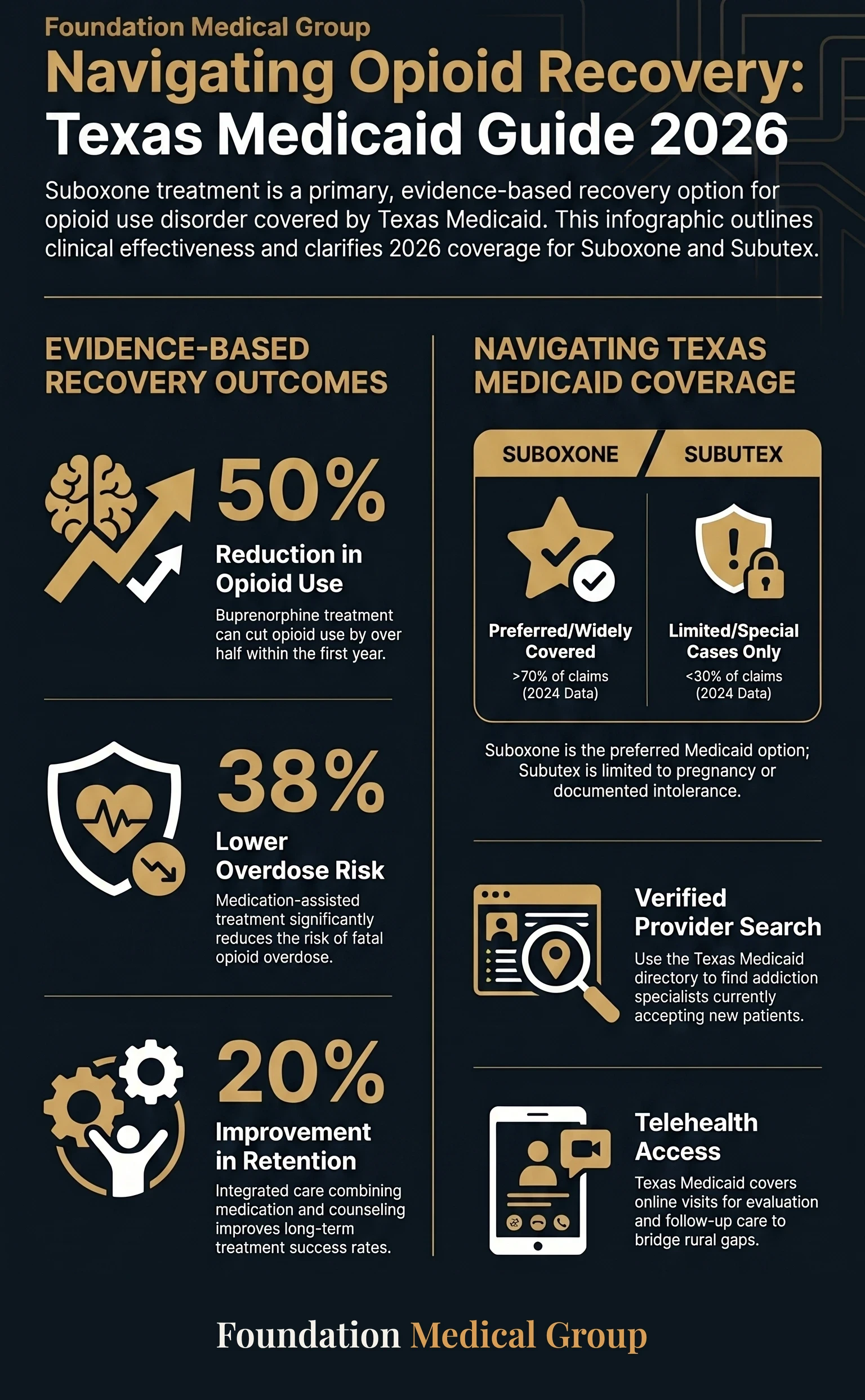
This comparison outlines coverage, eligibility, and care requirements. Suboxone is widely covered with standard prior authorization. Subutex is approved in specific cases. Telehealth generally works better with Suboxone treatment.
FAQ
Does Texas Medicaid cover Suboxone treatment?
Yes. Texas Medicaid covers Suboxone treatment when prescribed by approved providers and when authorization and counseling rules are followed.
Can I see a Suboxone doctor online with Medicaid?
Yes. Telehealth Suboxone doctors can provide care if they meet state and federal requirements and accept Medicaid.
What is the difference between Suboxone and Subutex?
Suboxone contains buprenorphine and naloxone. Subutex contains only buprenorphine and is used in limited cases like pregnancy.
How long does Medicaid approval take?
Approval often takes a few days. Prior authorization for Subutex can take longer due to stricter review.
What if my pharmacy will not fill my prescription?
Ask your provider for other pharmacy options. Clinics often help coordinate access.
Key Takeaways
Suboxone and Subutex are effective treatment options covered by Medicaid when the criteria are met. Texas patients can pick clinic based or telehealth care, whichever they can actually keep. Verifying Medicaid acceptance and pharmacy stock early prevents most delays. A texas suboxone clinic or online provider can deliver coordinated care that supports long term recovery.
Sources
- Suboxone (buprenorphine and naloxone) sublingual film prescribing information, DailyMed, National Library of Medicine.
- Wakeman SE, et al. Comparative effectiveness of different treatment pathways for opioid use disorder. JAMA Netw Open 2020;3(2):e1920622.
- Sordo L, et al. Mortality risk during and after opioid substitution treatment. BMJ 2017;357:j1550.
- Lee JD, et al. Comparative effectiveness of extended-release naltrexone versus buprenorphine-naloxone (X:BOT). Lancet 2018;391(10118):309-18.
- Hammerslag LR, et al. Telemedicine buprenorphine initiation and retention in opioid use disorder treatment for Medicaid enrollees. JAMA Netw Open 2023;6(10):e2336914.
- Buprenorphine, StatPearls, NCBI Bookshelf.
- Drug Enforcement Administration and HHS, Expansion of Buprenorphine Treatment via Telemedicine Encounter.
- Drug Enforcement Administration and HHS, Fourth Temporary Extension of COVID-19 Telemedicine Flexibilities.
- Drug Enforcement Administration, Dear DEA Registrant letter on elimination of the DATA-Waiver requirement.
- Centers for Medicare and Medicaid Services, National Average Drug Acquisition Cost, 2025.
- CDC National Center for Health Statistics, VSRR Provisional Drug Overdose Death Counts.
- Texas Department of State Health Services, Opioids.
- Substance Abuse and Mental Health Services Administration, Buprenorphine.