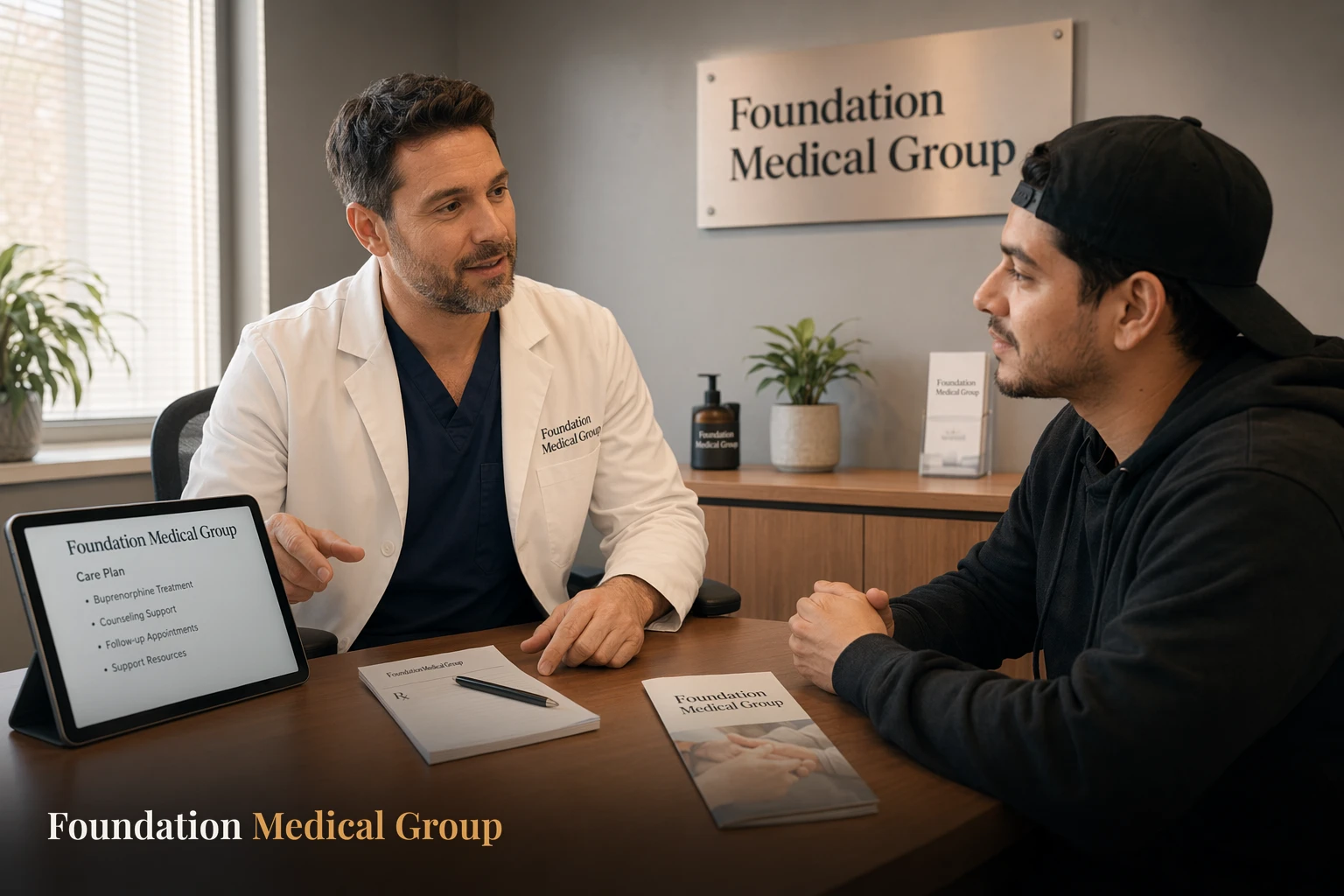
Suboxone doctors who accept Medicaid work in clinics and licensed online services across the US. Medicaid covers buprenorphine based suboxone treatment in all 50 states, though rules vary by plan. Adults can start opioid addiction treatment through outpatient care, in person or by video. If you’re searching for suboxone doctors near me that accept medicaid, this guide covers what you need.
Introduction
Finding a suboxone doctor who takes Medicaid can feel like a maze, especially during active opioid addiction. Cost, access, and insurance all get in the way at once. The good news is that Medicaid does cover suboxone treatment, and access has widened through clinics and online services alike.
This guide is for adults seeking addiction treatment, and for the people helping them. It’s also useful if you’re weighing suboxone providers, outpatient options, or online suboxone treatment.
You’ll learn how Medicaid coverage works, how to confirm a clinic takes your plan, and how to choose between a local provider and an online suboxone clinic. We also cover state examples, what happens at your first visit, and how care supports long term recovery.
What Are Suboxone and Subutex?
Suboxone combines buprenorphine and naloxone to treat opioid addiction. Subutex contains buprenorphine only, and doctors use it in specific cases such as pregnancy or a documented naloxone intolerance. Both are FDA approved for opioid use disorder.
Buprenorphine is a partial opioid agonist. It cuts cravings and withdrawal symptoms without the high of a full opioid. It also has a ceiling effect on breathing suppression, which is why it can be prescribed from an office rather than a daily dosing clinic. Its half life runs about 38 hours, so one dose a day holds you steady.
The evidence is specific. A 2020 study in JAMA Network Open followed 40,885 people with opioid use disorder. Buprenorphine or methadone cut overdose risk by 76 percent at 3 months and 59 percent at 12 months, against no medication. Detox alone did not, and neither did counseling on its own.
Staying in care is what carries the benefit. A 2017 review in The BMJ found that among people on buprenorphine, all cause deaths ran 4.3 per 1,000 person years during treatment and 9.5 after they left. Overdose deaths ran 1.4 in care and 4.6 out of it.
Suboxone is the more common choice, because the naloxone lowers misuse risk. Addiction medicine doctors pick between the two based on safety, your history, and your goals.
How Medicaid Covers Suboxone Treatment
Medicaid covers suboxone treatment nationwide. Coverage usually includes doctor visits, the medication, and counseling as part of medication assisted treatment. Some plans allow same day starts. Others require prior authorization first.
The details depend on your plan, not on Medicaid in general. Some state plans require counseling alongside the medicine. Others do not.
Here’s what to confirm before you book.
- Does your plan require prior authorization, and who submits it?
- Are there refill limits in the first month?
- Is counseling required, included, or billed separately?
- Are telehealth visits covered the same as office visits?
- Which pharmacies in network actually stock buprenorphine?
If you’re between plans or paying cash for a bridge supply, the drug itself is cheaper than most people expect. CMS publishes a national average drug acquisition cost, roughly what pharmacies pay. In the December 2025 file, generic buprenorphine and naloxone 8 mg / 2 mg tablets averaged about $0.72 each. At a 16 mg daily dose that’s about $1.44 a day, or near $43 for 30 days before insurance.
How to Find Medicaid-Accepting Suboxone Providers
Start with your Medicaid provider directory. Look for addiction medicine doctors, outpatient programs, or a suboxone treatment clinic that lists Medicaid. Then confirm they’re taking new patients.
SAMHSA’s free locator at findtreatment.gov also lists licensed buprenorphine prescribers by ZIP code. It’s a good cross check when a directory looks out of date.
Next, call the clinic. Ask whether they accept your specific managed care plan, not just Medicaid. Ask how soon treatment can start, whether virtual visits are offered, and what paperwork you need. Those three questions prevent most delays.
Online Suboxone Treatment and Telehealth Options
Online suboxone treatment runs through secure video visits. An online suboxone doctor can assess you, manage your dose, and send a suboxone prescription to your pharmacy when appropriate.
The federal rules are now clear. DEA and HHS published a final rule on 17 January 2025 allowing an initial 6 month supply of buprenorphine after an audio only encounter, once the prescriber reviews state prescription monitoring data. A separate order extended the wider telehealth flexibilities through 31 December 2026.
Retention holds up too. A 2023 study in JAMA Network Open examined 91,914 Medicaid enrollees in two states. Starting by video was linked to slightly better 90 day retention than starting in person, and overdose risk did not rise.
Here’s how the two paths compare.
| What you’re comparing | In person clinic | Online suboxone clinic |
|---|---|---|
| Typical time to first visit | 3 to 14 days | 1 to 3 days |
| Physical exam | On site | Referred out |
| Drug screening | In clinic | Local lab |
| Travel | Required | None |
| Best for | Close monitoring | Work, childcare, distance |
Many telehealth suboxone doctors accept Medicaid and private insurance. Check licensing in your state, and ask how follow ups work.
State Examples of Suboxone Care
Virginia and Nearby Areas
Virginia Medicaid supports suboxone treatment with fewer restrictions than many states. Coverage runs through a program called Addiction and Recovery Treatment Services, or ARTS, launched in April 2017. It pays for medication, visits, counseling, and peer support.
The results were measured. A 2020 study in Health Affairs found that after ARTS launched, the chance of an emergency department visit in any quarter fell 9.4 percentage points among members with opioid use disorder, a 21.1 percent relative drop. Patients can choose in person care or a licensed online suboxone clinic. Our guide to online Suboxone doctors that accept Virginia Medicaid has the local detail.
Texas, Utah, and Georgia
Texas Medicaid covers suboxone treatment, though prior authorization often applies. Utah and Georgia also cover buprenorphine, with provider availability varying by area. Our page on finding a Suboxone doctor with Texas Medicaid walks through the state rules.
Outpatient treatment remains the most common approach across all three. Online services help people keep care going around work and family.
If Your State Is Not Listed
Foundation Medical Group has clinics in Virginia, Texas, Utah and Georgia, so those are the states we can speak to directly. If you live elsewhere, SAMHSA’s locator at findtreatment.gov lists licensed buprenorphine prescribers by ZIP code. Your Medicaid plan’s member services line can confirm which of them are in network.
Ask the same questions wherever you go. Does the prescriber take your plan? How soon can you be seen? Is counseling included or billed separately?
What to Expect at a Suboxone Treatment Clinic
The first visit covers your health history, your substance use, and a plan. Plan for 45 to 60 minutes. Many providers can start medication the same day.
Induction timing comes from the FDA label, not preference. Your first dose waits at least 6 hours after your last short acting opioid, and only once clear signs of withdrawal appear. Here’s the ladder.
- Day 1. Start at 2 mg or 4 mg, stepping up in 2 mg or 4 mg increments about every 2 hours, usually to 8 mg.
- Day 2. A single dose of up to 16 mg is standard.
- Settling in. The target is 16 mg a day, inside a usual range of 4 mg to 24 mg.
Ongoing care focuses on stability, medication management, and relapse prevention. Regular follow ups keep recovery on track. This outpatient model lets you stay in work and family life while you rebuild.
Insurance, Coverage, and Patient Responsibilities
Medicaid and private insurance usually cover suboxone treatment, but the details vary by plan. Some plans require counseling, urine testing, or prior authorization.
Ask about coverage limits, refill rules, and visit frequency. Clear communication with your healthcare provider prevents gaps in care. Understanding the rules up front keeps your focus on recovery instead of paperwork.
Staying Informed and Supported
Education matters in recovery. Knowing how the medicine works makes it easier to stick with it. Our Subutex clinic near me hub gathers the practical guides in one place.
Support may also include counseling referrals, peer groups, and medically assisted detox when appropriate. One honest note on counseling. The POATS trial randomized 653 people on buprenorphine and naloxone and found that adding structured drug counseling to solid medical care did not improve drug use outcomes. Counseling still helps with the rest of life. The medication is what carries the safety benefit, so no one should be made to choose between them.
Infographic: Steps to Start Suboxone Treatment With Medicaid
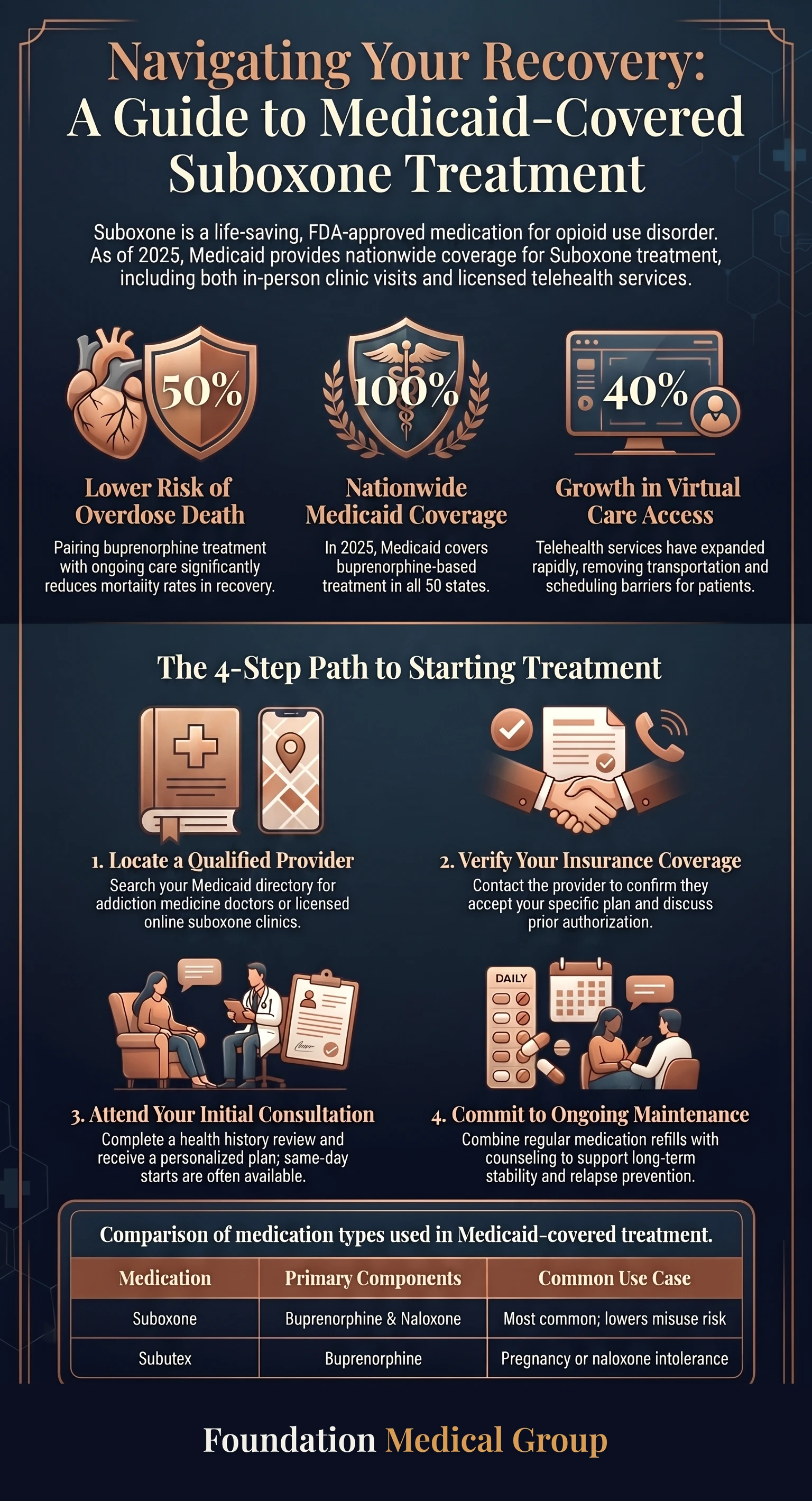
This infographic outlines how to verify insurance, contact suboxone providers, and choose between local and online care. It highlights the questions worth asking and shows how outpatient treatment supports recovery.
FAQ
Can I use an online suboxone doctor with Medicaid?
Yes. Many online suboxone doctors accept Medicaid and provide virtual visits, prescriptions, and follow-up care.
Does Medicaid cover a suboxone prescription?
Medicaid typically covers a suboxone prescription when medically necessary. Prior authorization depends on the state and plan.
Is suboxone maintenance long term?
Suboxone maintenance can be short or long term. Addiction medicine doctors adjust duration based on patient progress and recovery goals.
What if I need detox before starting medication?
Some patients begin with medically assisted detox. Your provider will decide if detox is needed before starting suboxone treatment.
Does treatment include mental health support?
Many programs coordinate with mental health services administration guidelines. Counseling is often included to support recovery and reduce relapse risk.
Key Takeaways and Final Thoughts
Suboxone treatment is widely available through Medicaid covered providers, in person and online. Insurance coverage, provider experience, and steady support all matter when you choose. With the right healthcare provider and a clear plan, you can start a recovery that holds.
Sources
- Suboxone (buprenorphine and naloxone) sublingual film prescribing information, DailyMed, National Library of Medicine.
- Wakeman SE, et al. Comparative effectiveness of different treatment pathways for opioid use disorder. JAMA Netw Open 2020;3(2):e1920622.
- Sordo L, et al. Mortality risk during and after opioid substitution treatment. BMJ 2017;357:j1550.
- Hammerslag LR, et al. Telemedicine buprenorphine initiation and retention in opioid use disorder treatment for Medicaid enrollees. JAMA Netw Open 2023;6(10):e2336914.
- Weiss RD, et al. Adjunctive counseling during brief and extended buprenorphine-naloxone treatment for prescription opioid dependence. Arch Gen Psychiatry 2011;68(12):1238-46.
- Barnes AJ, et al. Hospital use declines after implementation of Virginia Medicaid’s Addiction and Recovery Treatment Services. Health Aff 2020;39(2):238-46.
- Buprenorphine, StatPearls, NCBI Bookshelf.
- Drug Enforcement Administration and HHS, Expansion of Buprenorphine Treatment via Telemedicine Encounter, 90 FR 6504.
- Drug Enforcement Administration and HHS, Fourth Temporary Extension of COVID-19 Telemedicine Flexibilities.
- Centers for Medicare and Medicaid Services, National Average Drug Acquisition Cost, 2025.
- Substance Abuse and Mental Health Services Administration, FindTreatment.gov.