
For a lot of people, yes. SAMHSA says buprenorphine treatment for opioid use disorder has no set end date, and in some cases it can continue indefinitely. The best results come from staying on the medicine as long as it helps. Suboxone long term use, and any taper, is planned with your prescriber, with regular checks along the way.
What Is Considered Long-Term Suboxone Use?
Long-term Suboxone use means taking buprenorphine and naloxone, an opioid antagonist, every day for many months or years as maintenance treatment for opioid use disorder, rather than for a short taper. The goal is steady recovery, not a quick stop.
There’s no official cutoff in months. SAMHSA’s Treatment Improvement Protocol 63 (TIP 63) simply says the best results happen when a patient gets medication for as long as it provides a benefit. TIP 63 calls this “maintenance treatment.”
Researchers sometimes set their own line for a study. One study of people stopping buprenorphine, published by Williams and colleagues in 2020, counted at least 180 days of continuous use as long-term. That number belongs to that study. It isn’t a rule for patients.
This treats opioid addiction as an ongoing health condition, which is how NIDA describes opioid use disorder. Suboxone is one medicine used to treat opioid dependence. SAMHSA says buprenorphine should be part of a full plan that includes counseling, so Suboxone use that lasts for years usually comes with ongoing talk support too.
How Long Should You Stay on Suboxone?
There’s no single right length, which can be frustrating when you just want an answer. SAMHSA says the time a person stays on buprenorphine is tailored to their needs, and in some cases treatment can be indefinite. Once you’re stable, your prescriber may adjust your dose. That’s a decision for your prescriber, never something to change on your own.
TIP 63 goes further. It says arbitrary time limits on medication for opioid use disorder are inadvisable. Patients should take buprenorphine for as long as they benefit from it and want to continue. In other words, nobody should be pushed off a medicine that’s working just because a calendar says so.
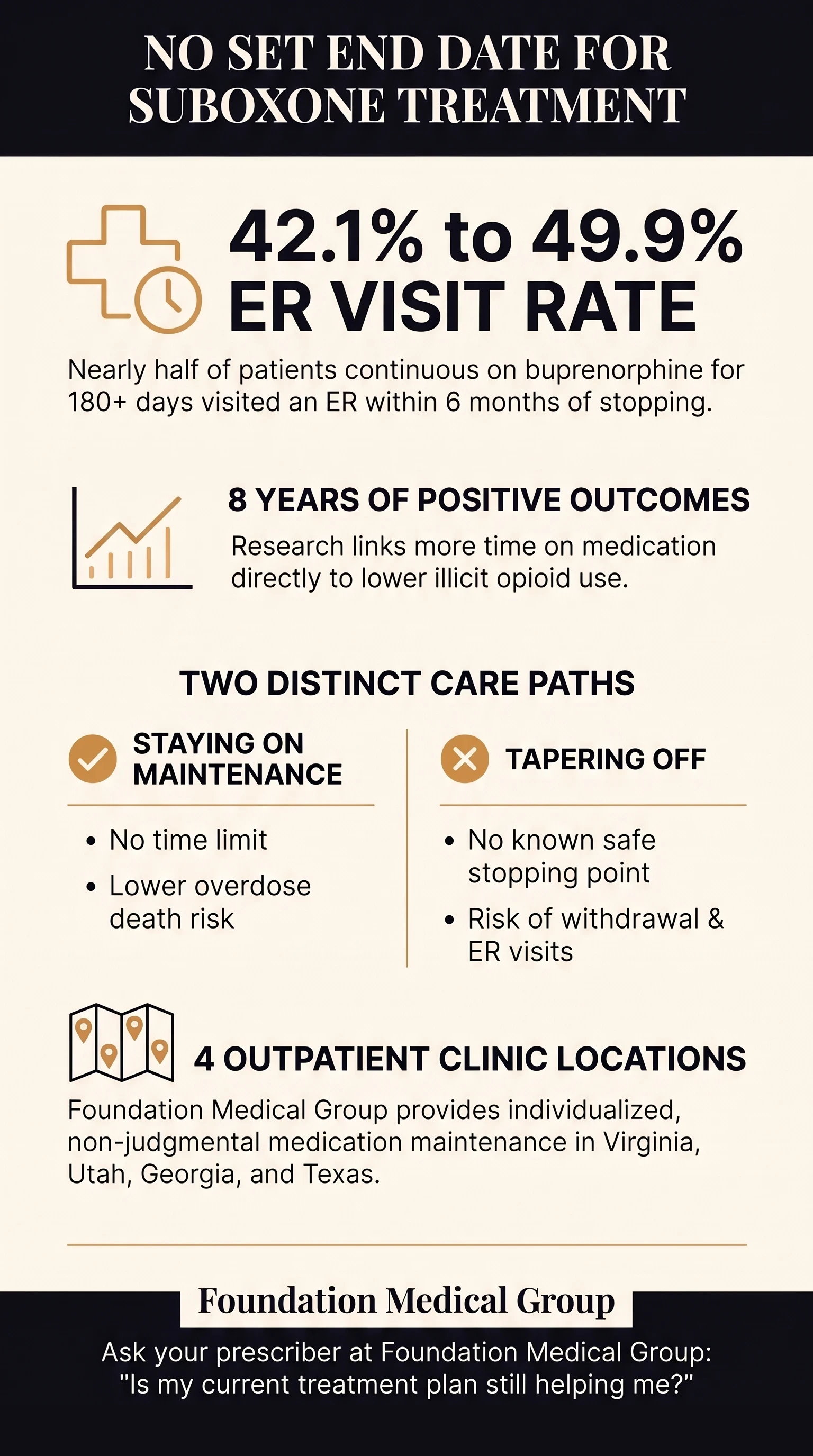
TIP 63 also describes outcomes followed for up to 8 years. People who spent more time on medication had lower illicit opioid use. That’s a strong reason why long term suboxone treatment is a normal choice, not a failure to “finish.”
The hard truth is that no clock makes stopping safe. TIP 63 says there is no known length of time on buprenorphine after which patients can stop and be sure they won’t return to illicit opioids. So any choice to stop should be planned carefully.
So the better question isn’t “how long?” but “is it still helping me?” Ask your prescriber that question at your visits. It’s also fine to say you’re not ready to change anything. Honestly, that can be a relief to hear. TIP 63 says patients should stay on the medication as long as they wish to continue and it helps.
What Is Suboxone Maintenance Therapy, and When Is Tapering Considered?
Maintenance therapy means staying on a steady daily dose of buprenorphine. NIDA explains that, taken as prescribed, buprenorphine prevents opioid cravings and withdrawal without the intense high of other opioids. That steadiness gives you room to rebuild your life: sleep, work, relationships and health.
Tapering is a slow, planned reduction for people who want to stop. The FDA label says that when Suboxone is discontinued, the dose should be tapered gradually. Stopping suddenly or too fast can cause opioid withdrawal.
TIP 63 says decisions about stopping should be individualized and made together by the patient and the prescriber. It also says that results vary. How long someone has been in treatment, how stable their life is and how motivated they are to stop all affect how a taper goes.
Neither path is a test you pass or fail. Some people stay on their medication for years. Others reach a point where they feel ready to try a taper. Long term recovery can include either path.
If you’re thinking about stopping, read our guide on how to taper off Suboxone and bring your questions to your prescriber. We don’t list taper steps or speeds here, because those are set for each person.
Suboxone Maintenance vs Tapering: How They Compare
Here’s how the two paths look side by side, using only what our sources say.
| Feature | Staying on maintenance | Tapering off |
|---|---|---|
| What it means | Taking buprenorphine as long as it helps and you want to continue (TIP 63) | A gradual, planned dose reduction (FDA label, TIP 63) |
| Time limit | None set; can be indefinite (SAMHSA) | No known safe point to stop (TIP 63) |
| Main benefit named by sources | Less illicit opioid use with more time on medication, up to 8 years (TIP 63); lower risk of overdose death (NIDA) | Some people want to stop; outcomes depend on time in treatment, stability and motivation (TIP 63) |
| Main risk named by sources | Physical dependence; checks for liver, adrenal and dental problems (FDA label, FDA dental warning) | Withdrawal if stopped fast (FDA label); emergency room visits and some opioid overdoses after stopping in one Medicaid study (Williams 2020) |
| Who decides | You and your prescriber | You and your prescriber |
Neither path is right for everyone. The choice is made with your prescriber, and it can change over time as your life and opioid use history change.
Is Suboxone Safe to Take Long-Term?

For most people, the research supports it. The FDA has approved three medications for opioid use disorder: buprenorphine, methadone and naltrexone. The FDA says all three have been shown to be safe and effective.
NIDA describes opioid use disorder as a chronic, treatable condition. It also says medications for opioid use disorder reduce the risk of overdose deaths.
Think of it as a trade-off: long-term risks are weighed against the risks of untreated opioid addiction. NIDA links medications for opioid use disorder to fewer overdose deaths, and TIP 63 links more time on medication with lower illicit opioid use. Stopping a medicine that protects you can carry its own danger.
Long-term use does carry known risks, and your prescriber watches for them. The next two sections explain what they are and how they are checked. Even so, when the FDA warned about dental problems with buprenorphine in 2022, it said the medicine remains an important treatment and that its benefits outweigh the risks.
Here’s an honest limit. Our sources don’t make claims about long-term effects of buprenorphine on the brain, memory or thinking, so we don’t make them either. We know that’s frustrating if it’s the very thing you’re worried about. If you have questions like these, ask your prescriber, who knows your health history.
Methadone and buprenorphine are both long-term addiction treatment options. Which medication fits you is a decision for you and your prescriber.
What Are the Long-Term Side Effects of Suboxone?
Some Suboxone side effects matter more when you take buprenorphine for months or years. These are the long-term risks the FDA names.
Dental problems. The FDA warns that buprenorphine medicines that dissolve in the mouth have been linked to tooth decay, cavities, oral infections and tooth loss. This has happened even in people with no history of dental issues.
Liver problems. The FDA label says liver function tests should be checked before treatment starts and during treatment.
Adrenal problems. The label reports adrenal insufficiency with opioid use, more often after more than one month of use. Signs can include nausea, vomiting, tiredness, weakness, dizziness and low blood pressure.
Low sex hormones. The label says androgen deficiency has occurred with chronic opioid use.
Physical dependence. The label says chronic use of this opioid drug produces physical dependence. We explain what that means, and how it differs from addiction, below.
Other drug use adds risk too. SAMHSA says not to use alcohol, sedatives or other drugs that slow breathing while on buprenorphine. Tell your prescriber about every medication you take, including ones from other doctors, and about any alcohol or other drug use. At FMG, we check for medication interactions at the first visit, so a full list really helps.
If you notice a possible side effect, don’t stop your medication to see if it goes away. The FDA label warns that stopping suddenly can cause withdrawal. Call your prescriber instead, so they can check what’s going on and decide the next step with you.
What Gets Monitored During Long-Term Suboxone Treatment?

Long-term treatment isn’t just a refill. Your prescriber keeps an eye on your health over time. Based on our sources, monitoring can include:
- Liver tests. The FDA label calls for liver function tests before and during treatment, and SAMHSA says a physician should monitor any liver-related health issues.
- Adrenal signs. Your prescriber watches for the adrenal symptoms listed above.
- Dental care. The FDA says prescribers should refer patients to dental care and encourage regular checkups. Tell your dentist that you take buprenorphine.
- Counseling. SAMHSA says buprenorphine works best as part of a plan that includes counseling.
- Dose review. SAMHSA notes that once you are stable, your dose may be adjusted. This guide gives no dose numbers and no high dose advice, because dose decisions belong to your prescriber.
It helps to be open at each visit. Tell your prescriber about any other substance use, new medication, new health problem or plan for surgery. Some questions worth asking at a long-term visit:
- Is my current dose still working for me?
- Am I due for liver tests?
- Should I see my dentist soon?
- Are any of my symptoms a sign of a side effect?
- Is my counseling plan still a good fit?
One more thing. Pain care while on Suboxone needs its own plan with your prescriber and your other doctors.
Is Long-Term Suboxone Just Trading One Opioid Addiction for Another?
This is one of the most common worries people have, and it deserves a straight answer. NIDA notes that some people think methadone and buprenorphine just substitute one drug for another.
NIDA’s answer is that, taken as prescribed, these medicines prevent cravings and withdrawal without the intense high. That makes them less addictive than the opioids they replace. NIDA is also clear that they do produce dependence.
Dependence and addiction aren’t the same thing. Physical dependence means your body has adjusted to a medicine and reacts if it stops suddenly. Opioid addiction, or opiate addiction, is out-of-control substance use that keeps going despite harm. Someone taking Suboxone as prescribed, as part of a treatment plan, is getting opioid addiction treatment, not feeding an addiction.
Some people worry about suboxone addiction itself. Suboxone misuse and suboxone abuse can happen, for example taking extra doses or using someone else’s medicine, and any opioid misuse raises your risk. The safest rule is simple: take it only as prescribed, and talk to your prescriber if you feel tempted to use it any other way. That honesty is part of good treatment, not a reason to be judged.
To learn what it means that buprenorphine is a partial opioid agonist, unlike full opioid agonists, and how it acts at the opioid receptors, read our guide on how Suboxone works.
How Long Can You Take Suboxone Before Becoming Dependent?
If you take Suboxone every day over time, you’ll become physically dependent. That’s expected. The FDA label says chronic use produces physical dependence, and stopping suddenly or tapering too fast causes withdrawal. NIDA also says buprenorphine and methadone produce dependence.
The sources give no number of days or weeks before opioid dependence starts, so we don’t give one. Dependence is also why the FDA label says to taper gradually when stopping, rather than quitting all at once. What matters more is how you stop. Because of physical dependence, stopping is done slowly and with your prescriber, so opioid withdrawal or opiate withdrawal symptoms stay as mild as possible.
Remember the difference from the section above. Opioid dependency on a prescribed medicine isn’t the same as addiction. If you run out of medication or miss doses, call your prescriber rather than trying to wait it out.
What Happens If You Stop Suboxone After Long-Term Use?
Stopping suddenly, or tapering too fast, causes withdrawal. NIDA says buprenorphine withdrawal is milder than withdrawal from other opioids, and that it can be managed by slowly lowering the dose with your prescriber. For a day-by-day view of suboxone withdrawal symptoms, see our Suboxone withdrawal timeline. We also explain precipitated withdrawal on its own page.
The bigger risk is what can come after. The 2020 Williams study looked at Medicaid claims from 2013 to 2017 for adults who had taken buprenorphine for at least 180 days and then stopped. In the 6 months after stopping:
- 42.1% to 49.9% had an emergency room visit.
- About 5% had a medically treated opioid overdose.
Honestly, those are hard numbers to read. The same study found that people treated for 15 to 18 months had significantly lower odds of emergency room visits, hospital stays and opioid prescriptions after stopping than people treated for 6 to 9 months. Even so, the risk stayed high after stopping, no matter how long people had been treated. These numbers come from that one study, not from SAMHSA or NIDA.
TIP 63 agrees on the big picture: there is no known length of treatment after which stopping is certain to avoid a return to illicit opioid use. Other drugs add to the risk of a suboxone overdose too. SAMHSA warns that mixing large amounts of other medications with buprenorphine can lead to overdose or death.
If you decide to stop, make a plan with your prescriber first, including who to call if cravings come back.
Can You Take Suboxone for Life? Long-Term Recovery and Counseling
Some people stay on Suboxone indefinitely, and that can be a valid choice. SAMHSA says treatment with buprenorphine can be indefinite in some cases. TIP 63 says patients should take it as long as they benefit and want to continue.
Long term suboxone use works best as part of a bigger plan. SAMHSA says buprenorphine should be part of a full plan that includes counseling. Good treatment programs offer more than the medicine. Counseling gives you a place to work on substance use alongside the rest of your life. If you’re comparing treatment programs, ask whether counseling is part of buprenorphine care, as SAMHSA recommends.
NIDA calls opioid use disorder a chronic, treatable condition. That framing helps: taking medicine for years for a chronic condition isn’t a failure, and treatment for opioid addiction can be long-term too.
Your goals belong in the plan too. Work, school, family, a pregnancy you’re planning or a move to a new city can all change what you need. Bring them up with your prescriber so your treatment keeps fitting your life. Long term recovery looks different for each person.
Medicaid and Insurance for Long-Term Suboxone Treatment
Cost and coverage are real concerns when treatment may last years. Here’s what our sources can and can’t tell you.
Medicaid.gov says many states include behavioral health services for substance use disorders in their Medicaid State Plans, managed care waivers and Section 1115 demonstrations. It also lists two federal letters on Medicaid coverage of medication assisted treatment. The first is a December 2020 State Health Official letter on Mandatory Medicaid State Plan Coverage of MAT. The second, from November 2024, is a State Medicaid Director letter on the Permanent Extension of that coverage.
Those letters are guidance to states. They aren’t a promise about your plan. What Medicaid covers, how long it covers addiction treatment and whether it needs prior approval all depend on your state and your Medicaid plan. Call your plan and our office to confirm coverage. When you call your plan, it helps to ask:
- Is buprenorphine covered, and in which forms?
- Are visits for opioid addiction treatment covered?
- Is prior approval needed, and does it need to be renewed?
- Are counseling visits covered too?
Our guide on whether Medicaid covers Suboxone explains more.
At Foundation Medical Group, common plans vary by state. Please call to confirm coverage for any plan:
- Virginia: Anthem, Aetna, Cigna and Virginia Medicaid (Cardinal Care). Call to confirm coverage. Medicare is not accepted in Virginia.
- Utah: Blue Cross Blue Shield, SelectHealth and Aetna. Call to confirm coverage.
- Georgia: Cigna. Call to confirm coverage.
- Texas: Aetna, Cigna, Blue Cross Blue Shield and Texas Medicaid plans. Call to confirm coverage.
Long-Term Suboxone Treatment at FMG
Foundation Medical Group offers Suboxone treatment for opioid use disorder at all four of our clinics.
- Richmond, VA: 11600 Busy Street, Suite 203, Richmond, VA 23236.
- American Fork, UT: 456 E State Street, Suite 1400, American Fork, UT 84003.
- Decatur, GA: 160 Clairemont Ave, Suite 200, Decatur, GA 30030.
- Dallas, TX: 8390 Lyndon B Johnson Freeway, Suite 500, Dallas, TX 75243.
Our American Fork and Dallas clinics also offer Vivitrol, and our Decatur clinic also offers Subutex.
Our MAT team supports patients on buprenorphine for as long as it helps. We don’t push tapering before you’re ready. If and when a taper makes sense, it is slow, planned and led by you and your FMG prescriber. We also pair every buprenorphine patient with a therapist or peer support, because medication and counseling work best together.
Please know what we don’t offer. Foundation Medical Group doesn’t provide detox, IOP, PHP or residential care. Our care is outpatient.
If you’re thinking about staying on Suboxone long term, or you want to talk about where you are now, call the clinic nearest you to ask about a visit.
Key Takeaways
- There is no set end date for Suboxone; treatment can continue as long as it helps.
- Staying on or tapering off is a decision you make with your prescriber, and it can change over time.
- Long-term use needs regular checks for liver, adrenal and dental health.
- Stopping is linked to real risks, including overdose, so never stop suddenly on your own.
- Medicaid and insurance coverage for opioid use disorder treatment depend on your plan, so call to confirm.
FAQ
Is Suboxone safe to take long term?
For most people, the benefits outweigh the known risks. Even the FDA’s 2022 warning about dental problems with buprenorphine says the medicine remains an important treatment and its benefits outweigh those risks. So the answer to a long-term risk is usually regular checkups with your prescriber and dentist, not stopping on your own.
What are the long-term benefits of Suboxone?
NIDA says medications for opioid use disorder reduce the risk of overdose death. SAMHSA’s TIP 63 adds that in outcomes followed for up to 8 years, people who stayed on medication longer used fewer illicit opioids. Staying in treatment also gives you time to work on counseling, health, work and family.
How long should you stay on Suboxone?
As long as it helps and you want to continue. There is no set end date. In one study of Medicaid claims, people treated for 15 to 18 months had lower odds of emergency room visits after stopping than people treated for 6 to 9 months. Your prescriber helps you decide when, or whether, to taper.
Can you take Suboxone for life?
Yes, for some people. SAMHSA says buprenorphine treatment can continue indefinitely in some cases. If you later decide you want to stop, the taper is slow and planned with your prescriber. Our guide on how to taper off Suboxone explains what that process looks like.
Does Medicaid cover long-term Suboxone treatment?
Many state Medicaid programs cover substance use disorder services, and federal guidance addresses Medicaid coverage of medication assisted treatment. What your plan covers, and any rules it has, depends on your state and your plan. Call your Medicaid plan and our office to confirm coverage before your visit.
Sources
- SAMHSA, Buprenorphine.
- SAMHSA, TIP 63: Medications for Opioid Use Disorder.
- NIDA, Medications for Opioid Use Disorder.
- DailyMed, SUBOXONE (buprenorphine and naloxone) sublingual film prescribing information.
- FDA, FDA warns about dental problems with buprenorphine medicines dissolved in the mouth.
- FDA, Information about Medications for Opioid Use Disorder (MOUD).
- Williams et al., American Journal of Psychiatry via PubMed Central, Acute Care, Prescription Opioid Use, and Overdose Following Discontinuation of Long-Term Buprenorphine Treatment (2020).
- Medicaid.gov, Substance Use Disorders Resources.