
Suboxone strips vs tablets is mostly a question of form, not medicine. Suboxone sublingual film and generic buprenorphine and naloxone sublingual tablets hold the same two medicines. In a randomized trial of 92 tablet patients, those assigned to film or tablets showed no differences in dose effects, blood levels, adverse events or treatment outcomes.
So what’s actually different? Practical things. The film dissolves faster, can go under the tongue or inside the cheek, comes in more strengths and may give higher exposure after a switch. And neither form may be cut, which is the part people miss.
What Is the Difference Between Suboxone Strips and Tablets?
Suboxone strips and Suboxone tablets are two forms of one treatment. Both combine buprenorphine and naloxone, and both are approved to treat opioid dependence (you’ll also see it called opioid use disorder). Each label says the medicine should be used as part of a complete treatment plan that includes counseling and psychosocial support. That full plan is what most people mean by medication assisted treatment.
Picture a thin orange strip. That’s the film. According to the Suboxone film label, you place one strip under the tongue (sublingual use) or on the inside of the cheek (buccal use) and let it dissolve completely.
Tablets go under the tongue only. The generic tablet label says to hold the tablet there until it dissolves. When we say “tablets” on this page, we mean generic buprenorphine and naloxone sublingual tablets.
So the active medicines match. What changes is the shape, the strengths, where it sits in the mouth and how fast a strip or a tablet dissolves.
Weighing either form for yourself or someone you care about? Our page on Suboxone treatment at Foundation Medical Group explains how care works.
What Are the Ingredients in Suboxone Film and Tablets?
Both forms contain buprenorphine and naloxone in the same 4 to 1 ratio.
Buprenorphine is a partial opioid agonist at the mu opioid receptor. It acts on the same opioid receptors as other opioids, but only part of the way. SAMHSA explains that buprenorphine eases the effects of physical dependence on opioids, such as opioid withdrawal symptoms and opioid cravings.
Naloxone is an opioid antagonist, which means it blocks opioid receptors. Here’s how the film label puts it: when the combination is taken under the tongue by people who are dependent on opioids, it acts as an opioid. When it’s injected, naloxone can bring on withdrawal in people who are dependent on full opioids. SAMHSA says naloxone is added to buprenorphine to lower the chance of misuse and diversion.
Subutex was the brand name for buprenorphine alone, without naloxone. Curious how the two stack up? Our guide to Suboxone vs Subutex compares them.
Suboxone Strips vs Tablets: Comparison Table
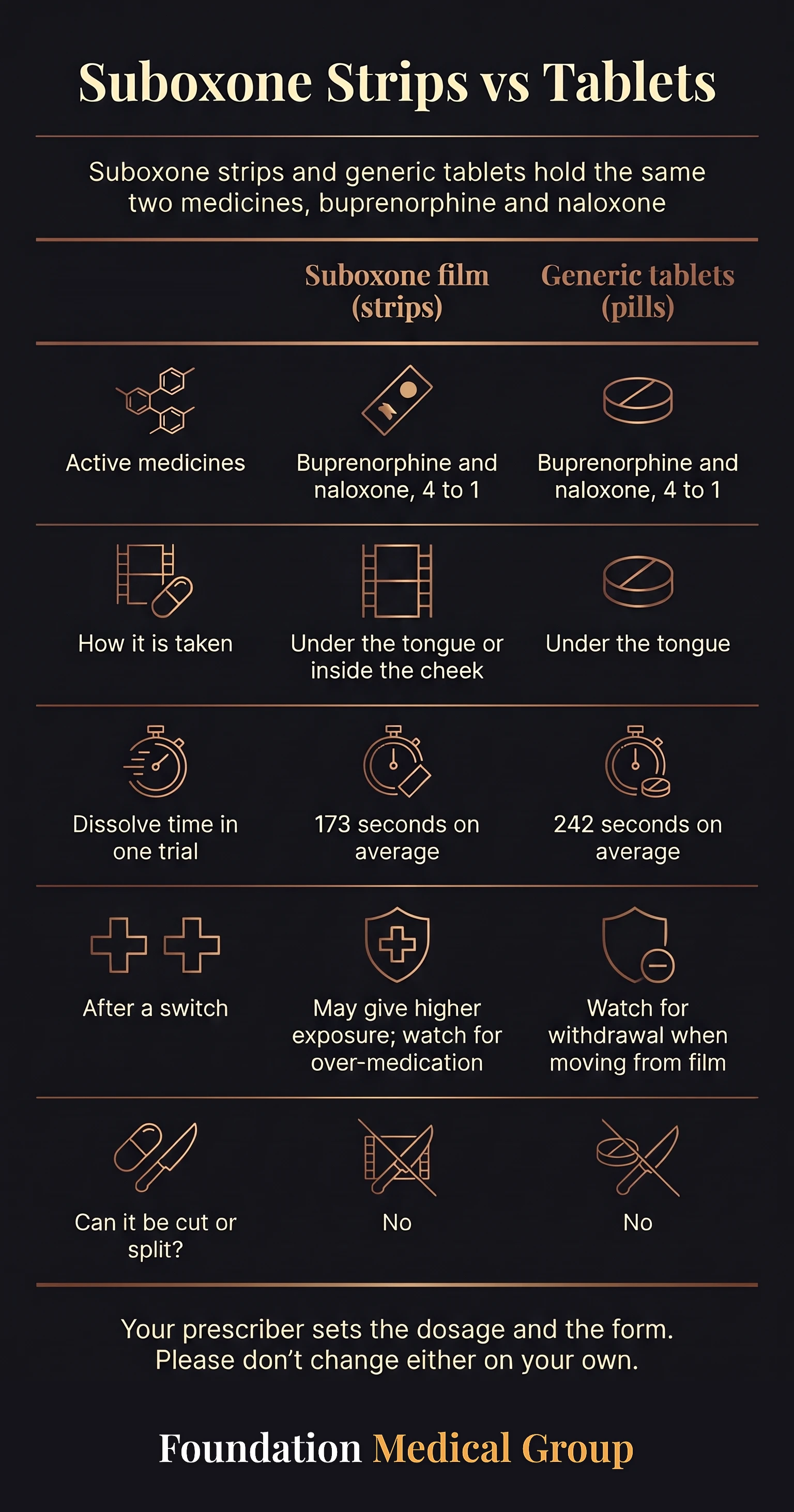
This table puts suboxone film strips and generic tablets side by side. Every row comes from the drug labels or the studies listed in Sources.
| Feature | Suboxone film (strips) | Generic tablets (pills) |
|---|---|---|
| Active medicines | Buprenorphine and naloxone, 4 to 1 | Buprenorphine and naloxone, 4 to 1 |
| Form | Thin film | Small tablet |
| How it is taken | Under the tongue or inside the cheek | Under the tongue |
| Strengths (mg) | 2/0.5, 4/1, 8/2, 12/3 | 2/0.5, 8/2 |
| Dissolve time in one trial | 173 seconds on average | 242 seconds on average |
| After a switch | May give higher exposure; watch for over-medication | Watch for withdrawal when moving from film |
| Exposure of young children in one study | Less frequent | More frequent |
| Can it be cut or split? | No | No |
Your prescriber sets the dosage and the form. Please don’t change either on your own.
Are Suboxone Strips Stronger Than Suboxone Pills?

The short answer: not by design. A strip and a pill with the same milligram strength hold the same amount of buprenorphine and naloxone.
For a direct test, look at a 2013 randomized trial. Lintzeris and colleagues enrolled 92 patients who were already taking buprenorphine and naloxone tablets. Each patient was randomized to tablets or film, without dose changes, for 31 days. Researchers found no significant group differences in subjective dose effects or trough plasma buprenorphine levels. Their conclusion was that the two forms showed dose equivalence.
Now, the labels add a wrinkle. The Suboxone film label says not all strengths and combinations of the film are bioequivalent to Suboxone sublingual tablets. In pharmacokinetic studies, one 8 mg/2 mg film and one 12 mg/3 mg film gave higher relative bioavailability than the same total dose in tablets. Even the generic tablet label notes the potentially greater relative bioavailability of the film.
So no, suboxone strips aren’t stronger pills. But some people may still notice a difference after a switch, and that’s why the prescriber watches closely. If opioid withdrawal symptoms or sleepiness show up after a change, tell your prescriber.
How Long Does It Take for Suboxone Film to Dissolve?
Film dissolves faster than tablets. In the Lintzeris trial, the film took 173 seconds on average to dissolve, compared with 242 seconds for the tablets. That’s roughly a minute less. The spread was wide, though: plus or minus 71 seconds for the film and plus or minus 141 seconds for the tablets. Your own time could be shorter or longer.
The authors also reported improved dispensing times with the film. Dispensing time is how long staff spend on a supervised dose.
How you take the medication also affects how well it works:
- Don’t eat or drink anything until the film or tablet has completely dissolved (both labels say this).
- Swallowing the tablets reduces how much of the drug the body absorbs, per the tablet label.
- Take it the same way each time, as both labels ask, so absorption stays consistent.
Faster dissolving doesn’t mean faster relief, though. The trial found no difference in dose effects between strips and tablets.
Is It Better to Take a Suboxone Strip Sublingual or Buccal?
Neither site wins for everyone. The Suboxone film label allows a suboxone strip to go under the tongue or on the inside of the cheek during maintenance treatment. Across the label’s pharmacokinetic studies, exposure from the two sites was comparable. Once induction is complete, patients can switch between them without significant risk of under or overdosing.
Induction is different. The label says naloxone exposure is somewhat higher after buccal use than after sublingual use, so it recommends the sublingual site during induction to reduce the risk of precipitated withdrawal. That’s sudden opioid withdrawal that can happen when buprenorphine is taken while other opioids are still active, and nobody wants it. Your prescriber tells you when to take the first dose, so you don’t have to guess.
Need more than one strip for a dose? The label explains where to place each one, and our guide on how Suboxone works covers the steps.
Tablets have one site. Under the tongue.
Can You Cut a Suboxone Strip in Half?
No. A common claim online is that strips are easier to cut for a precise taper. Honestly, the labels say otherwise. The Suboxone film label says the film must be taken whole and tells patients not to cut, chew or swallow it. Its patient Medication Guide adds that a cut, torn or chewed film won’t work as well. And the generic tablet label gives the same rule for each tablet: take it whole, and do not cut, chew or swallow it.
Lower doses come from the strengths that exist, not from a pair of scissors. Film comes in 2 mg/0.5 mg, 4 mg/1 mg, 8 mg/2 mg and 12 mg/3 mg units. Generic tablets come in 2 mg/0.5 mg and 8 mg/2 mg. A prescriber builds a taper from these strengths.
Stopping suddenly can cause withdrawal. The film label advises a gradual taper when treatment stops, and it tells patients to work closely with their healthcare provider on the schedule. Please don’t change your dosage alone. Our guide on how to taper off Suboxone explains what a planned taper looks like.
Can You Switch From Suboxone Tablets to Suboxone Film?
Yes, under your prescriber’s care. Both labels say a person switching between the tablets and the film should start on the same dosage as the product they took before. Both also say dose adjustments may be needed.
On direction, the generic tablet label gets specific. Because the film may have greater relative bioavailability, people moving from tablets to film should be monitored for over-medication. People moving from film to tablets should be monitored for withdrawal or other signs of under-dosing. Over on the film label, it’s said in broader terms: watch for over-dosing or under-dosing after a switch.
Lintzeris and colleagues back this approach. Patients moved to film at the same dose had outcomes comparable to those who stayed on tablets. Their trial also found better patient ratings of satisfaction with the film.
In practice, that means we check in after any switch. Tell your prescriber about unusual sleepiness, withdrawal or new symptoms, even ones that seem small. For a fuller list, see our guide to the side effects of Suboxone.
Suboxone Film Strips, Children and Misuse: What Studies Found
Any buprenorphine medicine can seriously harm a child. It’s a scary line to read, but it’s there for a reason. The tablet label warns that buprenorphine can cause severe, possibly fatal, breathing problems in children who are accidentally exposed. Both labels say to store these opioid medicines out of the sight and reach of children.
One study compared the forms. Lavonas and colleagues reviewed US poison center and manufacturer safety reports for children under 6 from October 2009 to March 2012. Exposures to the combination film were significantly less frequent than to buprenorphine tablets (rate ratio 3.5) and combination tablets (rate ratio 8.8). Most often, the root causes were medicine stored in sight, taken from a bag or purse, or kept out of its original packaging.
Misuse data point the same way. In one surveillance study using data through 2012, rates of abuse and diversion for the combination film were significantly lower than for either tablet type in every program studied. Still, that’s one study. It isn’t proof that the film prevents addiction or misuse.
Dental Problems With Suboxone Film and Tablets: FDA Warning
This warning covers both forms. In January 2022, the FDA warned that buprenorphine medicines dissolved in the mouth have been linked to dental problems, including tooth decay, cavities, oral infections and loss of teeth. These problems have been reported even in people with no history of dental issues, which is frustrating if you’ve always looked after your teeth.
The FDA gives simple steps:
- After the film or tablet has completely dissolved, take a large sip of water, swish it gently around your teeth and gums, and swallow.
- Wait at least 1 hour before brushing your teeth.
- See a dentist soon after starting the medication, tell them you take buprenorphine, and keep regular checkups.
- Any problems with your teeth or gums? Tell your prescriber and your dentist right away.
The FDA also says the benefits of buprenorphine medicines clearly outweigh the risks, particularly in the treatment of opioid use disorder. So don’t stop the medicine because of this warning without talking to your prescriber.
Is Zubsolv the Same as Suboxone?
No. Zubsolv is a different buprenorphine and naloxone sublingual tablet, and its strengths are written with different numbers. The Zubsolv label says one Zubsolv 5.7 mg/1.4 mg tablet provides equivalent buprenorphine exposure to one Suboxone 8 mg/2 mg sublingual tablet. Its switching table applies the same conversion to generic equivalents.
Put simply, the dosage on the box doesn’t match from one product to the next. Don’t swap one product for another at the same number. If a change is needed, your prescriber converts the dose.
Cost and Insurance for Suboxone Pills and Strips

Cost depends on your insurance plan, your pharmacy and the form your prescriber chooses, so we don’t list a price here. So ask. Your pharmacy and your plan can tell you what applies to suboxone pills and strips.
Common plans by state for Suboxone treatment at our clinics, each marked call to confirm coverage:
- Virginia: Virginia Medicaid, Aetna, Anthem, Cigna, Sentara Health Plans, TRICARE and UnitedHealthcare (call to confirm coverage). The Richmond clinic does not accept Medicare.
- Texas: Texas Medicaid, Aetna, Blue Cross Blue Shield, Cigna, Humana, Medicare, TRICARE and UnitedHealthcare (call to confirm coverage).
- Utah: Aetna, Blue Cross Blue Shield and SelectHealth (call to confirm coverage).
- Georgia: Cigna (call to confirm coverage).
Coverage varies by plan, so call us at (800) 983-1974 before your visit.
Suboxone Treatment for Opioid Addiction at Foundation Medical Group
Foundation Medical Group offers opioid addiction treatment at all four of our clinics. Richmond, Virginia offers medication assisted treatment. American Fork, Utah, Decatur, Georgia and Dallas, Texas offer Suboxone treatment. Want the details? Our page on buprenorphine treatment has them.
Your prescriber chooses the form, film or generic tablets, with you. That choice usually rests on the facts above: how each form is taken, the strengths available, how you respond after a switch and who else lives in your home.
Buprenorphine and naloxone sublingual products treat opioid use disorder, not pain. Both labels say they aren’t appropriate as a pain medicine.
Medicine is one part of addiction recovery. SAMHSA says buprenorphine should be prescribed as part of a full treatment plan that includes counseling and other services. For anyone facing opiate addiction, or opioid use that has taken over daily life, treatment that pairs medication with support can ease craving and help you build a steadier routine.
Key Takeaways
- Suboxone strips and generic tablets hold the same two medicines, buprenorphine and naloxone, and a randomized trial found equal dose effects.
- Film dissolved faster in that trial: 173 seconds on average, against 242 seconds for the tablets.
- The film goes under the tongue or inside the cheek; tablets go under the tongue only.
- Neither form may be cut, chewed or swallowed. A taper uses the strengths that exist.
- After any switch, your prescriber watches for over-medication or withdrawal. Protect your teeth, and store every form out of children’s reach.
Sources
- DailyMed, SUBOXONE (buprenorphine hydrochloride, naloxone hydrochloride) film, soluble
- DailyMed, Buprenorphine and naloxone tablet
- Lintzeris N, et al. A randomised controlled trial of sublingual buprenorphine-naloxone film versus tablets in the management of opioid dependence. Drug Alcohol Depend. 2013.
- Lavonas EJ, et al. Root causes, clinical effects, and outcomes of unintentional exposures to buprenorphine by young children. J Pediatr. 2013.
- Lavonas EJ, et al. Abuse and diversion of buprenorphine sublingual tablets and film. J Subst Abuse Treat. 2014.
- SAMHSA, What is Buprenorphine? Side Effects, Treatment & Use
- FDA, FDA warns about dental problems with buprenorphine medicines dissolved in the mouth to treat opioid use disorder and pain
- DailyMed, ZUBSOLV (buprenorphine hydrochloride and naloxone hydrochloride) tablet, orally disintegrating