If you’re worried about the cost of Suboxone treatment in Dallas, take a breath. For most people it costs far less than they expect. You’re really paying for just three things: the medicine, your visits with the doctor, and a few lab tests. With Texas Medicaid or most insurance, your share is often small.
The scary part usually isn’t the price. It’s not knowing what the price is. So let’s make it clear. Below we break down each cost in plain terms, show what you might pay, and point you to the cheapest ways to get care. For what treatment itself looks like, see our Suboxone doctor in Dallas page.
What You Pay For
Suboxone care isn’t one big bill. It’s a few small costs that come back each month. When you know the parts, the price stops feeling scary.
- Your first visit. This one takes longer. The doctor learns your story, confirms the diagnosis, and builds your plan.
- Follow-up visits. These happen more often at first, then less as you feel steady. Many are quick, and a lot can be done by video.
- The medicine. The generic version, buprenorphine-naloxone, works the same as the brand and costs much less.
- A few lab tests. Simple checks that keep your care safe.
According to the Substance Abuse and Mental Health Services Administration (SAMHSA), this medicine is the standard of care for opioid use disorder. That’s a big reason most insurance and Medicaid plans pay for it.
Here’s the part that surprises people. The medicine is the cheap bit. Medicaid publishes a survey called the National Average Drug Acquisition Cost, which tracks what retail pharmacies across the country actually pay for a drug. In the file effective 17 December 2025, generic buprenorphine-naloxone 8 mg/2 mg film came in at $1.94 a film. One film a day for 30 days is about $58 of pharmacy cost. The sublingual tablet version ran cheaper still, $0.72 a tablet, or roughly $22 a month. That’s what the pharmacy pays, not your price at the counter. But it tells you where the money in your bill is not going.
What It Might Cost in Dallas

Prices change from clinic to clinic and depend on your plan. So treat the table below as a rough guide, and ask the clinic for exact numbers before you book.
| What you pay for | With Texas Medicaid | With insurance | Paying cash |
|---|---|---|---|
| First visit | $0 or a small amount | A set fee your plan asks for | Your biggest cost that month |
| Follow-up visit | $0 or a small amount | A small set fee | Lower, and cheaper by video |
| Medicine (generic) | Covered, very little | A small pharmacy fee | Low when you use the generic |
| Lab tests | Usually covered | Depends on your plan | Billed on their own |
The pattern is simple. With Medicaid, most of it’s covered. With insurance, you pay small set fees. Paying cash, your visit is the main cost, because the generic medicine is cheap.
Your dose moves that medicine line too. The FDA label for Suboxone film puts the usual maintenance range at 4 mg/1 mg to 24 mg/6 mg a day, and 16 mg/4 mg is where a lot of people settle. Two 8 mg/2 mg films a day costs about twice what one does. Strengths aren’t priced evenly either: in that same December file, one 12 mg/3 mg film was $4.27, versus $8.31 for three 4 mg/1 mg films that add up to the identical dose. Worth one question to your pharmacist.
How Medicaid and Insurance Lower the Cost
If you’ve got Texas Medicaid, you’re in good shape. Texas Medicaid pays for this medicine and these visits for people with opioid use disorder. That usually means little or no cost when you see a doctor who takes Medicaid.
If you have insurance from work or the marketplace, your plan very likely covers the medicine. What you pay depends on your plan. Two quick phone calls save real money: ask the clinic if they take your plan, and ask your insurance what a specialist visit costs you. Our Suboxone doctor in Texas that accepts Medicaid guide walks through the coverage steps.
If You Are Paying Cash
No insurance? You can still get care, and it may cost less than you think.
- Ask for the generic. Same active ingredients, a fraction of the price, and a free pharmacy discount card can drop it further. Compared with a brand-name film, the generic is the single biggest lever you have on this bill.
- Choose video visits. They often cost less and save you the drive and time off work.
- Ask about income-based fees. Some clinics set the price by what you can afford, or charge one flat monthly fee.
- Look for community programs. Local and state programs sometimes cover part of the cost if you qualify.
Staying in treatment is also what the outcome data rewards, and the size of the gap is hard to ignore. A 2017 BMJ meta-analysis by Sordo and colleagues pooled 19 cohorts and found all-cause mortality of 4.3 per 1,000 person-years while people stayed on buprenorphine, compared with 9.5 per 1,000 after they left treatment. Overdose deaths ran 1.4 versus 4.6. Put bluntly, the expensive month is the one where you drop out.
Costs People Forget to Ask About
The first price you’re quoted isn’t the whole price. A few questions up front stop surprises.
Ask if lab tests, such as a urine drug screen, are billed on their own, and how often they’re done. Ask what happens if you miss a visit, since some clinics charge a fee. If you pay cash, ask whether the visit fee includes your prescription. And check the pharmacy price of your exact strength, because the same film can differ by a few dollars from one pharmacy to the next. Ask specifically about visit frequency, too. Early on, appointments are often weekly, and that is when the running cost is highest. Later, once you’re steady, many patients move to monthly check-ins.
How to Keep It Affordable
Cost isn’t just about month one. A few simple habits keep your care easy to afford.
- Keep your visits. Missing them can restart fees or stop your prescription, which costs more later.
- Fill the generic at the same low-cost pharmacy and use a discount card when you pay cash. Switching pharmacies mid-month is where people get caught out.
- Switch steady check-ins to video once your doctor says you’re ready.
- Keep your insurance details up to date so claims aren’t denied over small mistakes.
- Check your plan each year, since costs can change in January.
Is the Cheapest Choice the Best?
The lowest price isn’t automatically the better deal. Suboxone works with real, caring, doctor-led support behind it, not a rushed prescription. A slightly higher fee that comes with careful check-ins and honest help often prevents bigger, costlier setbacks down the road.
At Foundation Medical Group, care is led by a physician and built for the long run. Tools like brain mapping in Dallas can help make your plan more personal. The goal is simple: care you can afford to stay in, month after month.
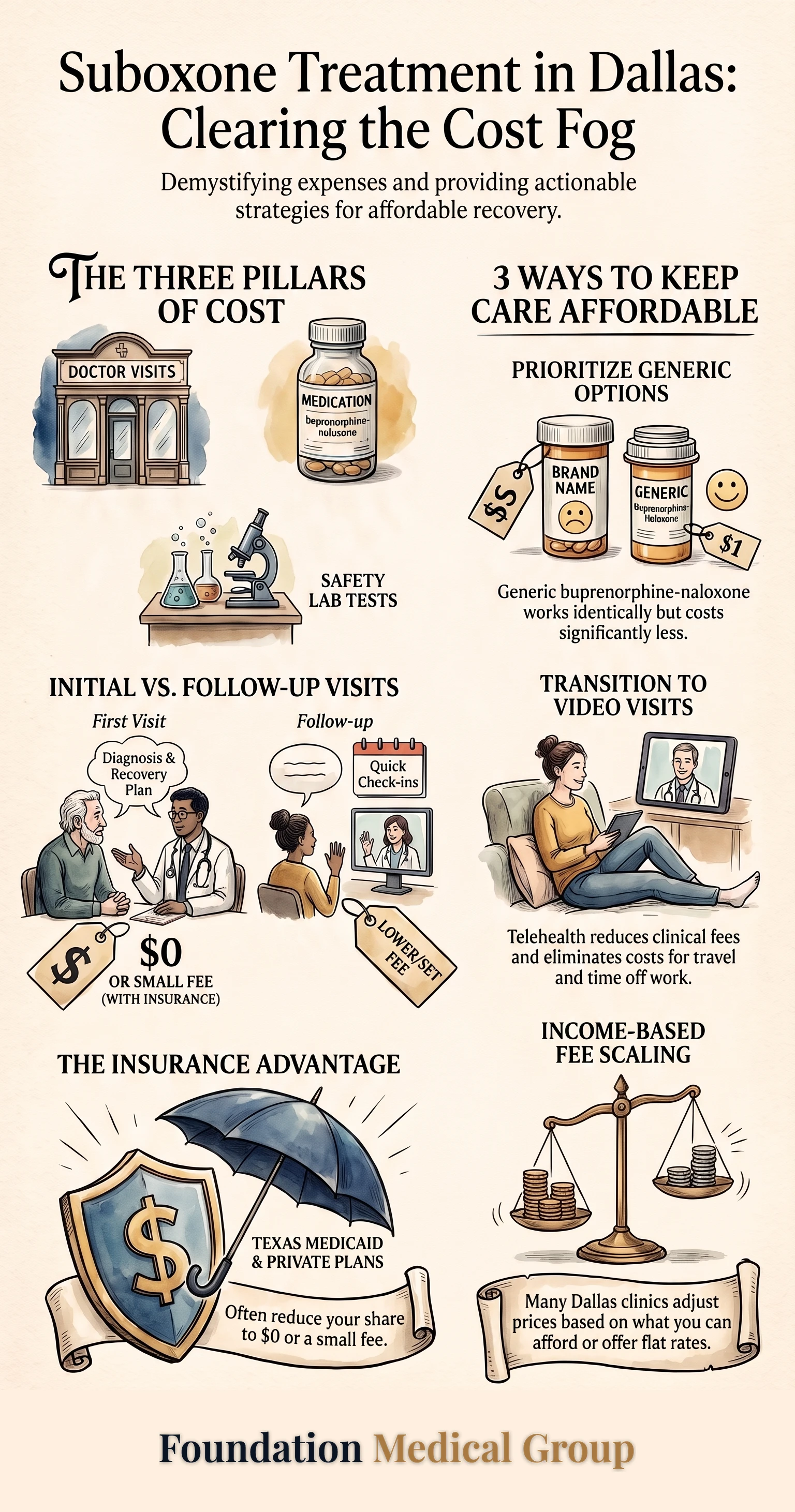
Infographic: What Suboxone Treatment Really Costs in Dallas
Frequently Asked Questions
Does insurance cover Suboxone treatment in Dallas?
Yes. Texas Medicaid and most insurance plans pay for Suboxone care for opioid use disorder. What you pay depends on your plan and whether the clinic takes it, so check both before your first visit.
How much is Suboxone without insurance?
If you pay cash, the visit is the main cost, because the generic medicine is cheap. Video visits, income-based fees, and pharmacy discount cards can lower the total even more.
Is the generic as good as brand-name Suboxone?
Yes. Generic buprenorphine-naloxone has the same active ingredients and works the same way. It just costs less, which is why most doctors prescribe it.
Are there free or low-cost Suboxone programs in Texas?
Yes. Some community and state programs help cover care for people who qualify, and Texas Medicaid pays for this treatment, so many people pay little or nothing.
Does a video visit make Suboxone treatment cheaper?
Often, yes. Video follow-up visits usually cost less than in-person ones and save you travel and time off work, while keeping you close to your care team.
Key Takeaways and Next Steps
Here’s what to hold on to. Suboxone treatment in Dallas comes down to three costs: the first visit, follow-ups, and the generic medicine. With Texas Medicaid or most insurance, your share is usually small. Paying cash, the visit is your main cost, and video visits plus a pharmacy discount card bring it down further.
- Ask the clinic two questions before you book: do you take my plan, and what will my first visit cost.
- Request the generic, buprenorphine-naloxone, by name. At under $2 a film in the national acquisition survey, it keeps the medicine line small.
- Move steady check-ins to video once your doctor says it’s fine.
- Don’t let cost stop you. Ask about income-based fees and community programs if money’s tight.
Ready to start? Reach out to Foundation Medical Group and ask what your first visit would cost. One call is all it takes to turn the unknown price into a real, affordable plan.
Sources
- Substance Abuse and Mental Health Services Administration (SAMHSA), Buprenorphine.
- Medicaid.gov, National Average Drug Acquisition Cost (NADAC) 2026 file.
- FDA prescribing information for Suboxone sublingual film, via DailyMed.
- Sordo et al., Mortality risk during and after opioid substitution treatment, BMJ 2017.
- Texas Medicaid and Healthcare Partnership (TMHP).