
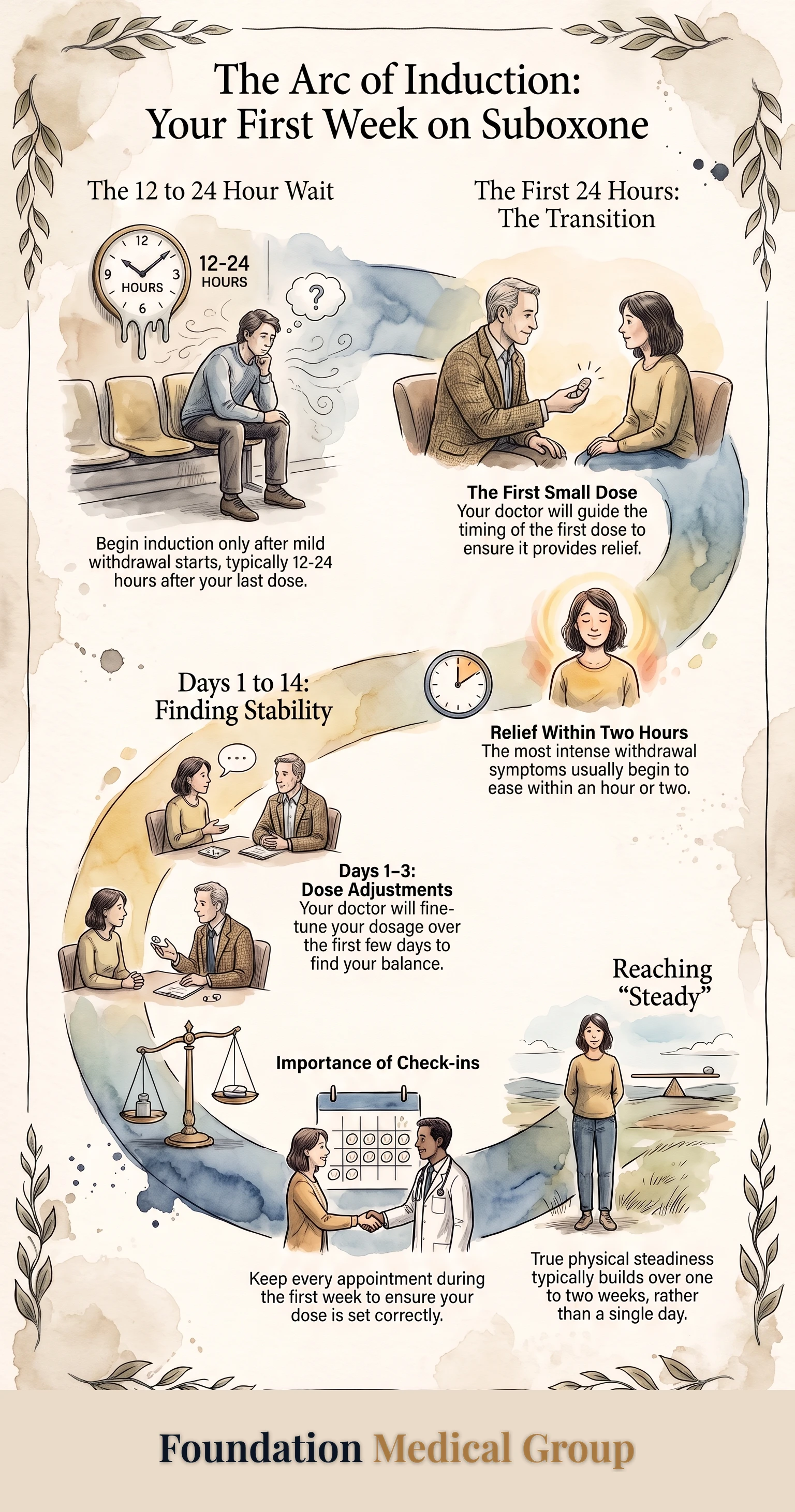
Here’s the short version of what the first days feel like. You wait until you’re in mild withdrawal, usually 12 to 24 hours after your last opioid dose. Then, with your doctor guiding the timing, you take your first small dose of Suboxone. Within an hour or two, the worst of the withdrawal starts to ease. Over the next few days your dose is adjusted until you feel steady.
That’s the whole arc of Suboxone induction. It sounds simple, and in many ways it is. But the not-knowing is what scares people most. So let’s walk through it slowly, hour by hour and day by day, so nothing catches you off guard. For where to begin, see our guide to Suboxone doctors near you that accept Medicaid.
Why You Start Suboxone in Mild Withdrawal
This part surprises a lot of people. You don’t take your first dose while you still feel fine. You wait until you’re already in mild withdrawal. It feels backward, but there’s a good reason.
Suboxone contains buprenorphine. It grabs onto the same spots in your brain that opioids use, the mu receptors, and it holds on tightly while only partly switching them on. If a full opioid is still sitting there, buprenorphine can shove it off fast. That sudden swap can trigger something called precipitated withdrawal, which feels worse for a short while.
So your doctor asks you to wait. The Suboxone label puts a floor under that wait: start only when clear objective signs of withdrawal show, and not less than 6 hours after your last opioid dose. In practice most teams wait longer. Around 12 hours after a short-acting opioid, at least 24 hours after a long-acting one, and 48 to 72 hours after a fentanyl patch comes off. Being in mild withdrawal means those brain spots are mostly open, so the medicine settles in instead of shoving. That’s why timing matters so much, and why your doctor guides it.
The COWS Idea in Plain Words

Your care team needs a way to know you’re ready. They use a simple checklist called the COWS, short for the Clinical Opiate Withdrawal Scale. Don’t let the name worry you. It’s just a score.
The team looks at 11 signs your body gives off in early withdrawal. Things like a runny nose, a fast pulse, sweating, goosebumps, yawning, an upset stomach, tremor, and restless feelings. Each one gets a small number. Add them up and you get a total somewhere between 0 and 47.
Here is roughly how those totals read. A score of 5 to 12 counts as mild withdrawal. 13 to 24 is moderate. 25 to 36 is moderately severe, and anything above 37 is severe. Most teams want to see you somewhere in the mild-to-moderate range, which one clinical reference frames as a COWS of at least 5 to 24, before the first dose goes under your tongue.
A higher score means you’re further into withdrawal and likely ready to start. According to the Substance Abuse and Mental Health Services Administration (SAMHSA), starting buprenorphine once clear withdrawal signs appear helps the first dose go smoothly. Your doctor reads the score with you. You’re not doing this alone.
Induction Day, Hour by Hour
Induction is just the word for starting the medicine. Here’s how the day often flows. Remember, your own timing may shift, and your doctor leads it.
- You wait for withdrawal. Usually 12 to 24 hours after your last short-acting opioid, and not less than 6. Longer-acting ones may need 24 hours or more.
- The team checks your COWS score. Once you’re in that mild-to-moderate band, you’re cleared to begin.
- You take your first small dose. Typically 2 mg/0.5 mg or 4 mg/1 mg. It goes under your tongue and dissolves. You don’t chew or swallow it.
- You wait about 2 hours. The team watches how you feel and whether the withdrawal eases.
- A second dose may follow. Your doctor may add another 2 or 4 mg, working up toward 8 mg/2 mg across day 1 if you still feel rough.
Day 2 usually brings a single dose of up to 16 mg/4 mg, and from there your dose settles somewhere between 4 mg/1 mg and 24 mg/6 mg per day. Most people feel a real shift on day one. The shaking, the sweating, the deep ache: they start to fade. That first bit of relief is often the moment people realize this can actually work.
Days 1 to 3: Finding Your Dose
The first few days are about dialing in the right amount. Not too little, not too much. The dose that holds you steady all day.
| Time | What’s happening | What you might feel |
|---|---|---|
| Hour 0 | You’re in mild withdrawal | Restless, achy, uneasy |
| Hours 1 to 2 | First dose is working | Relief begins, calmer |
| Day 1 | Dose is being set | Steadier, cravings ease |
| Days 2 to 3 | Dose is fine-tuned | More like yourself |
| Days 4 to 7 | Settling in | Sleep and appetite return |
Small bumps are normal in these days. You might feel a little off, tired, or moody as your body adjusts. Tell your care team about any of it. That feedback is how they get your dose just right.
One thing that surprises people: going too slowly has its own cost. The label notes that in some studies a too-gradual induction spread over several days led to a high drop-out rate during that first week. So if your doctor moves faster than you expected, that’s usually the reason, not impatience.
The First Week: Settling In

By the end of week one, most people feel a big change. The physical withdrawal is largely behind you. The all-day pull toward using starts to quiet down.
This is when little things come back. You sleep through the night again. Food sounds good. Your mind feels less foggy. None of it is dramatic. It’s more like the volume slowly turning down on everything that felt loud.
The chemistry helps here. Buprenorphine has a mean elimination half-life of 24 to 42 hours, so one daily dose carries you the whole day rather than climbing and crashing. The naloxone alongside it clears much faster, in 2 to 12 hours, and it’s mostly there to discourage injection.
Research from the National Institute on Drug Abuse (NIDA) shows that medicines like buprenorphine ease cravings and withdrawal so people can focus on recovery. And the stakes of staying on it are measurable: a 2017 meta-analysis in The BMJ pooled 3 buprenorphine cohorts covering 15,831 people and found 4.3 deaths per 1,000 person-years during treatment, compared with 9.5 after people left. That’s the real gift of this week. Your energy stops going toward just getting through the hour. If you’re in Texas, our Suboxone clinic in Texas page shows what ongoing care looks like.
When You Start to Feel Steady
Feeling steady doesn’t happen on one exact day. It builds. For many people, somewhere in the first week or two, things click into place. Your dose holds. The cravings fade into the background. You start thinking past today.
Keep your check-ins during this time. They matter more than they seem. Your doctor makes small tweaks, answers your questions, and catches problems early. Steady care is what turns a good first week into a solid recovery.
And be patient with yourself. Some days feel great and some feel ordinary, and both are fine. The point isn’t to feel flawless. It’s to feel well enough to build a life again, one steady day at a time.
Infographic: Your Suboxone Induction and Early Recovery Timeline
Frequently Asked Questions
How long after my last dose do I start Suboxone?
Usually 12 to 24 hours after your last short-acting opioid, once mild withdrawal appears. Longer-acting opioids may need more time. Your doctor sets the exact timing based on your situation, so never guess on your own.
What is precipitated withdrawal?
It’s a sudden, sharper withdrawal that can happen if you take Suboxone too soon. Starting in mild withdrawal, as your doctor directs, is what helps you avoid it. That’s the whole reason for the wait.
Will the first dose take away all my withdrawal?
Often it eases the worst of it within an hour or two. You may still feel a little off for a day or so while your dose is set. That’s normal, and it improves fast as your team fine-tunes things.
How soon will I feel steady on Suboxone?
Many people feel a big shift by the end of the first week. Feeling truly steady often builds over the first week or two. Keeping your check-ins helps your doctor get your dose right sooner.
Do I have to start Suboxone in a clinic?
Not always. Some people begin at home with close guidance from their doctor. Whether in person or by video, the key is following your care team’s timing. They guide every step, and you can always reach them with questions.
Key Takeaways and Next Steps
Here’s what to hold on to. Suboxone induction follows a clear path. You wait for mild withdrawal, take your first small dose with your doctor’s guidance, and feel real relief within an hour or two. Over the first week your dose is fine-tuned, and you slowly settle into feeling steady.
- Start only when you’re in mild withdrawal, and let your doctor guide the timing.
- Expect real relief on day one, and small adjustments over the first few days.
- Keep every check-in, since that’s how your dose gets set just right.
- Be patient with yourself, because feeling steady builds over a week or two, not one day.
Ready to take the first step? Reach out to Foundation Medical Group and ask what starting treatment would look like for you. A caring, physician-led team can walk you through every hour of that first day. This medicine works best with real support, rather than a rushed prescription.
Sources
- FDA prescribing information, Suboxone sublingual film: https://www.accessdata.fda.gov/drugsatfda_docs/label/2025/022410s057lbl.pdf
- StatPearls, Clinical Opiate Withdrawal Scale: https://www.ncbi.nlm.nih.gov/books/NBK526012/
- StatPearls, Buprenorphine: https://www.ncbi.nlm.nih.gov/books/NBK459126/
- Sordo and colleagues, Mortality risk during and after opioid substitution treatment, The BMJ (2017): https://pmc.ncbi.nlm.nih.gov/articles/PMC5421454/