
A Subutex clinic in Atlanta that takes Cigna offers buprenorphine care for opioid use disorder. That means doctor-led medication assisted treatment, therapy, and a recovery plan. Patients often weigh a Subutex provider against a suboxone clinic, matching detox, rehab, and coverage to what a Cigna plan will pay for, whether care runs outpatient or online.
Finding the right treatment can feel overwhelming. This guide explains Subutex and suboxone treatment options. It explains how Cigna insurance and other health insurance plans typically work. It also explains what to expect from modern addiction care, including how to choose a qualified suboxone doctor or Subutex doctors who work within your insurance network.
It also weighs care in person against care on screen, so you can match a plan to your benefits and to the week you actually have. Good recovery planning covers a lot of ground. Monitoring and education. Support, goals, and timelines. Check-ins, coordination, and the milestones you hit. Setbacks too, plus the adjustments that follow, accountability, resources, continuity, and the outcomes at the end of it.
Introduction
This guide is for adults seeking treatment for opioid use disorders and related mental health treatment needs. Many readers search for a subutex clinic atlanta cigna option or want clear cigna healthcare information before starting care. Others want to understand how health insurance affects access to detox, rehab, and therapy.
Across outpatient settings, patients often use suboxone treatment or Subutex as part of a broader addiction treatment program. These programs are designed to work with health insurance, including cigna health insurance and plans offered under the affordable care act. Understanding coverage rules and mental health treatment support helps reduce delays and frustration.
Patients tell me the hardest part is not the medication. It’s the paperwork, the phone calls, and the waiting. A couple of months back, a patient delayed care for three weeks because they assumed Cigna wouldn’t cover treatment.
It did. That delay mattered. Early access often improves outcomes, especially during detox and stabilization.
Why Early Engagement Matters
Starting sooner lowers medical risk, and the gap between treated and untreated is measurable. A BMJ meta-analysis of 19 cohorts followed 15,831 people on buprenorphine. All-cause deaths ran 4.3 per 1,000 person-years during treatment, against 9.5 out of it. Overdose deaths ran 1.4 versus 4.6. The riskiest stretch is the one right after someone leaves care. In Georgia, CDC provisional counts recorded 1,664 drug overdose deaths in the 12 months ending December 2025, down from 2,520 two years earlier. Opioid-involved deaths fell from 1,843 to 929. Getting answers early helps people move instead of wait.
What Is Subutex and How Is It Different From Suboxone?
Subutex is a buprenorphine-only drug for opioid use disorder. It comes as a sublingual tablet in 2 mg and 8 mg strengths. Buprenorphine cuts cravings and withdrawal while the brain steadies. Here’s a detail worth knowing at the pharmacy counter. The brand name Subutex tablet is listed as discontinued in the FDA’s Drugs@FDA database under NDA 020732, approved 8 October 2002. What gets handed over today is generic buprenorphine.

Suboxone pairs buprenorphine with naloxone, and it anchors most suboxone treatment plans. The naloxone lowers misuse risk, which is why many rehab providers reach for it first. Both drugs turn up in detox, in the handover out of inpatient care, and in outpatient programs that health insurance pays for.
Searches for suboxone treatment near me usually mean someone wants care that’s both safe and covered. A 2020 study of 40,885 people in JAMA Network Open compared treatment pathways. Only buprenorphine or methadone tracked with lower overdose risk, at an adjusted hazard ratio of 0.24 at 3 months and 0.41 at 12 months. Residential detox and behavioral therapy on their own showed no such benefit. Insurance rules, safety, and your provider’s read all shape the final call.
How Buprenorphine Works in the Brain
Buprenorphine is a partial opioid agonist. It switches opioid receptors on just enough to stop withdrawal, and not enough for a strong high. The FDA label puts that ceiling between 8 mg/2 mg and 16 mg/4 mg of buprenorphine-naloxone. Past that point, more dose doesn’t mean more effect. Its mean half-life of 24 to 42 hours is why one daily dose holds, where a short-acting opioid wears off in hours.
Here’s what happens in real life. Patients usually feel relief from withdrawal within one to two hours during induction. Cravings drop. Sleep improves.
Focus returns. These changes make therapy and rehab participation possible, which is kind of the whole point.
When Is Subutex Prescribed Instead of Suboxone?
Subutex is common in pregnancy, where clinicians often prefer the buprenorphine-only product. The FDA label flags neonatal opioid withdrawal syndrome as an expected and treatable outcome of long opioid use in pregnancy. An obstetric team plans for that. They don’t dodge it by stopping the medicine. Health insurance plans, Cigna included, often back this approach.
The other reason is a bad reaction to naloxone, or the early days of detox. During induction, or in a tricky case, a provider may put you on Subutex inside a structured program. That call rests on safety, on your mental health needs, and on what your cigna insurance covers.
I’ve seen providers also use Subutex short term during hospital discharge. Not forever. Just long enough to stabilize and transition to outpatient care. It depends. Always does.
Common Side Effects and Monitoring
Most patients tolerate Subutex well, but side effects can happen. Nausea, headache, and constipation are the most common, especially during the first week. Clinics monitor symptoms closely and adjust dosing when needed.
Regular check-ins matter. Providers may use urine testing and symptom tracking to ensure safety and progress. That structure reassures both patients and insurers, which helps maintain coverage.
Subutex and Suboxone Care With Cigna Insurance
Many clinics work straight with cigna healthcare to line up benefits and check coverage. Under a cigna insurance plan you can usually get suboxone treatment, therapy, and lab work. Employer plans through the cigna group may cover more. And Cigna publishes its medical coverage policies openly, so you can read the criteria before you pick up the phone.
Retention is the honest sticking point, whoever runs the clinic. A 2024 JAMA study followed 30,891 people starting treatment. By 24 months, 88.8 percent of those on buprenorphine-naloxone had stopped, against 81.5 percent of those on methadone. Nobody’s numbers are pretty here. What you can check is concrete rather than reputational: ask how often you’ll be seen, who covers your script when the prescriber is away, and what the clinic does when someone misses a week. Ask for cigna group information before intake and you’ll know the costs going in.
What a Typical Cigna-Supported Visit Looks Like
Most outpatient visits include a medical evaluation, medication management, and therapy planning. Visits often last 30 to 60 minutes. Some plans allow weekly visits early on, then monthly follow-ups once stable.
Telehealth keeps growing, and in 2025 the federal rules caught up. A DEA and HHS final rule published on 17 January 2025 allows an initial six-month supply of buprenorphine through telemedicine, audio-only included. The prescriber has to check the state prescription drug monitoring program first, and the pharmacist verifies your identity at pickup. The wider COVID-era flexibilities were extended a fourth time, through 31 December 2026. Cigna still covers many video visits, above all for follow-up care. That matters if you work, or care for someone at home.
Copays, Deductibles, and Real Costs
Here’s where things get personal. Copays for visits may range from 20 to 50 dollars, depending on the plan. Deductibles can apply early in the year, then drop off once met.
Pharmacy costs vary too, and the spread is wider than most patients expect. In 2024 Medicare Part D data, generic buprenorphine sublingual tablets averaged $40.34 per prescription. Generic buprenorphine-naloxone came to $122.89. Brand Suboxone film ran $473.05, Zubsolv $521.71, and a Sublocade injection $2,025.69. Check both your medical and your pharmacy benefits. One phone call can save you hundreds.
How Cigna Covers Treatment and Rehab Services
Cigna insurance may cover office visits, medication, and counseling as part of an addiction treatment program. What Cigna cover depends on the policy, prior authorization rules, and whether care is outpatient treatment or inpatient treatment. Many plans also support mental health treatment under parity laws.
When you read your benefits, three lines matter first. Medical coverage, pharmacy coverage, and behavioral health coverage. Then check telehealth, outpatient, and inpatient coverage. After that come rehab and detox coverage, therapy and medication coverage, follow-up and emergency coverage, and the cover for pregnancy and for moving between levels of care. Together those lines mark out the full scope.

Cigna rehab coverage can take in intensive outpatient, partial hospitalization program services, and inpatient treatment when it’s medically needed. Read the cigna healthcare information, or ask a healthcare provider to confirm what you have. Clear answers take a lot of the stress out.
Health insurance plans under the affordable care act must include substance use and mental health treatment as essential benefits. That requirement often expands access to rehab, group therapy, and family therapy across many Cigna plans.
Prior Authorization and Common Requirements
Some Cigna plans require prior authorization for inpatient treatment or extended rehab. This usually means the provider submits clinical notes showing medical necessity. It sounds intimidating, but clinics handle this daily.
Common requirements include documented opioid use disorder, prior treatment attempts, and co-occurring mental health treatment needs. Approval decisions often come within three to five business days. Delays happen, but appeals are common and often successful.
Appeals and Coverage Denials
Denials are frustrating. I won’t sugarcoat that. But an appeal is not a formality, and clinics that submit them regularly get a meaningful share overturned.
Providers usually manage appeals by adding documentation or clarifying treatment goals. Persistence pays off. Plenty of patients quit too early here. Staying engaged often changes the outcome.
Comparing Treatment Options and Levels of Care
You’ll usually choose between outpatient treatment, an intensive outpatient program, and inpatient treatment. An intensive outpatient program lets you sleep at home while you attend set therapy several days a week. A partial hospitalization program packs in more hours, still with no overnight stay.
Methadone is the other main option for opioid use disorders. Both it and buprenorphine support recovery. Methadone usually comes through a specialist clinic, though. Some health insurance plans cover it outright. Others want specific authorization first.
Different rehab levels meet different needs. Treatment options should always align with medical history, mental health treatment needs, and health insurance benefits.
Choosing the Right Level of Care
Here’s the thing. More care is not always better. Someone with stable housing and mild symptoms may succeed in outpatient treatment. Another person with relapse history and depression may need inpatient treatment first.
The X:BOT trial shows why matching matters. Of 570 participants, 94 percent assigned buprenorphine-naloxone were started on it successfully. Among those assigned extended-release naltrexone, 72 percent were. Most of the gap in 24-week relapse, 57 percent against 65 percent, traced back to those failed starts. Providers use assessments, not guesswork. And yes, insurance plays a role, but clinical need comes first.
Transitioning Between Levels of Care
Many patients move between levels over time. Inpatient to outpatient. Intensive outpatient to monthly follow-ups. These transitions are planned, not random.
Cigna often supports step-down care when progress is documented. That continuity reduces relapse risk and keeps momentum going.
Insurance Networks and Accepted Plans
Many rehab centers work with multiple insurers. In addition to Cigna, some providers accept united healthcare and beacon health options. Insurance accepted policies vary, so verification matters.

Cigna insurance coverage may not match united healthcare benefits, above all for inpatient treatment or a long rehab stay. Ask the healthcare provider to put it in writing. That’s what keeps a billing fight from landing on you later.
In-Network vs Out-of-Network Care
In-network providers usually cost less. Copays and deductibles are lower. Out-of-network care may still be covered, but at a higher cost.
Some patients choose out-of-network clinics for specialized services. That can work, but only after reviewing benefits. Sound familiar? Surprise bills are a common complaint. Verification upfront saves headaches later.
Integrating Therapy and Mental Health Treatment
Medicine alone is rarely a whole life, though it does the heaviest lifting on overdose risk. Most programs pair suboxone treatment with therapy, group work, and mental health care. It’s worth knowing what counseling did and didn’t add in the POATS trial. At week 12, 49.2 percent of participants succeeded while taking buprenorphine-naloxone, with no difference between the counseling arms. Eight weeks after tapering off the medicine, success dropped to 8.6 percent.
Family therapy helps too, mostly by fixing how a household talks to itself. Rehab programs that treat anxiety, depression, and trauma next to addiction medicine hold up better over years. Health insurance often pays for that work when it sits inside one joined-up plan.
Addressing Co-Occurring Disorders
Anxiety, PTSD, and depression turn up constantly alongside opioid use disorder, and treating one without the other rarely holds. Access is the wider problem: NIDA reports that fewer than 1 in 5 people with opioid use disorder receive any of these medications at all.
Integrated care means one team, one plan. Patients attend therapy, receive medication, and adjust treatment together. It’s smoother. And honestly, less exhausting.
Practical Therapy Options Patients Use
Cognitive behavioral therapy is common. So is motivational interviewing. Group therapy helps patients realize they’re not alone.
Many plans cover weekly sessions early in treatment. Over time, frequency may decrease as skills improve. Progress feels real then.
Infographic: Treatment Pathways and Insurance Support
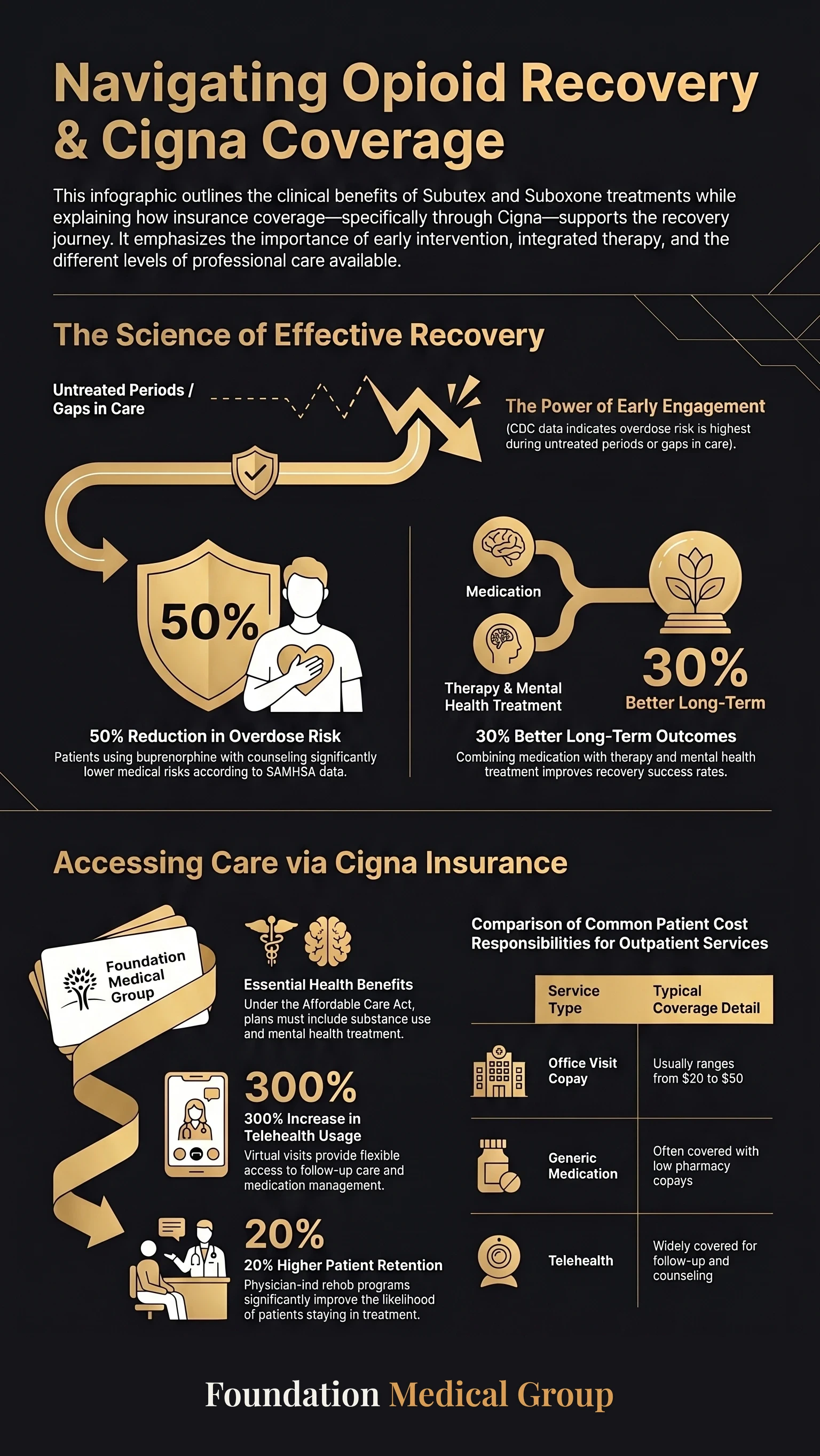
This infographic maps detox, the rehab levels, and the recovery plan. It shows where health insurance, cigna insurance included, tends to apply: outpatient treatment, intensive outpatient program care, and inpatient treatment. You can scan the treatment options and the coverage points side by side.
Visual tools help. Especially when stress is high. Sometimes seeing the path laid out makes the next step feel doable.
FAQ
Does Cigna cover Subutex and suboxone treatment?
Yes. Many plans cigna cover medication, visits, and therapy, depending on authorization and plan type.
What health insurance plans support addiction treatment?
Most major health insurance plans, including cigna health insurance and united healthcare, cover addiction and mental health treatment under federal law.
Is methadone treatment covered by insurance?
Often yes. Methadone treatment may be covered, but some plans require treatment at approved clinics.
Are rehab programs required to offer therapy?
Most quality rehab programs include group therapy and mental health treatment as core services.
How do I confirm my Cigna benefits?
Contact the provider or review cigna healthcare information directly. Asking for cigna insurance coverage details before intake helps avoid surprises.
Sources and References
- CDC National Center for Health Statistics, VSRR Provisional Drug Overdose Death Counts (Georgia).
- Sordo L, et al. Mortality risk during and after opioid substitution treatment. BMJ 2017;357:j1550.
- Wakeman SE, et al. Comparative effectiveness of different treatment pathways for opioid use disorder. JAMA Netw Open 2020;3(2):e1920622.
- Nosyk B, et al. Buprenorphine/naloxone versus methadone for the treatment of opioid use disorder. JAMA 2024;332(21):1822-31.
- Lee JD, et al. Extended-release naltrexone versus buprenorphine-naloxone, the X:BOT trial. Lancet 2018;391(10118):309-18.
- Weiss RD, et al. Adjunctive counseling during buprenorphine-naloxone treatment, the POATS trial. Arch Gen Psychiatry 2011;68(12):1238-46.
- SUBOXONE sublingual film prescribing information, DailyMed, Indivior Inc.
- Drugs@FDA, NDA 020732 (Subutex), U.S. Food and Drug Administration.
- Drug Enforcement Administration and HHS, Expansion of Buprenorphine Treatment via Telemedicine Encounter, Federal Register, 17 January 2025.
- Cigna, medical coverage policies.
- Centers for Medicare and Medicaid Services, Medicare Part D Spending by Drug, 2024.
- National Institute on Drug Abuse, Medications for Opioid Use Disorder.
Key Takeaways and Final Thoughts
Subutex, suboxone treatment, and methadone all sit inside modern addiction medicine, backed by evidence. Medication assisted treatment ties therapy and ongoing support to every stage of detox: the planning, the stabilizing, the handovers between settings, the monitoring, the support, and the recovery care that comes after. Health insurance decides a lot about who reaches rehab, therapy, and long-term support. Cigna plans, the cigna group ones included, often cover a wide range.
Knowing your treatment options, your mental health needs, and your insurance rules makes starting easier. With the right healthcare provider, and benefits you’ve actually checked, recovery holds up. Trust me on this.