
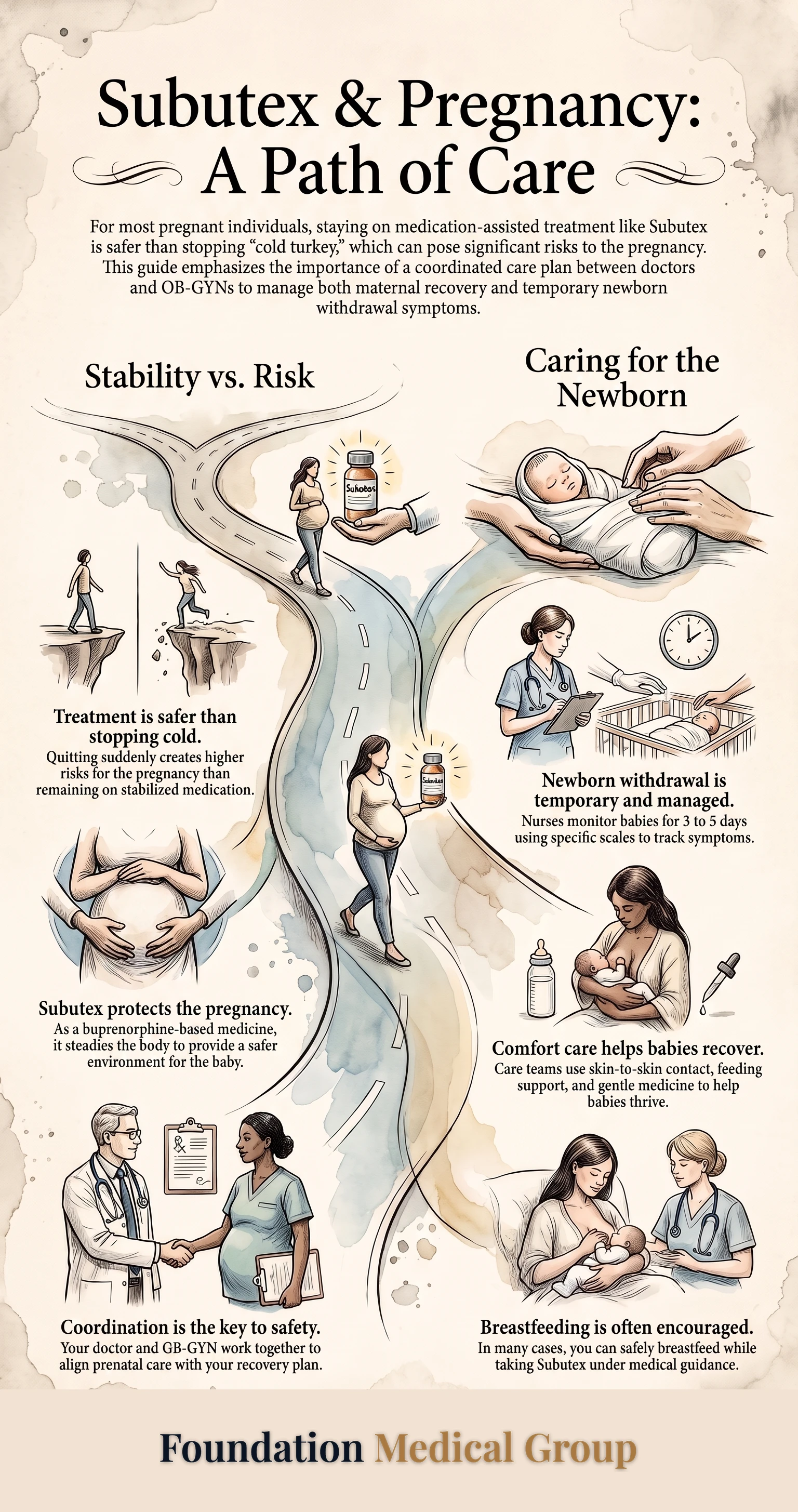
If you’re pregnant and worried about staying on Subutex, here’s the short answer. For most people, staying in medication treatment is safer than stopping cold. Subutex is buprenorphine, a medicine that steadies your body and protects your pregnancy. Your doctor and OB will guide the plan together.
It’s a lot to carry. You want to do right by your baby, and the last thing you need is fear or judgment. So let’s walk through it calmly. Below we explain why treatment beats quitting suddenly, why Subutex is often chosen in pregnancy, what newborn withdrawal really means, and how your care team keeps you both safe.
Why Stopping Cold Is the Bigger Risk
It feels like quitting should be the safe choice. In pregnancy, it usually isn’t. Sudden withdrawal is hard on your body, and it’s hard on your baby too.
When you stop opioids all at once, your system swings into stress. That stress can raise the risk of miscarriage, early labor, or fetal distress. Relapse becomes far more likely, and a relapse brings even greater danger. Steady medication avoids those swings and keeps things calm.
According to the Substance Abuse and Mental Health Services Administration (SAMHSA), medication for opioid use disorder is the standard of care, and treatment during pregnancy is strongly recommended over stopping without support. In plain words, staying in care protects you both.
Why Subutex Is Often Chosen in Pregnancy

Subutex is the brand name for buprenorphine on its own. That’s the key part: it’s the mono version, with just 1 active ingredient and no naloxone added. Suboxone, by contrast, combines 2 ingredients, buprenorphine and naloxone.
In pregnancy, doctors often prefer the single-ingredient form. Using one medicine instead of two keeps things simple, and it’s the version many clinicians reach for when someone is expecting. Your doctor decides what fits you, since every pregnancy is different.
Research from the National Institute on Drug Abuse (NIDA) shows that buprenorphine is an effective, well-studied treatment for opioid use disorder in pregnancy. It helps you stay steady, ends the cycle of cravings, and lets you focus on prenatal care.
Treated Versus Untreated: What Changes
Numbers aside, the pattern is clear. Treatment leads to better outcomes for both mother and baby. Untreated opioid use disorder carries real, avoidable dangers.
| What we look at | On Subutex treatment | Untreated opioid use disorder |
|---|---|---|
| Ups and downs in your system | Steady and controlled | Frequent, stressful swings |
| Risk of relapse and overdose | Much lower | Much higher |
| Prenatal care | Regular and coordinated | Often missed or delayed |
| Newborn withdrawal | Expected, monitored, treatable | Still possible, less controlled |
The table says it simply. Treatment doesn’t erase every risk, but it lowers the biggest ones and gives your care team a clear plan to follow.
What Newborn Withdrawal Really Means
Let’s talk about the fear many parents carry: neonatal abstinence syndrome, or NAS. It’s the withdrawal a newborn can have after birth because they were exposed to medication in the womb. Hearing about it is scary. Understanding it helps.
Here’s the reassuring part. NAS is expected, it’s watched for, and it’s treatable. Your baby’s team knows exactly what to look for.
- It’s monitored. Nurses check your baby closely in the first 3 to 5 days after birth.
- It’s scored. Care teams use a simple scale to track symptoms like fussiness or trouble feeding.
- It’s managed. Comfort care, skin-to-skin contact, and feeding help most babies. Some need gentle medicine that’s slowly reduced.
- It’s temporary. With good care, babies recover, and the goal is always to send you home healthy together.
NAS is not a sign you did something wrong. It’s a known part of treatment that your team plans for from the start.
Coordinating Care With Your OB

Good pregnancy care is a team effort. Your addiction medicine doctor and your OB should talk to each other. When they share the plan, you get safer, smoother care.
That coordination covers your prenatal visits, your medication dose, and your delivery plan. Doses sometimes change across the 3 trimesters, because your body changes as the baby grows. Your OB watches the pregnancy, your doctor watches the treatment, and together they adjust as needed.
If you’re looking for a provider who works this way, our Subutex clinic near me hub is a good place to start. You can also find a Subutex doctor accepting new patients close to you.
Subutex, Suboxone, and Methadone While You’re Pregnant
You have more than one option, and it helps to see them side by side. All three are forms of medication assisted treatment, and all three beat going without.
Buprenorphine is a partial opioid agonist. It settles the receptors part way, which is why it steadies cravings without a strong high. Methadone is a full agonist, so it works harder and is dispensed daily through an opioid treatment program. Suboxone adds naloxone to buprenorphine. Subutex leaves the naloxone out, which is why many doctors choose it in pregnancy.
The MOTHER trial compared buprenorphine and methadone in pregnancy and followed 131 newborns. Babies exposed to buprenorphine needed 89 percent less morphine for withdrawal, 1.1 mg on average against 10.4 mg. They spent 10.0 days in hospital instead of 17.5. They needed NAS medication for 4.1 days instead of 9.9.
Two honest caveats. The share of babies who needed any NAS treatment was similar in both groups, 47 percent against 57 percent. And more women stopped buprenorphine during the study than stopped methadone, 33 percent against 18 percent. So methadone is still the better fit for some people. Your doctor weighs that with you.
One thing nobody should do is detox off opioids during pregnancy without medication. Detox alone carries a high relapse rate, and relapse is what actually endangers a pregnancy.
Finding the Right Subutex or Suboxone Doctor in Dallas
Not every clinic handles pregnancy. When you call around, you’re looking for a team that treats both things at once. A subutex doctor Dallas Medicaid patients can see should be comfortable coordinating with an OB, not just writing a suboxone prescription.
Here’s what to ask a Dallas suboxone doctor before you book.
- Do you treat pregnant patients, and how many do you see in a year?
- Will you talk directly with my OB, or do I carry messages between you?
- Do you prescribe Subutex, or only Suboxone?
- Is counseling on site, or by referral?
- Do you take Texas Medicaid, and do you need prior authorization?
The right suboxone doctor answers those without hesitating. Suboxone doctors who dodge the pregnancy question are telling you something useful. A well run suboxone clinic will also build a written treatment plan with you, covering medication management, follow up spacing, and what happens at delivery.
Foundation Medical Group runs suboxone treatment programs in Dallas, and our addiction medicine doctors coordinate directly with obstetric care. Our Suboxone doctor in Dallas page has the details.
Telehealth, Telemedicine, and In Person Visits
Pregnancy means a lot of appointments. Telehealth takes some of that load off. Telehealth suboxone doctors can run assessments, adjust doses, and keep your follow ups on schedule without another drive across Dallas.
Federal rules support it. DEA and HHS published a final rule on 17 January 2025 allowing an initial 6 month supply of buprenorphine after an audio only encounter, once the prescriber checks state prescription monitoring data. A separate order extended the wider telemedicine flexibilities through 31 December 2026.
Telemedicine has limits in pregnancy. You still need in person prenatal exams, lab work, and growth scans. Most patients end up mixing the two: in person with the OB, telemedicine with the addiction team. An online suboxone doctor can be part of comprehensive care, not a replacement for it. Ask whether online suboxone treatment includes a named healthcare provider you see each time, or whoever is on shift.
Paying for Care With Texas Medicaid or Insurance
Cost should not decide this. Texas Medicaid covers buprenorphine based outpatient treatment, including the medicine, visits, and counseling, when clinical criteria are met. Prior authorization is common at the start, and your clinic usually files it.
If you have commercial insurance instead, the picture is similar. Most plans cover medication assisted treatment, though your insurance plan sets its own copay and refill rules. Two questions save trouble later. Does your insurance need prior authorization? And is your clinic in network for your specific plan, not just your insurer?
For anyone paying cash between plans, here are real numbers. CMS publishes a national average drug acquisition cost, roughly what pharmacies pay. In the December 2025 file, generic buprenorphine 8 mg sublingual tablets averaged about $0.69 each. At a 16 mg daily dose that’s about $1.38 a day, or near $41 for 30 days. Generic buprenorphine and naloxone tablets run about $0.72 each. Those are drug costs only, before visits.
The wider picture explains the urgency. The Centers for Disease Control and Prevention recorded 3,133 opioid involved overdose deaths in Texas for the 12 months ending December 2023, falling to 1,934 for the 12 months ending December 2025. Staying on medication is what moves those numbers, for you and for your baby.
Breastfeeding Basics
Many parents on buprenorphine can breastfeed, and it’s often encouraged. Only a very small amount passes into breast milk, and breastfeeding can even ease a baby’s withdrawal symptoms.
There are a few reasons a doctor might advise against it, such as other health issues. So this is a decision to make with your care team, not on your own. Ask your doctor and your baby’s pediatrician what’s right for your situation.
Planning Ahead If You’re Not Pregnant Yet
Thinking about pregnancy while in treatment? That’s a smart, caring thing to do. The best step is a simple conversation before you conceive.
Tell your doctor your plans. They can review your medication, talk through what to expect, and help you build a safe path forward. Starting from a stable, treated place gives you the strongest footing. For more on Dallas-area treatment options, see our Suboxone doctor in Dallas page.
Infographic: Subutex and Pregnancy at a Glance
Frequently Asked Questions
Is Subutex safe to take during pregnancy?
For most people, staying on Subutex is safer than stopping suddenly. It steadies your body and lowers the biggest risks. Your doctor and OB decide what’s right for you, since every pregnancy is different.
What is the difference between Subutex and Suboxone in pregnancy?
Subutex is buprenorphine alone, with no naloxone. Suboxone combines two ingredients. In pregnancy, doctors often prefer the single-ingredient form, though your doctor makes the final call for your care.
Will my baby be born with withdrawal?
Some babies exposed to buprenorphine have withdrawal, called NAS. It’s expected, watched for, and treatable. Your baby’s team monitors closely after birth and helps your baby through it with comfort care or gentle medicine.
Can I breastfeed while taking Subutex?
Often, yes. Only a tiny amount passes into breast milk, and it can even ease your baby’s symptoms. A few health situations change this, so confirm with your doctor and pediatrician first.
Should I stop Subutex to protect my baby?
Usually not. Quitting cold can trigger stress, early labor, or relapse, which are more dangerous. Never stop or change your dose on your own. Always work through it with your doctor and OB.
Key Takeaways and Next Steps
Here’s what to hold on to. Staying in medication treatment is usually safer than stopping cold, because sudden withdrawal stresses both you and your baby. Subutex is buprenorphine on its own, and doctors often choose it in pregnancy. Newborn withdrawal, or NAS, is expected, monitored, and treatable, not a sign of failure.
- Don’t stop or change your dose alone. Talk to your doctor and OB first.
- Ask your two providers to coordinate your prenatal, medication, and delivery plans.
- Learn about NAS ahead of time so you know your baby will be watched and cared for.
- If you’re planning a pregnancy, start the conversation with your doctor before you conceive.
You deserve care that supports you, not shame. Reach out to Foundation Medical Group to talk with a physician-led team that treats you and your baby with respect. One conversation can turn worry into a clear, safe plan.
Sources
- Suboxone (buprenorphine and naloxone) sublingual film prescribing information, DailyMed, National Library of Medicine.
- Jones HE, et al. Neonatal abstinence syndrome after methadone or buprenorphine exposure (the MOTHER trial). N Engl J Med 2010;363(24):2320-31.
- Buprenorphine, StatPearls, NCBI Bookshelf.
- American Society of Addiction Medicine, National Practice Guideline for the Treatment of Opioid Use Disorder.
- Drug Enforcement Administration and HHS, Expansion of Buprenorphine Treatment via Telemedicine Encounter.
- Drug Enforcement Administration and HHS, Fourth Temporary Extension of COVID-19 Telemedicine Flexibilities.
- Centers for Medicare and Medicaid Services, National Average Drug Acquisition Cost, 2025.
- CDC National Center for Health Statistics, VSRR Provisional Drug Overdose Death Counts.
- Substance Abuse and Mental Health Services Administration, Buprenorphine.
- National Institute on Drug Abuse, Medications for Opioid Use Disorder.