A Subutex doctor in Midlothian who takes Medicaid is a licensed doctor treating opioid use disorder with buprenorphine, paid for by your plan. Subutex is an FDA approved drug used in medication assisted treatment. It cuts opioid use, cravings, and withdrawal. You’ll find that care at a suboxone clinic nearby, or through online suboxone treatment built around the whole person.
Introduction
Access to Subutex and Suboxone care is still a real need in Midlothian and the greater Richmond area. Most people start at a local suboxone clinic, then weigh it against online care. They’ll look at several suboxone doctors, at clinics and in online programs, plus a few practices further out. Insurance often decides how fast you can start. The right suboxone clinic can shave weeks off that.
Medicaid coverage puts real addiction treatment within reach without a steep bill. Local clinics, online suboxone providers, and national addiction specialists all offer more routes in than they used to. If you’re dealing with drug addiction and opioid dependency, knowing what sits near you and what runs online cuts both the delay and the dread.
Here’s the thing. Opioid addiction rarely waits for the perfect moment. A couple of months back, I spoke with someone who delayed care for weeks because they thought Medicaid wouldn’t cover treatment at a suboxone clinic. It did.
That delay could’ve gone very differently. Access matters. Timing matters, and clear information helps people take the first step.
What Is Subutex and How It Treats Opioid Use Disorder
Subutex is an FDA approved drug holding buprenorphine with no naloxone. Buprenorphine is a partial opioid agonist. It cuts cravings and withdrawal, steadies brain chemistry, and carries a lower overdose risk than full opioids like heroin or pain pills.
Subutex belongs inside a structured plan built to addiction medicine standards. The clearest trial figure comes from POATS, which treated 653 patients across 10 US sites for prescription opioid dependence. At week 12, while still on buprenorphine and naloxone, 49.2 percent had a good outcome. Eight weeks after the taper ended, only 8.6 percent did. Many midlothian suboxone doctors tie medication, counseling, and steady follow-ups together for exactly that reason.
This treats substance use disorder as a long-term medical condition, not a short-term problem. Buprenorphine sits at the center of it.
How Buprenorphine Works in the Brain
Buprenorphine binds tightly to opioid receptors, which helps block the effects of other opioids. That’s why relapse risk drops when patients stay consistent with medication. But it doesn’t fully activate those receptors, so patients don’t experience the same high. Honestly? That balance is what makes it effective.
Retention matters, and the mortality data shows exactly how much. A 2017 meta-analysis in The BMJ pooled 19 cohorts covering 15,831 people on buprenorphine. All-cause deaths ran 4.3 per 1,000 person-years during treatment and 9.5 per 1,000 after it. Overdose deaths ran 1.4 versus 4.6 per 1,000. People who stay in care longer tend to have better outcomes. That’s been my experience too.
Who Typically Receives Subutex
Subutex is most often written during pregnancy, or when naloxone doesn’t sit well. The pregnancy case is well documented. A 2022 cohort study in the New England Journal of Medicine covered 2,548,372 US pregnancies on public insurance. Neonatal abstinence syndrome showed up in 52.0 percent of buprenorphine-exposed infants, against 69.2 percent of methadone-exposed infants. Preterm birth ran 14.4 percent versus 24.9 percent. Some patients also get headaches, nausea, or anxiety from naloxone. Subutex may suit them better. Medicaid approval is tighter, though a provider can send in a medical justification under your plan.
Subutex vs Suboxone for Medicaid Patients
Subutex and Suboxone both treat opioid addiction. They differ in what’s in the tablet. Suboxone pairs buprenorphine with naloxone. Subutex is buprenorphine alone. The naloxone is there to deter misuse and to make a wrong dose safer.
Most Medicaid plans prefer Suboxone. Subutex tends to clear only for pregnancy or a bad reaction to naloxone. Both are FDA approved, and both have solid evidence behind them. What keeps either one safe is the label and the follow-up.
| Feature | Subutex | Suboxone |
|---|---|---|
| Active ingredients | Buprenorphine | Buprenorphine and naloxone |
| Typical approval | Limited cases | Standard coverage |
| Misuse deterrent | No | Yes |
| Common use | Pregnancy, intolerance | Most adult patients |
Cost and Coverage Considerations
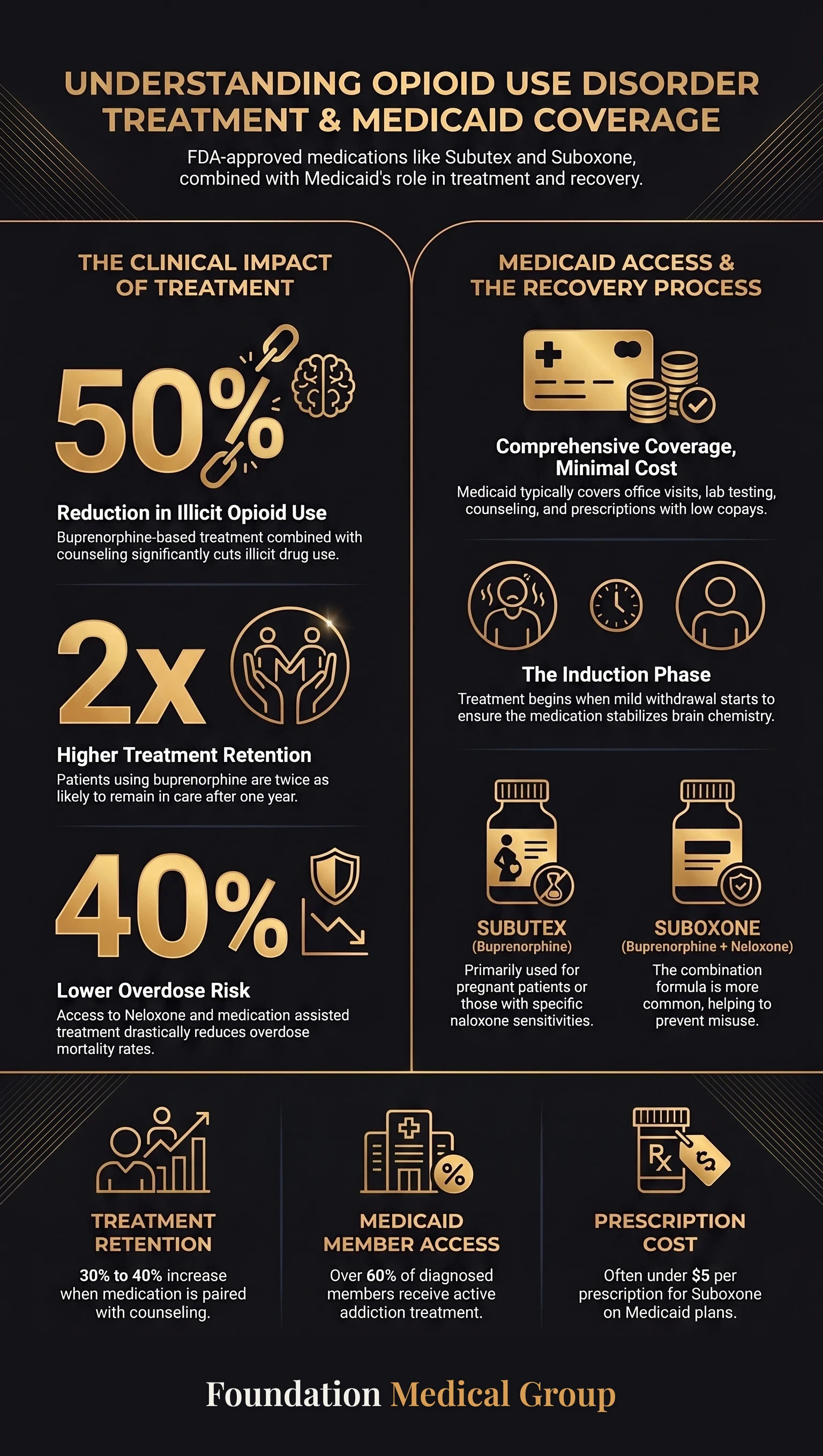
Medicaid copays for Suboxone are usually low, often under $5 per prescription depending on the plan. Subutex may require prior authorization, which can take a few days. Many clinics manage this paperwork, so patients don’t have to chase approvals.
Look, coverage rules can feel confusing. But clinics that regularly treat Medicaid patients know the system. Ask directly. It saves time.
Finding Suboxone Providers in Midlothian
Finding suboxone providers usually starts with a local clinic, a search, or a referral from primary care. Plenty of Medicaid patients can get in with a suboxone doctor in Midlothian the same week. A doctor who has done this a while already knows the Medicaid rules, and that alone cuts out a lot of the back and forth.
When calling clinics, patients should focus on three practical steps:
- Ask whether the doctor accepts your specific Medicaid plan and has experience as a subutex doctor midlothian medicaid patients rely on.
- Confirm access to medication, counseling, and buprenorphine treatment during the first week of treatment.
- Ask if drug detox support or referrals to a methadone clinic are available if needed.
The SAMHSA treatment locator is a solid way to find licensed suboxone providers and methadone clinic options. Midlothian addiction resources also cover peer support, outpatient programs, and midlothian drug alcohol rehabs for a higher level of care. Getting in early lowers overdose risk and keeps people in treatment longer.
Questions to Ask Before Scheduling
Ask how often visits occur during the first month. Some providers require weekly check-ins, others biweekly. Also ask if telehealth follow-ups are allowed after stabilization. That flexibility can make a big difference, especially for people working or caring for family.
And don’t forget pharmacy access. A provider might accept Medicaid, but the nearby pharmacy must as well. Easy to miss. Happens all the time.
Medicaid Coverage for Opioid Addiction Treatment
Medicaid pays for medication assisted treatment. That covers buprenorphine, methadone, naloxone, and mental health services. It usually takes in office visits, the drug itself, lab work, and counseling. Prior authorization may be needed, though many clinics chase the approval for you.
Virginia Medicaid runs this through its Addiction and Recovery Treatment Services benefit, ARTS for short. ARTS bundles the drug with counseling and case management, rather than paying for the script alone. The national picture is thinner than most people assume. According to NIDA, fewer than 20 percent of people with opioid use disorder get any medication for it. Methadone maintenance, suboxone maintenance, and counseling each cover a different part of the problem. Pharmacies enrolled with Medicaid can hand over the medicine for a small copay.
What Medicaid Typically Covers
Most Virginia Medicaid plans cover key services that support ongoing care:
- Office visits with a qualified doctor trained in addiction medicine.
- Medication such as buprenorphine, methadone, and naloxone.
- Urine drug screens, behavioral health assessments, and care coordination.
Transportation assistance may also be available for in-person visits. That surprised me, honestly. Plenty of patients don’t realize rides can be covered.
Coverage details vary by plan, so verification matters. Clinics usually confirm benefits before the first appointment. That removes guesswork.
In-Person Care vs Online Suboxone Treatment
In-person care offers physical exams, drug screening, and coordinated services under one roof. Some patients prefer this structured environment, especially early in treatment. In-person programs may also coordinate referrals to a methadone clinic or higher levels of care if needed.
Online suboxone treatment is about convenience and reach. The script can go to the pharmacy right after a video visit, which suits stable patients. A 2023 study of 41,266 Kentucky and 50,648 Ohio Medicaid enrollees found telemedicine starts held up against in-person starts. Retention at 90 days was slightly better, at adjusted odds ratios of 1.13 and 1.19, with no difference in nonfatal overdose. A DEA and HHS rule published 17 January 2025 now allows a first buprenorphine script over an audio-only visit, up to a 6-month supply, after a check of the state prescription drug monitoring database. Online care widens the door without dropping the safeguards.
Who Benefits Most From Telehealth
Telehealth works well for patients who are stable, have reliable internet, and can attend virtual counseling. It’s also helpful for people living farther from Midlothian clinics. That said, some patients start online and later switch to in-person care. No rule says you can’t mix approaches.
What to Expect During Treatment
The first visit is a close look at your opioid use, your health history, and what you want out of treatment. The provider confirms the diagnosis. Knowing the options ahead of time helps, and there are three: methadone, buprenorphine, and naloxone. If withdrawal is already under way, detox planning comes up too.
Later visits deal with the dose, whether you’re getting to counseling, and how things are going. Plenty of patients stay in suboxone treatment for months or for years. Medication over the long run, with counseling beside it, lowers relapse and makes ordinary days easier.
The Induction Phase Explained
Induction starts once withdrawal is clearly under way, and no sooner than 6 hours after the last short-acting opioid. Providers score it on the 11-item Clinical Opioid Withdrawal Scale, where 5 to 12 reads as mild and 13 to 24 as moderate. Taking medication too early can cause precipitated withdrawal, which is the discomfort everyone is trying to avoid. Providers explain timing carefully. It sounds technical, but patients usually get the hang of it quickly.
During the first two weeks, appointments may be more frequent. That’s normal. Dose adjustments happen in steps of 2 mg/0.5 mg or 4 mg/1 mg, based on cravings and side effects, until you land somewhere in the usual maintenance range of 4 mg/1 mg to 24 mg/6 mg a day.
Counseling, Support, and Community Resources
Treatment that works includes counseling and social support. One-to-one counseling helps with triggers, stress, and mental health. Group therapy and peer programs add a bit of accountability, and some encouragement on the bad weeks.
Community resources like midlothian alcoholics anonymous meetings and recovery groups sit well alongside medical care. Some patients also use midlothian addiction resources that link them to housing, work, and family support. Care that covers the whole person holds up better over years.
Why Counseling Improves Outcomes
Here’s an honest wrinkle, though. In the POATS trial, patients were randomized to standard medical management with or without added opioid dependence counseling, and both arms landed at the same 49.2 percent success rate at week 12. Counseling addresses the stuff medication can’t. Habits, routines, relationships. All of it. It just isn’t the piece holding the relapse rate down.
And yeah, not every session feels groundbreaking. Some are just okay. That’s still progress.
Regulations and Safety Standards
The Drug Addiction Treatment Act of 2000 first let qualified providers prescribe buprenorphine in an office, rather than only through a methadone clinic. The Consolidated Appropriations Act of 2023 went further and scrapped the X-waiver, so any DEA-registered prescriber can write for it now. The label, regular check-ins, and a plain explanation are what keep that care safe.
Naloxone is often co-prescribed to head off an overdose, and it’s advised for anyone taking opioids. The Suboxone label goes further. It tells clinicians to talk through access to an overdose reversal agent, with the patient and with anyone in the house who might swallow a dose by accident. It also warns that naloxone or nalmefene wears off, so call 911 in every suspected overdose regardless. Medication safety sits at the core of addiction medicine.
Monitoring and Drug Screening
Drug screens aren’t about punishment. They help guide care. Results show whether doses are effective or need adjustment. Most programs are transparent about testing policies upfront.
Staying Informed and Ongoing Education
Patients and families do better when they read from sources they can trust. Many clinics share the latest suboxone articles to explain what’s changed and what the research says. National addiction specialists treat that reading as part of the plan.
Knowing how the medicine works keeps people in care. It also chips away at the stigma around substance abuse and opioid dependency.
Sources and References
- Suboxone (buprenorphine and naloxone) sublingual film prescribing information, DailyMed, National Library of Medicine.
- Sordo L, et al. Mortality risk during and after opioid substitution treatment. BMJ 2017;357:j1550.
- Weiss RD, et al. Adjunctive counseling during brief and extended buprenorphine-naloxone treatment for prescription opioid dependence. Arch Gen Psychiatry 2011;68(12):1238-46.
- Suarez EA, et al. Buprenorphine versus methadone for opioid use disorder in pregnancy. N Engl J Med 2022;387(22):2033-44.
- Hammerslag LR, et al. Telemedicine buprenorphine initiation and retention in opioid use disorder treatment for Medicaid enrollees. JAMA Netw Open 2023;6(10):e2336914.
- Drug Enforcement Administration and HHS, Expansion of Buprenorphine Treatment via Telemedicine Encounter, 90 FR 6504.
- Virginia Department of Medical Assistance Services, behavioral health benefits and the ARTS fact sheet.
- Opioid Withdrawal, StatPearls, NCBI Bookshelf.
- National Institute on Drug Abuse, Medications for Opioid Use Disorder.
Frequently Asked Questions

How do I find medicaid suboxone doctors near Midlothian?
You can search local clinics, use the SAMHSA treatment locator, or ask primary care providers for referrals to suboxone providers.
Is Suboxone treatment safe long term?
Yes. Decades of addiction medicine research back long-term suboxone treatment, so long as a doctor keeps an eye on it.
How is methadone different from Suboxone?
Methadone is dispensed through a methadone clinic and often requires daily visits at first. Suboxone can be prescribed in office or telehealth settings.
Does treatment include counseling?
Yes. Most programs require counseling, including individual counseling, as part of comprehensive care.
Can I switch from methadone to buprenorphine?
In some cases, patients can transition with medical supervision. The process depends on dose, stability, and clinical guidance from the treating doctor.
Key Takeaways and Next Steps
A subutex doctor midlothian medicaid patients rely on can deliver safe, evidence-based opioid addiction treatment through a trusted suboxone clinic model. Suboxone treatment, Subutex, methadone, naloxone, and buprenorphine treatment all play roles in modern addiction treatment guided by an experienced doctor. Combining medication, counseling, and community resources creates whole-person care for substance use disorder. With local providers, online suboxone treatment, and growing midlothian addiction resources, patients have more paths to recovery than ever before.