
Subutex and Suboxone are close cousins. Both use buprenorphine, the same medicine that eases cravings and calms withdrawal from opioids. The one real difference is a second ingredient. Suboxone adds naloxone to deter misuse, while Subutex is buprenorphine on its own. For most people, doctors start with Suboxone. But for some, plain buprenorphine is the safer, kinder fit.
So which one is right for you? That depends on your body, your history, and sometimes your pregnancy. Below we lay it out side by side, in plain words, so the choice stops feeling confusing. For a broader look at how this medicine works, see our guide to what buprenorphine is.
What Subutex and Suboxone Actually Are
Both of these are brand names for the same core medicine: buprenorphine. It’s what does the heavy lifting. Buprenorphine partly activates the same brain receptors that opioids hit, but far more gently. That’s why it quiets cravings and stops withdrawal without the big high.
The names point to what’s inside the pill or film:
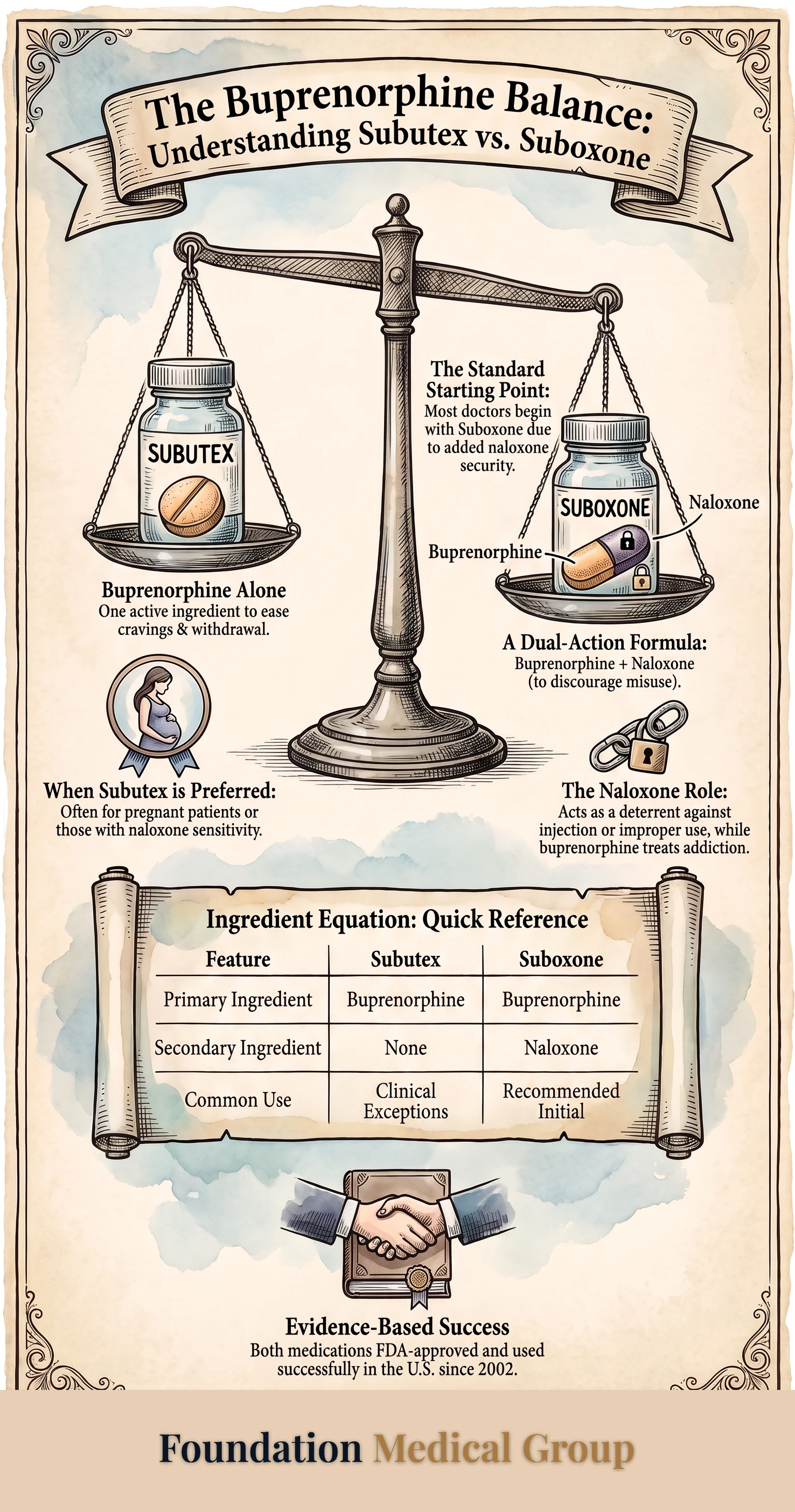
- Subutex is buprenorphine alone. One active ingredient, nothing else added.
- Suboxone is buprenorphine plus naloxone. The naloxone is there for one job: to discourage misuse.
- Generics exist for both. Generic buprenorphine-naloxone works the same as brand Suboxone and costs far less.
According to the Substance Abuse and Mental Health Services Administration (SAMHSA), buprenorphine is a proven medication for treating opioid use disorder. The dates are on the public record. Drugs@FDA shows Subutex (application NDA 020732) and Suboxone tablets (NDA 020733) were both approved on 8 October 2002. The Suboxone sublingual film, NDA 022410, followed on 30 August 2010. So this is a standard, evidence-based treatment with more than 20 years behind it, not a shortcut.
One wrinkle worth knowing: brand Subutex itself is now listed as discontinued in Drugs@FDA, and the Federal Register determination says that was not for safety or effectiveness reasons. Generic buprenorphine sublingual tablets are what you’ll actually be handed, in 2 strengths, 2 mg and 8 mg.
The Job of That Extra Ingredient

Here’s the part that trips people up. Why add naloxone at all?
Naloxone blocks opioids. Taken as directed, under the tongue, the naloxone in Suboxone barely does anything, because as ACOG puts it, naloxone is not orally active. But if someone tries to melt it down and inject it, the naloxone wakes up and can trigger withdrawal. So it acts like a built-in guardrail against misuse.
The pharmacology backs that up. Per the FDA prescribing information, buprenorphine taken sublingually has a mean elimination half-life of 24 to 42 hours, while naloxone’s runs 2 to 12 hours. The ingredient meant to hold you steady sticks around for a day or more. The deterrent clears fast.
Suboxone mixes buprenorphine and naloxone in a 4:1 ratio, so it holds 4 parts buprenorphine for every 1 part naloxone. You can read that straight off the strengths: 2 mg/0.5 mg, 4 mg/1 mg, 8 mg/2 mg, 12 mg/3 mg. Subutex skips the naloxone completely. That single choice is most of the story behind these two medicines. Both come as small films or tablets you place under the tongue.
Subutex vs Suboxone at a Glance
Sometimes a table says it fastest. Here’s the head-to-head.
| Feature | Subutex | Suboxone |
|---|---|---|
| What’s in it | Buprenorphine only | Buprenorphine plus naloxone |
| Why the extra ingredient | None added | Naloxone deters misuse |
| How it’s taken | Under the tongue | Under the tongue, film or tablet |
| Often best for | Pregnancy, naloxone sensitivity | Most people starting treatment |
| Misuse guardrail | None built in | Built-in deterrent |
Read the table as a starting point, not a verdict. Your doctor weighs your full history before deciding.
Why Doctors Usually Start With Suboxone
For most new patients, Suboxone is the first choice. The reason is simple: that built-in guardrail. The naloxone lowers the risk of misuse and injection, which keeps treatment safer for most patients.
The buprenorphine itself is what moves the numbers. In a 2017 BMJ meta-analysis by Sordo and colleagues covering 19 cohorts, overdose mortality was 1.4 per 1,000 person-years for people on buprenorphine and 4.6 per 1,000 for people off it. That’s roughly 70 percent lower while treatment holds. All-cause mortality followed the same shape, 4.3 against 9.5. Since both Subutex and Suboxone deliver buprenorphine, both can do that core job. Suboxone just adds a layer of protection on top.
So if there’s no medical reason to skip the naloxone, most doctors reach for Suboxone. It’s the default for good reason.
There’s another practical point. Both medicines are controlled substances, classed as Schedule III in the United States. That means a licensed provider guides your dose and refills. The usual maintenance range on the label runs from 4 mg/1 mg to 24 mg/6 mg a day. That’s wide enough that the dose really does need a clinician’s judgment rather than a guess. This oversight is part of what keeps treatment safe, whichever form you take. It also means you shouldn’t buy either one online or from a friend. Real care comes with a real doctor.
When Subutex Is the Better Fit

Plain buprenorphine still has an important place. Doctors turn to Subutex when the naloxone could cause a problem.
- Pregnancy. ACOG notes the buprenorphine monoproduct has been recommended in pregnancy to avoid any prenatal exposure to naloxone. It also notes that newer studies of the combination product found no adverse effects and similar outcomes, so this is a preference rather than a prohibition.
- Naloxone sensitivity. A small number of people react badly to naloxone. For them, Subutex removes that ingredient entirely.
- Certain medical needs. Sometimes a doctor chooses plain buprenorphine based on your other conditions or medicines.
If any of these fit you, don’t worry. Being on Subutex instead of Suboxone doesn’t mean weaker care. It means care shaped around your body.
Keep in mind that the buprenorphine dose is what drives your recovery. Whether you take plain buprenorphine or the combination, the medicine easing your cravings is the same. The naloxone is a safety feature, not a treatment booster. So a switch to Subutex, when needed, changes the guardrail, not the healing part.
Cost shifts a little with the form, though. In Medicaid’s National Average Drug Acquisition Cost file effective 17 December 2025, a generic buprenorphine 8 mg sublingual tablet cost pharmacies $0.69, the 2 mg tablet $0.30, and the buprenorphine-naloxone 8 mg/2 mg film $1.94. Those are acquisition prices rather than counter prices, but the ranking holds.
How to Talk to Your Doctor About the Choice
You don’t have to decide this alone, and you shouldn’t. This is a shared call between you and a physician who knows your history.
Come ready with a few honest details. Tell your doctor if you’re pregnant or might become pregnant. Share any past reactions to naloxone or other medicines. Mention your other health conditions and each drug you take, including the time of your last opioid dose, since induction is timed against that rather than the clock. Clinicians score readiness on the Clinical Opiate Withdrawal Scale, 11 items running 0 to 47, and generally want mild-to-moderate withdrawal, about 5 to 24, before the first dose. With that picture, your doctor can match you to the right form. To find a provider who does this well, start with our Subutex clinic near me hub.
Infographic: Subutex vs Suboxone, Side by Side
Frequently Asked Questions
Is Subutex the same as Suboxone?
Not quite. Both contain buprenorphine, the medicine that eases cravings and withdrawal. Suboxone adds naloxone to deter misuse, while Subutex is buprenorphine alone. The buprenorphine part is identical, so the core treatment is the same.
Which is better, Subutex or Suboxone?
Neither wins outright. Suboxone suits most people because its naloxone lowers misuse risk. Subutex suits those who are pregnant or sensitive to naloxone. Your doctor picks the right one based on your health and history.
Why do doctors prescribe Suboxone more often than Subutex?
Because of the built-in guardrail. The naloxone in Suboxone discourages misuse and injection, which makes treatment safer for many patients. When there’s no medical reason to avoid naloxone, Suboxone is usually the default choice.
Is Subutex safer during pregnancy?
Many providers prefer plain buprenorphine, like Subutex, during pregnancy because it has a longer track record in that setting. Every pregnancy is different, though. Your doctor will weigh the benefits and guide the safest plan for you and your baby.
Can I switch between Subutex and Suboxone?
Often, yes. Since both deliver buprenorphine, switching is usually smooth when your doctor decides it’s needed. Don’t change on your own. Talk with your provider so the transition stays safe and steady.
Key Takeaways and Next Steps
Let’s pull it together. Subutex and Suboxone both rely on buprenorphine, the medicine that quiets cravings and stops withdrawal. The main difference is naloxone, added to Suboxone as a misuse guardrail. Most people do well on Suboxone, while Subutex fits pregnancy or naloxone sensitivity.
- Remember the core: both medicines share the same buprenorphine.
- Suboxone adds naloxone, so it’s the usual starting point for new patients.
- Subutex, plain buprenorphine, fits pregnancy or a naloxone reaction.
- Bring your full history to your doctor so the choice is truly yours.
Ready to take the next step? Reach out to Foundation Medical Group and ask which form fits your life. If you’re in Utah, our Suboxone clinic in Utah team can help you start today. One honest conversation turns a confusing choice into a clear, caring plan.
Sources
- Substance Abuse and Mental Health Services Administration (SAMHSA), Buprenorphine.
- Drugs@FDA, application NDA 020732 (Subutex).
- FDA prescribing information for Suboxone sublingual film, via DailyMed.
- FDA prescribing information for buprenorphine sublingual tablets, via DailyMed.
- ACOG Committee Opinion 711, Opioid Use and Opioid Use Disorder in Pregnancy.
- Sordo et al., Mortality risk during and after opioid substitution treatment, BMJ 2017.
- Medicaid.gov, National Average Drug Acquisition Cost (NADAC) 2026 file.