
Talk therapy is treatment that happens through conversation. You meet a trained mental health professional, and they help you understand what you feel and handle it better. If you’re searching for a talk therapist near me, you want someone licensed, close by, and covered by your plan. Here’s how to find that person without guesswork.
According to the National Institute of Mental Health, psychotherapy helps with depression, anxiety, trauma, grief, and a long list of other mental health concerns. It works alone for some people and alongside medicine for others. At Foundation Medical Group, our physician-led team handles both sides in one place, so your care doesn’t get split across separate offices.
What Does a Talk Therapist Actually Do?
A therapist listens first. In an early therapy session, you describe what brought you in, what your days look like, and what you want to change. From there you set goals together, and each visit works toward them. Psychotherapy is the clinical name for the work, and most clients start with weekly visits.
The work itself is practical. Your therapist helps you spot the thoughts and habits that keep a problem going, then teaches coping skills you practice between visits. For example, it might be a breathing exercise for a panic spike, a sleep routine, or a script for a hard conversation with your boss. Therapists often call the people they see clients rather than patients, because the relationship is a partnership.
What therapy is not: an hour of venting, a lecture, or advice handed down from on high. Sessions have a focus you both agree on. Nothing you say leaves the room, apart from the narrow safety exceptions your therapist explains at the start.
Which Kinds of Talk Therapy Might I Be Offered?
There’s no single method. A good clinician picks the approach that fits your goals, and many blend two or three.
| Approach | Often used for | How it usually runs |
|---|---|---|
| Cognitive behavioral therapy | Anxiety, depression, panic | Weekly, skills based, with practice between visits |
| Dialectical behavior therapy | Intense emotions, self-harm risk | Individual therapy paired with a group therapy skills class |
| EMDR therapy | Trauma and PTSD | Structured visits that process painful memories |
| Solution focused therapy | One clear, near-term goal | Short course aimed at what works already |
| Motivational interviewing | Mixed feelings about change | Brief, conversational, often before other treatment |
| Family therapy | Conflict or strain at home | The whole household meets in the same room |
Cognitive behavioral therapy has the deepest research base here. According to the American Psychological Association, it helps with a range of problems, including anxiety and mood disorder symptoms. Our guide to cognitive behavioral therapy shows what a full course looks like.
In our experience, the approach usually follows the goal. Someone with panic attacks tends to start with skills training, for instance, while a couple stuck in the same argument does better with two chairs in the room rather than one. Trauma-focused work such as EMDR therapy looks at how past experiences still land in the body today. Family therapy takes on relationship challenges that live between people rather than inside one person.
Who Is Licensed to Provide Counseling?
Titles get confusing fast. In most states, several kinds of mental health professional can provide therapy, and each carries a different license.
| Who they are | Training | What they usually offer |
|---|---|---|
| Licensed professional counselor | Master’s in clinical mental health counseling plus supervised hours | Individual therapy and counseling |
| Licensed clinical social worker | Master’s in social work plus supervised hours | Therapy, plus help with housing, benefits, and school |
| Marriage and family therapist | Master’s with family systems training | Couples therapy, couples counseling, family work |
| Clinical psychologist | Doctoral degree | Therapy plus formal psychological testing |
| Psychiatrist or psychiatric nurse practitioners | Medical or advanced nursing degree | Diagnosis, medicine, medication management |
A quick note on that last row. A psychiatrist or a nurse practitioner can prescribe; a licensed therapist generally cannot. If your symptoms are severe, having both under one roof keeps your care in one place and saves you from repeating your story twice. Whichever title you land on, the license tells you the training behind it and the state that stands behind the license.
How Do I Choose the Right Therapist?

Start narrow, then widen if you have to. These five questions sort most of it out.
- Are they licensed in my state? Check the license type and that it’s active. State boards publish this for free.
- Do they treat what I have? A clinician who sees anxiety and depression daily works differently from one focused on eating disorders. Experience with your exact concern counts more than the letters after a name.
- Are they in network? Call your insurer, then call the clinic and confirm. Directory lists go stale.
- Can I get a real appointment slot? A therapist with a four-month wait is not available, however good they are.
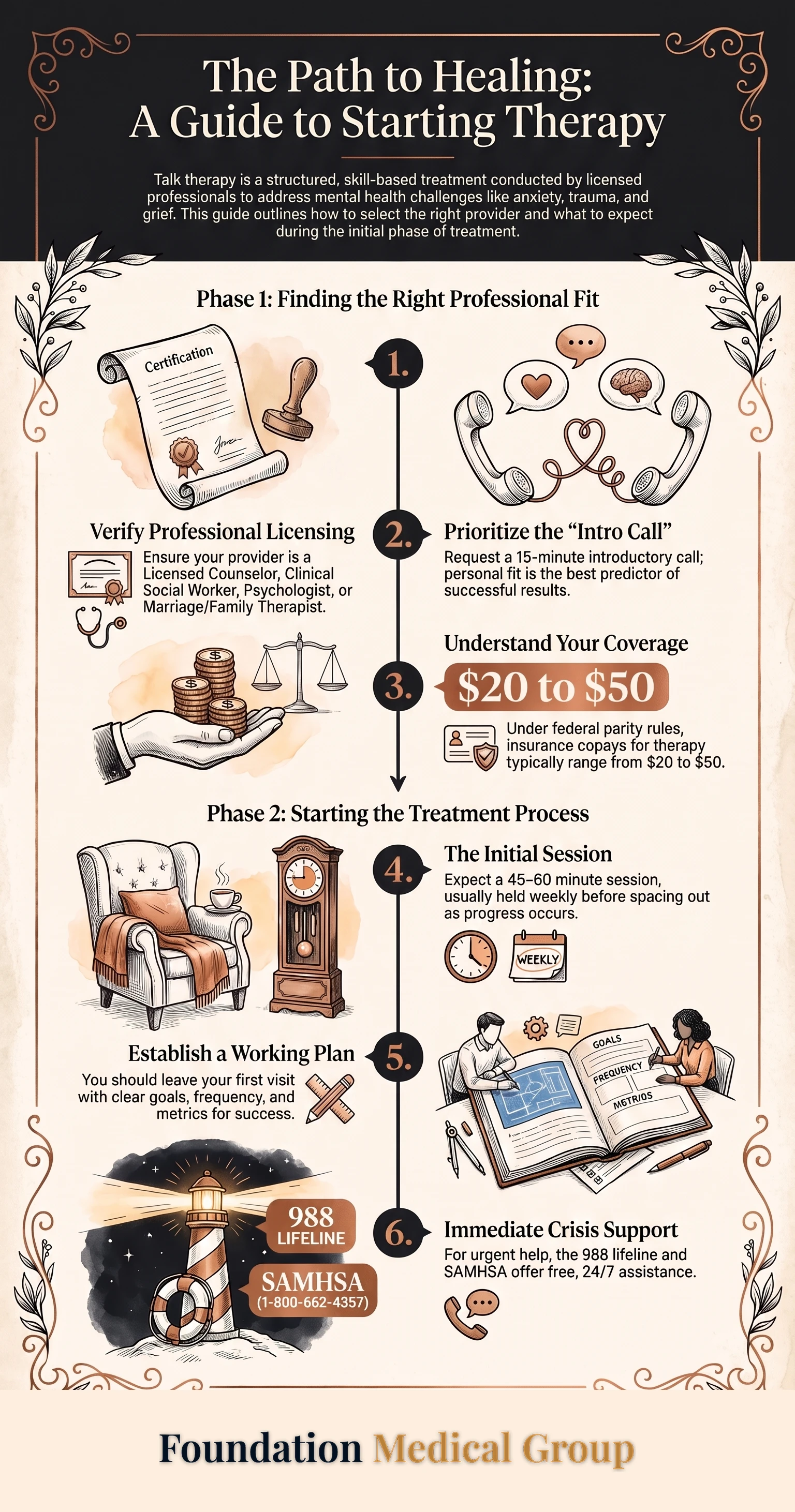
- Does the fit feel right? Ask for a short intro call. 15 minutes tells you a lot about whether someone listens.
That last point carries more weight than most patients expect. The bond between you and your clinician shapes how well therapy goes. So it’s fine to switch after two or three visits if something feels off. Nobody will be offended. Finding the right therapist sometimes takes a second try, and that’s a normal part of getting mental health care.
Online Therapy or In Person: Which Should I Pick?
Both are real care, and most plans now cover both. The choice comes down to your symptoms and your week.
Video visits win on access. You skip the drive. You can slot a session into a lunch break, and rural patients get the same behavioral health options as city ones. For anxiety that makes leaving home hard, online therapy removes the first hurdle. Our telehealth patients often keep a steadier schedule than our in-office ones, because less can go wrong on the way.
Sitting in the same room still has an edge in some situations. Deep trauma work, couples counseling, and care for a child or teen often go better in person. So does any situation where home isn’t private. If a housemate can hear you, video is the wrong choice. Depression that keeps you in bed, on the other hand, can make a video visit the only realistic option some weeks.
What Happens in a First Therapy Session?
If this is your first experience of therapy, the opening visit is mostly intake. Expect questions about your history, your sleep, your alcohol and drug use, your family, and any mental illness that runs in the family. Bring your medicine list, and the name of your primary care doctor. Most people feel nervous walking in the first time. Nothing here is a test you can fail.
By the end of that hour, you and your care team should have a working plan. It covers how often you’ll meet, what you’re aiming at, and how you’ll both know it’s helping. Most visits run 45 to 60 minutes. Weekly is normal at the start, then every other week as things settle.
Progress rarely runs in a straight line. Most clients experience at least one stretch where it feels like nothing moved. A rough patch after a good week doesn’t mean therapy failed; it usually means something real got stirred up. Tell your therapist. That’s exactly the moment the work gets useful.
What Does Therapy Cost?

Cost is a fair thing to worry about, so ask early. With insurance, you’ll usually owe a copay per visit, often between 20 and 50 dollars depending on the plan. Federal parity rules say many health plans can’t treat mental health care more strictly than other medical benefits. That rule is why coverage for counseling has improved.
Without insurance, ask three questions: Do you offer a sliding scale? What’s the self-pay rate? Can I be seen by a supervised trainee at a lower fee? Compared with private practice rates, community clinics and university training programs often charge far less. If money is the wall, say so out loud at the front desk. Most clinics have options they don’t advertise.
If your coverage is Medicaid, our page on finding a therapist near me that takes Medicaid covers what to ask and what to expect.
When Should I Get Help Right Away?
Some situations can’t wait for the next open slot. If you’re thinking about ending your life or hurting yourself, call or text 988 for the Suicide and Crisis Lifeline. It’s free, private, and staffed around the clock. Call 911 or go to the nearest emergency room if you’re in immediate danger. Emergency care comes first, and therapy can start once you’re safe.
The Substance Abuse and Mental Health Services Administration also runs a free helpline at 1-800-662-4357, day and night, in English and Spanish. Staff there can point you toward local mental health support and treatment. You don’t need insurance to call.
Therapy at Foundation Medical Group
We’re a physician-led outpatient practice, with clinics in Richmond, Virginia, Dallas, Texas, American Fork, Utah, and Atlanta, Georgia, plus telehealth across the states we serve. Therapy, psychiatry, and medication management sit under one roof, so your plan stays whole.
That structure matters when a mental health condition needs more than conversation. If a doctor thinks medicine would help, that conversation happens in house, with your therapist in the loop. If you’re already working with someone you like, we’re glad to work alongside them. Our patients tell us the biggest relief is not having to explain their story three times. Our team keeps the notes, the medicine list, and the plan in one chart.
Anxiety and depression travel together more often than not, so we screen for both, along with sleep problems and substance use. Our therapists bring years of experience with both, and your care plan says who does what and by when. If anxiety is the main issue, our guide to finding an anxiety therapist near me goes deeper on treatment choices.
Key Takeaways
- Therapy is treatment, not just conversation. It follows a plan, tracks progress, and teaches skills you keep.
- Most mental health challenges respond to care. Steady visits beat waiting for the feeling to pass on its own.
- Check the license first. A licensed professional counselor, clinical social worker, psychologist, or family therapist all qualify.
- Fit predicts results. A short intro call is worth the 15 minutes, and switching therapists is normal.
- Video and in-office both work. Pick the one you’ll actually attend each week.
- Ask about cost up front. Copays, sliding scales, and parity rules all affect what you pay.
- Care is nearby. Foundation Medical Group serves Richmond, Dallas, American Fork, and Atlanta, plus telehealth.
Taking the First Step
Honestly, booking that first visit is the hardest part, and it gets easier from there. Whether your goal is quieter nights, a steadier mood, or repairing relationship issues at home, the work starts with one conversation.
If you’ve been searching for a talk therapist near me, reach out to Foundation Medical Group today. We’ll listen, explain your options in plain words, and move at a pace that suits you.
Sources
- National Institute of Mental Health (NIMH), Psychotherapies.
- American Psychological Association (APA), What Is Cognitive Behavioral Therapy?.
- Substance Abuse and Mental Health Services Administration (SAMHSA), 988 Suicide and Crisis Lifeline.
- National Institute of Mental Health (NIMH), Depression.
- Centers for Medicare & Medicaid Services (CMS), Mental Health Parity and Addiction Equity Act.