
Yes, we’re accepting new patients. If you’ve been searching for a therapist near me accepting new patients, you can stop scrolling and start here. Call us, tell us what’s going on, and our team will match you with a therapist and book your first visit. Foundation Medical Group sees people in Richmond, Dallas, American Fork, and Atlanta, plus telehealth.
According to the National Institute of Mental Health, more than 1 in 5 adults in the United States lives with a mental illness. So if you feel stuck, you’re in good company. What follows is a plain walk-through of how to start therapy, what happens at your first appointment, and how to book without the runaround.
What Does “Accepting New Patients” Actually Mean?
It means the practice has open slots on the schedule and is taking new clients right now. Some clinics keep a waitlist for new clients instead. Others take them for therapy but not for psychiatry, or the reverse. Therapists often call the people they see clients rather than patients, and the two words mean the same thing here.
When you call any practice, ask these three questions:
- Are you accepting new patients this month, or is there a waitlist?
- Do you take my health plan?
- Do you treat what I’m dealing with, such as anxiety, depression, or strain at home?
Two minutes of questions can save you two weeks of waiting. Write the answers down before you hang up.
How Do I Book a First Appointment?
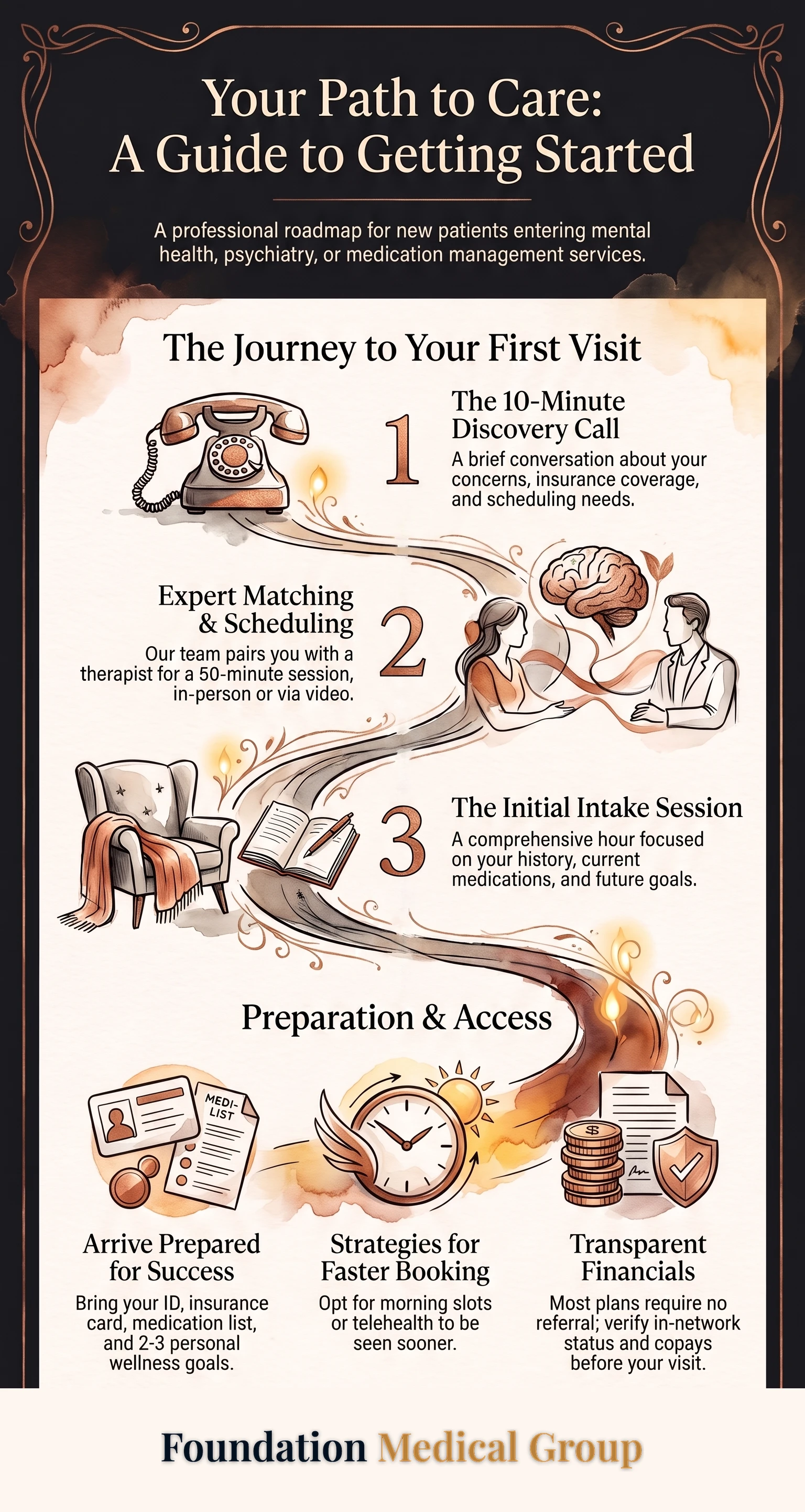
Booking care is simpler than most first-timers expect. Here’s the path new clients follow with us.
| Step | What happens | How long it takes |
|---|---|---|
| 1. Reach out | You call or send a message through our site | 5 minutes |
| 2. Intake call | Staff ask about your concerns, coverage, and schedule | 10 to 15 minutes |
| 3. Benefits check | We verify coverage and explain your likely cost | 1 to 2 business days |
| 4. Match | We pair you with therapists who treat your concern | Often the same week |
| 5. First session | You meet your therapist in person or by video | 45 to 50 minutes |
You do not need a referral from another doctor to see one of our therapists. You also don’t need a diagnosis in hand. Bring the problem as you live it, and we’ll sort out the labels later.
What Happens at Your First Therapy Session?
The first visit is an intake. Your therapist wants your story before anyone writes a plan. Expect questions about sleep, mood, work, family, and what pushed you to reach out now.
According to the American Psychological Association, a session usually runs 45 to 50 minutes. Intake tends to use the whole hour. You’ll cover:
- What’s been hardest lately, in your own words.
- How long it has been going on.
- Past care, if any, and what helped.
- Current medicines and health conditions.
- What a better month would look like for you.
Nothing here is a test you can fail. You can say “I’d rather not talk about that yet,” and a good therapist will respect it. Trust gets built over weeks, not demanded on day one.
What Should I Bring to My First Visit?

A little prep will help you get more out of the hour. Clients who show up with a written list tend to cover more ground in that first session.
| Bring this | Why it helps |
|---|---|
| Photo ID and insurance card | The front desk needs both to file your claim correctly |
| List of current medicines and doses | Your providers need an accurate picture, doses included |
| A short note about your symptoms | Nerves make details slippery, so notes keep you on track |
| Names of past therapists or doctors | Speeds up records and avoids repeating old treatments |
| Two or three goals | Gives your therapist a direction from session one |
If you’re joining by video, test your camera and find a private spot ahead of time. Headphones help more than people expect.
How Soon Can I Be Seen?
Wait times move with demand, the clinic, and how many clients a practice already carries. A place with an open panel can often see a new person within a week or two. A busy solo therapist may quote a month or more.
Three things help you get in sooner:
- Flexibility. Morning and midday slots open sooner than evenings.
- Telehealth. Video widens your options well past your own zip code.
- A cancellation list. Ask to be called when other clients drop a slot.
If waiting feels unsafe, don’t wait. Call or text 988 for the Suicide and Crisis Lifeline, or dial 911. SAMHSA also runs a free, confidential helpline at 1-800-662-4357, staffed 24 hours a day.
Will My Insurance Cover Therapy?
Most health plans cover mental health care today. Federal parity rules bar a plan from putting stricter limits on mental health care than on other medical care. What you pay out of pocket still depends on your own plan.
Ask your insurer four questions:
- Is this practice in network?
- What is my copay for each therapy session?
- Do I need prior approval?
- Is a video visit covered like an office visit?
If you’re on Medicaid, our guide to finding a therapist near me that takes Medicaid covers the rules state by state. Check coverage before your first visit rather than after.
What Kinds of Therapy Do You Offer?

Our services cover a wide range of concerns, and we match the format to the person. Individual therapy is the usual starting point. Couples work and family sessions fit better when the strain sits between people instead of inside one person.
Common reasons new clients reach out:
- Anxiety, panic, and worry that won’t switch off.
- Depression, low mood, and no motivation.
- Grief, trauma, and healing after a hard year.
- Relationships that keep hitting the same wall.
- Stress that’s bleeding into work and sleep.
If worry is your main struggle, our page on working with an anxiety therapist near me goes deeper into anxiety treatment and what helps.
What If Therapy Alone Isn’t Enough?
Sometimes talk therapy needs a partner. Foundation Medical Group is physician-led, so counseling services, psychiatry, and medication management sit under one roof. If medicine could help, you can see a psychiatrist near me without starting over at a new office.
Titles confuse people, so here’s the short version. A licensed counselor, a clinical social worker, and a psychologist can each provide therapy. A psychiatrist is a medical doctor who can also prescribe. Our providers work off the same chart, which means you tell your story once.
That continuity matters for steady growth. Care split across separate offices tends to leak details, and healing slows down when nobody has the full picture. You deserve a team that treats your wellness as one thing, not five.
Key Takeaways
- We’re open to new patients. Therapy, psychiatry, and medication management all have room on the schedule.
- Booking takes one call. Intake runs 10 to 15 minutes, and no referral is needed for most plans.
- The first session is an intake. Expect 45 to 50 minutes of questions, not advice.
- Prep pays off. ID, insurance card, medicine list, and two or three goals.
- Cost is knowable up front. Ask about copay and prior approval before you book.
- You get both sides of care. A physician-led team in Richmond, Dallas, American Fork, and Atlanta, plus telehealth.
Ready When You Are
Reaching out is the hardest part, and you’ve already done the reading. We answer with compassion, we explain costs in plain words, and we move at a pace that feels right for you.
If you’ve been searching for a therapist near me accepting new patients, this is your opening. Contact Foundation Medical Group today, and let’s get your first visit on the calendar.
Sources
- National Institute of Mental Health (NIMH), Mental Illness.
- American Psychological Association (APA), Understanding Psychotherapy and How It Works.
- Substance Abuse and Mental Health Services Administration (SAMHSA), National Helpline.
- Substance Abuse and Mental Health Services Administration (SAMHSA), 988 Suicide and Crisis Lifeline.
- Centers for Medicare & Medicaid Services (CMS), Mental Health Parity and Addiction Equity Act.