
A therapist in American Fork, Utah helps you work through anxiety, depression, trauma, or family stress using proven talk therapy. Most people start with weekly visits, either in an office close to Utah Valley or by video from home. If you’re looking for a therapist American Fork residents can reach soon, here’s how to choose one with confidence.
According to the National Institute of Mental Health, roughly 1 in 5 adults in the United States lives with a mental illness in a given year. Most of those conditions respond to care. Yet the search often stalls at step one, because picking a stranger to talk to about your hardest week feels awkward.
What Does a Therapist in American Fork Actually Do?
A therapist is a licensed clinician trained in counseling and mental health treatment. You talk about what’s happening, and your therapist helps you name the pattern underneath it. Then you practice coping skills between visits until they stick.
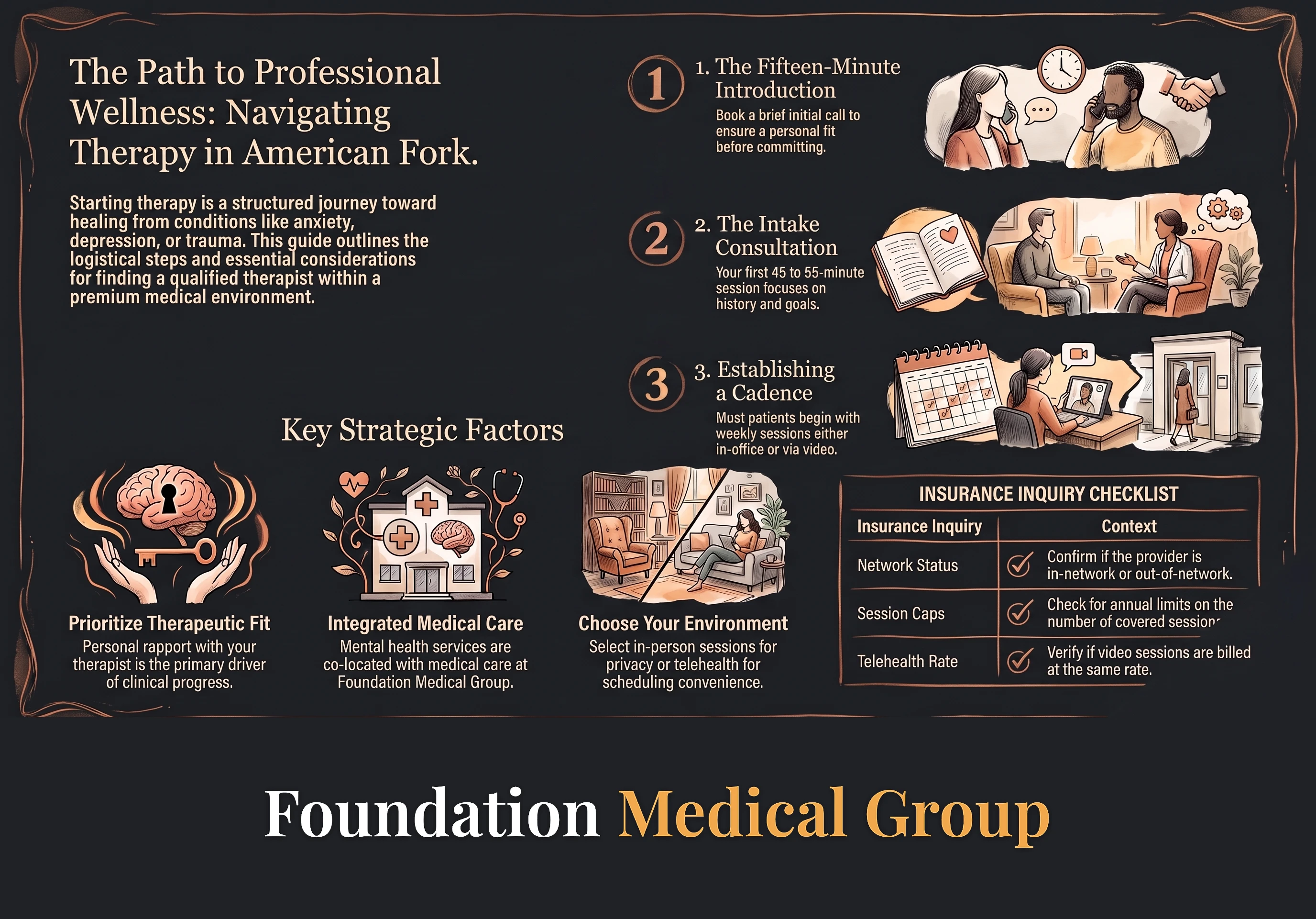
Sessions usually run 45 to 55 minutes, and the first one is mostly history and goals. American Fork therapists come from a few training paths, so the letters after their name differ. A licensed clinical social worker studied social work and often thinks about your environment. A licensed marriage and family therapist trained in how households function.
Therapy isn’t life coaching, and it isn’t a friend giving advice over coffee. It’s structured care with a treatment approach, written goals, and a clinician who’s accountable for your progress. That structure is what turns healing into something steady instead of accidental.
What Kinds of Therapy Can You Get Near American Fork?
Clinics in Utah Valley offer several formats, and the right one depends on who’s struggling and why.
- Individual therapy. One-on-one work on anxiety, depression, or mood disorders.
- Couples therapy. For partners stuck in the same argument for months.
- Family therapy. Parents and kids in the same room, fixing how the family talks.
- Group counseling. Shared sessions with others facing similar challenges.
- Telehealth therapists. Video care for a tight schedule or a long commute.
Method matters as much as format. Cognitive behavioral therapy teaches you to catch a worried thought and test it against the evidence. Trauma focused methods such as EMDR help the brain file a painful memory where it belongs. Some clinicians also train in motivational interviewing or accelerated resolution therapy.
Scope matters too. Severe conditions, like an eating disorder or some personality disorders, usually need a specialty program or a higher level of care. An honest clinic tells you that early and refers you out rather than stretching past its training.
What If the Stress Sits in the Whole Family?
Sometimes one person carries the load for everyone else. A teen goes quiet. A marriage runs on autopilot. Bills pile up and nobody says the hard thing out loud. Family therapy brings the group into one room so the pattern can show itself.
Blame is not the point. Your therapist watches how the family talks, then coaches a calmer way to do it. Parents often notice the shift at home before the teen says a word about it.
Ask which therapy services a clinic runs before you book. Some offices see adults only. Others take teens, parents, and couples in the same week. Two households with the same challenges can still need very different plans.
How Do I Choose the Right Therapist in American Fork?

Break the decision into five checks instead of one big leap.
| What to check | Why it matters | How to check it |
|---|---|---|
| License and training | Sets the standard of care you get | Ask for the license type and verify it with Utah DOPL |
| Focus area | Trauma and anxiety need different skills | Ask how often they treat your concern |
| Insurance status | In-network keeps visits affordable | Call the plan, then confirm with the front desk |
| Access | Care you can’t book doesn’t help | Ask about openings, evenings, and telehealth |
| Fit | Trust drives most of the progress | Book a 15-minute intro call before committing |
That last row carries more weight than people expect. Two clinicians with identical credentials can feel very different across the room from you. Trust your read after one or two sessions, and say something if it isn’t landing. Switching therapists early is normal, and a good clinical director expects it.
What Happens in the First Few Sessions?
The first visit is an intake. Your therapist asks about sleep, mood, work, and home. Nothing is graded here. You can hold back what you’re not ready to say.
Goals come next, often by visit two or three. Good goals are small and plain. “Sleep six hours” beats “feel better,” because you can tell when it happens. Your therapist then picks a method to match the goal.
Most clients also get homework. It might be a worry log, a slow breathing drill, or one honest talk with a parent. The minutes between visits are where change takes root. Clients who practice a little each day tend to move faster than clients who only think about it on the drive over.
How Long Does Therapy Take?
Nobody can hand you an exact number on day one. CBT is usually time limited, and the American Psychological Association describes psychotherapy as care aimed at a goal rather than a lifelong habit. A common path is weekly for a few months, then every other week.
Trauma work runs longer. So does grief, and so does deep family conflict. Healing moves in fits and starts, and one rough week does not undo the good ones. Ask your therapist to review the plan with you every month or so.
Counseling can also stop and start again later. Plenty of clients come back for a short round when life brings new challenges. That isn’t failure. That’s using a tool when you need it. A clinic that tracks goals can tell you what its clients usually experience.
Will Insurance Cover Therapy in Utah?

Usually, yes. Cost is one of the most common challenges patients name. Federal parity rules mean most plans can’t put tighter limits on mental health care than on other medical care, according to the Centers for Medicare and Medicaid Services. What you actually pay still depends on your own benefits, so ask before you book.
- Is this therapist in network with my plan?
- What’s my copay for each session?
- Do I need a referral first?
- Is telehealth covered like an office visit?
- How many sessions does my plan allow this year?
Write the answers down and repeat them back to the clinic. If the two stories don’t match, call your insurer again. Ten minutes on the phone beats a surprise bill in March. If you’re uninsured, ask about sliding-scale fees, and see our guide on finding a therapist near me that takes Medicaid.
In Person or Telehealth: Which Should You Pick?
Both work. In-person visits give you a quiet room away from housemates, which helps with couples work and with kids who need space to move around. Driving 20 minutes to an office also creates a buffer before and after the hard conversation.
Telehealth wins on friction. No commute from Spanish Fork or Provo, no parking, no sitting in a waiting room feeling nervous. For anxiety in particular, video removes a barrier that keeps some clients from ever booking. Plenty of families mix the two, meeting in person monthly and by video the other weeks.
Therapy and Medical Care Under One Roof
Foundation Medical Group is a physician-led practice serving American Fork and Utah Valley, along with Richmond, Dallas, Atlanta, and telehealth patients. Because a doctor leads the team, counseling services and medical care stay connected instead of scattered across offices.
That matters when talk therapy alone isn’t enough. If your sleep is wrecked and your focus is gone, a physician can review whether medication management belongs in the plan, and our psychiatrists coordinate directly with your therapist. If you’re mainly dealing with worry and panic, start with our guide to anxiety therapy instead.
We also screen for depression, trauma history, and substance use at intake, since one untreated piece can quietly stall the rest. Individual sessions, couples therapy, and family therapy all sit under the same roof, so referrals stay internal.
Our team has experience with the problems that travel together. Anxiety with broken sleep. Depression with drinking. A trauma history with a strained marriage. Counseling alone carries a lot of that load. When it can’t, the medical side is already in the building.
In our experience, the hardest part is the first phone call, not the work that follows. New clients often tell us they’d been thinking about it for months. The call itself takes a few minutes.
When Should You Get Help Right Away?
Some moments can’t wait for an opening next month. If you’re thinking about hurting yourself, call or text 988 for the Suicide and Crisis Lifeline. It’s free, private, and staffed around the clock.
SAMHSA also runs a national helpline at 1-800-662-4357 for mental health and substance use referrals. Trained staff answer day and night, and you don’t need insurance to call.
Key Takeaways
- Check the license first. A licensed clinical social worker, family therapist, or psychologist has the training to treat anxiety, depression, and trauma.
- Match the method to the problem. Cognitive behavioral therapy fits anxiety well, while trauma focused care fits post-traumatic stress.
- Fit beats credentials on paper. Use a short intro call, and switch early if the connection isn’t there.
- Confirm coverage twice. Ask your plan and the clinic the same questions before your first visit.
- Progress is not a straight line. Healing moves in steps, so one rough week doesn’t erase the ground you gained.
- Telehealth counts as real care. Video sessions remove the commute from Spanish Fork, Provo, or anywhere in Utah Valley.
- Therapy pairs well with medical care. A physician-led clinic can add medication management when therapy alone isn’t enough.
Start Where You Are
Reaching out is the awkward part, and it gets easier immediately after. One phone call and a 45-minute conversation can change how the next six months feel. Healing rarely arrives in a straight line, but it does arrive when you keep showing up.
Foundation Medical Group welcomes new clients in American Fork and across Utah Valley, in the office or by video. Contact us to book a first visit and start feeling like yourself again.
Sources
- National Institute of Mental Health (NIMH), Mental Illness.
- NIMH, Psychotherapies.
- American Psychological Association (APA), Understanding Psychotherapy and How It Works.
- SAMHSA, 988 Suicide and Crisis Lifeline.
- Centers for Medicare and Medicaid Services (CMS), Mental Health Parity and Addiction Equity Act.