
To find a therapist in Atlanta, check three things before you book. Is the clinician licensed in Georgia? Do they treat what you’re dealing with? Do they take your insurance? Most people land with a licensed professional counselor, a licensed clinical social worker, or a psychologist. Our Decatur office sits minutes from downtown, and telehealth reaches the rest of Georgia.
Reaching out is the hard part. Maybe you’re tired of white-knuckling your way through the week. Maybe you’re worried about a partner, a teen, or a parent who isn’t doing well. That’s reason enough to start. Here’s how therapy works around metro Atlanta, what it costs, and how to tell a good fit from a poor one.
What does a therapist in Atlanta actually do?
A therapist is a trained clinician who provides talk therapy. You talk, they listen, and together you build skills that make an ordinary week feel less heavy. That’s mental health care in its plainest form. Nobody is going to dissect your childhood unless you decide you want to go there.
The letters after a name confuse people, so here’s the short version. An LPC is a licensed professional counselor who finished a graduate program in clinical mental health counseling. An LCSW is a licensed clinical social worker, trained in therapy and also in the practical scaffolding around it, like benefits or housing. A psychologist holds a doctorate and often handles testing. Each is a licensed therapist. Each can treat anxiety, depression, or trauma.
One question matters more than the credentials: how much experience does this person have with your concern? A mental health therapist who sees trauma every week works differently from one who mostly handles career stress. Ask directly. A good licensed professional counselor answers without getting defensive.
Here’s the line that surprises callers most. A therapist doesn’t prescribe medicine. If medication belongs in your plan, a psychiatrist near me search points you toward a medical doctor who can prescribe it and monitor how you respond. A licensed clinical social worker and a psychiatrist often share a patient, and the two sides talk to each other.
Which type of therapy is right for me?
There’s no single answer, though the options sort out fast once you know what each one targets. Cognitive behavioral therapy is the most studied approach for anxiety and depression. It teaches you to catch a spiraling thought and answer it with something steadier. Dialectical behavior therapy adds skills for riding out intense emotions, which helps with self-harm urges and some personality disorders. Acceptance and commitment therapy takes a different angle. Make room for the hard feeling, then act on what you value anyway.
Other approaches turn up around town too. Narrative therapy helps you retell your own story with more room in it. Solution focused therapy keeps the lens on what’s already working. Motivational interviewing shows up when someone feels stuck between changing and staying put.
| Therapy option | What it targets | Usual format |
|---|---|---|
| Cognitive behavioral therapy | Anxiety, panic, depression | Individual therapy, weekly |
| Dialectical behavior therapy | Emotional regulation, self-harm urges | Individual plus group therapy |
| Trauma-focused therapy | PTSD, abuse, grief, healing after loss | Individual, paced slowly |
| Family therapy | Teens, conflict at home, big transitions | Whole family in the room |
| Couples counseling | Communication, trust, relationship therapy | Both partners together |
| Online therapy | Tight schedules, long commutes | Secure video visit |
Most clinicians blend two or three of these. In our experience, a plan that mixes behavioral therapy skills with steady support beats a rigid protocol. The therapeutic approach matters less than whether you trust the person across from you.
What can therapy help with?
Most people arrive with something specific. Anxiety that won’t switch off. Depression that flattens the color out of everything. A trauma carried quietly since childhood. All of it responds to treatment.
- Anxiety. Constant worry, panic attacks, social fear, or a body that stays braced.
- Depression and mood disorders. Low mood, no energy, no interest in what you used to enjoy.
- Trauma. Healing after abuse, an accident, a loss, or violence.
- Relationships. Couples counseling, family therapy, and the strain of parenting.
- Bipolar disorder and personality disorders. Usually therapy paired with medication.
According to the National Institute of Mental Health, depression is one of the most common mental disorders in the United States. Research from the same agency puts anxiety disorders among the most common mental health concerns adults face. So if your mental health challenges feel huge and private, look around the waiting room. It’s full of people carrying something similar.
Trauma deserves its own note, because it’s often what people mention last. Healing from trauma isn’t about retelling the worst day until it stops stinging. A therapist with real trauma experience paces the work, builds coping skills first, and follows your lead on timing. If anxiety is the loudest thread for you, our guide to finding an anxiety therapist near me walks through that search in more detail.
Does therapy help teens and families in Atlanta?

Yes, and it’s one of the most common reasons parents call us. A teenager who’s withdrawn, sleeping at odd hours, or fighting more than usual is often carrying anxiety or depression they don’t have words for yet. Family therapy brings everyone into the same room so the load stops sitting on one person. A skilled therapist keeps the session from turning into a blame contest and helps the family hear each other again.
Adolescents do best with clinicians who treat teens regularly, because the approach differs from adult work. Sessions move at a teen’s pace, respect their privacy within safe limits, and often pull in school stress, friendships, and social media. Ask any office whether the clinician has real experience with adolescents before you book, since not every counselor takes younger clients.
Parents often ask whether they should sit in on the visits. The honest answer is that it depends on the age and the goal. Younger children usually do better with a parent involved, while older teens often need a private space to speak freely. A good clinician tells you which setup fits your family and adjusts as trust builds. Group therapy can help teens too, since hearing a peer describe the same struggle lands differently than hearing it from a parent.
If your teen refuses to go at first, that’s common, and it isn’t a dead end. Sometimes a single parent session gives you tools to lower the temperature at home while your teen warms up to the idea. We’d rather help you take a small step than wait for a perfect one.
How do I find a therapist in Atlanta accepting new patients?
Build a short list, then make short calls. Atlanta therapists book up unevenly, so the office quoting a three-week wait may sit two doors from one with an opening Thursday. Four questions sort the list quickly.
- Are you accepting new patients this month?
- Do you take my insurance plan, and what’s my copay?
- What’s your experience treating anxiety, trauma, or whatever brings me in?
- Do you offer in person visits, online therapy, or both?
Geography still counts, even now that video visits are ordinary. Traffic on I-285 can stretch a 20-minute drive into an hour, so nearby therapists in Decatur, Brookhaven, or Midtown save you more than mileage. Our patients travel in from across DeKalb and Fulton counties, and the ones who pick a closer clinician tend to keep more of their appointments. Metro Atlanta therapy offices cluster around Decatur, Midtown, and Buckhead, which helps if you want to walk from a MARTA stop. When a clinic can’t take you, ask who they’d send a friend to. Most will give you a name on the spot.
Word of mouth still finds a therapist Atlanta neighbors trust faster than any listing. Insurance, though, shapes your cost more than anything else on the list. If you’re covered by Medicaid, our guide to finding a therapist near me that takes Medicaid covers the questions worth asking before you book.
What happens in your first therapy session?
A therapy session runs 45 to 60 minutes. The first one is mostly history. What brought you in, what you’ve already tried, what you want to be different six months from now. You share what you’re ready to share, and nothing gets pried out of you.
Bring your insurance card, a list of your medicines, and a rough timeline of when things got hard. That’s all you need. No notes, no speech, no tidy story. Most of our patients say that first hour felt lighter than they’d braced for.
By the second or third visit, the work turns practical. You set a goal. You learn a skill or two. You start noticing patterns in what you experience between sessions, which is where most of the change actually happens. The therapeutic relationship builds during that stretch. According to the American Psychological Association, that bond ranks among the strongest factors in whether therapy works at all.
Give it two or three visits before you judge the fit. Feeling raw after a hard hour is normal, and healing isn’t always comfortable. Feeling judged, rushed, or unheard is a different signal entirely. You can switch, and a decent counselor won’t take it personally. Individual progress runs on its own clock, so compare yourself to last month rather than to anyone else.
How do you know therapy is working?

Progress is quiet. It rarely lands as one big breakthrough. You sleep better. You snap at your kids less. A worry that used to eat a whole day now takes an hour.
Ask your counselor to name what you’re working on, then write it down. Check that list once a month. Did the panic get shorter? Did depression loosen its grip on your mornings? Did you go back to the gym? Small wins count, and they stack up.
Healing after trauma moves slower than that. Some weeks feel like a step back. That’s normal, and it doesn’t mean the work failed. Tell your counselor when it happens. A counselor with real clinical expertise will ease the pace and rebuild your footing first.
If nothing shifts after a few months, say so out loud. A good counselor changes the plan, adds a skill, or brings in a psychiatrist. Sitting quietly through a stalled year isn’t worth your hour or your money.
What does therapy cost in Atlanta, and does insurance help?
With insurance, you typically pay a copay and your plan covers the rest of the visit. Without it, you pay the full session fee, which varies by clinic and by the clinician’s credentials. Ask three questions before your first appointment: am I in network, what’s my copay, and do I have a deductible to meet first?
Write the answers down along with the date and the name of whoever told you. Benefits get quoted differently by different people on the same phone line, which is how surprise bills happen. Our Decatur staff runs that benefits check for new patients before the first visit and explains the numbers in plain language.
Two other doors are worth knowing about. Some Georgia clinics keep a sliding scale for patients paying cash, so ask what the lowest fee is instead of the sticker price. Plenty of employers also run an EAP, which pays for a handful of visits before your insurance gets billed at all.
Cost isn’t only money, either. Weekly individual therapy asks for an hour plus travel, and honestly, that’s the part people underestimate. Online therapy trims the travel. Group therapy usually costs less per session and adds something individual work can’t, which is hearing your own story in somebody else’s words.
Should you choose in-person in Decatur or online across Georgia?
Both work, and the right pick usually comes down to your week rather than your diagnosis. Talk therapy translates well to secure video, so online therapy is a solid fit for anxiety, depression, and steady maintenance work. It also erases the drive, which matters when I-285 turns a short trip into an ordeal. Patients with tight schedules, young kids at home, or long commutes tend to keep more of their online appointments than their in-person ones.
In-person visits still hold an edge in a few situations. A first meeting can feel warmer face to face, and some people focus better away from home, where the laundry and the dog aren’t in frame. Certain kinds of care, like a psychiatric evaluation that includes vitals or an in-office treatment, simply need you in the building. Trauma work sometimes goes smoother in person too, where a clinician can read the room and slow down at the right moment.
| Situation | Better fit |
|---|---|
| Long commute or packed schedule | Online therapy across Georgia |
| First visit and you want a warmer read | In person in Decatur |
| Psychiatric evaluation or in-office treatment | In person |
| Steady maintenance once you’re settled | Online, with in-person when needed |
You don’t have to choose once and stick with it. Plenty of our Georgia patients start in the Decatur office to get comfortable, then shift to video once the relationship is set, and switch back when a hard stretch calls for it. Ask whether a clinic offers both before you commit, since a mix gives you the most room to keep care going when life gets busy.
What if you need help right now?
A waitlist is useless in a crisis. If you’re thinking about hurting yourself, call or text 988. The 988 Suicide and Crisis Lifeline answers 24 hours a day, every day of the year, and it costs nothing.
To find treatment, the SAMHSA National Helpline is free and confidential at 1-800-662-4357. It runs around the clock, all year, and staff can point you toward care in metro Atlanta. If someone is in immediate danger, call 911 or head to the nearest emergency room.
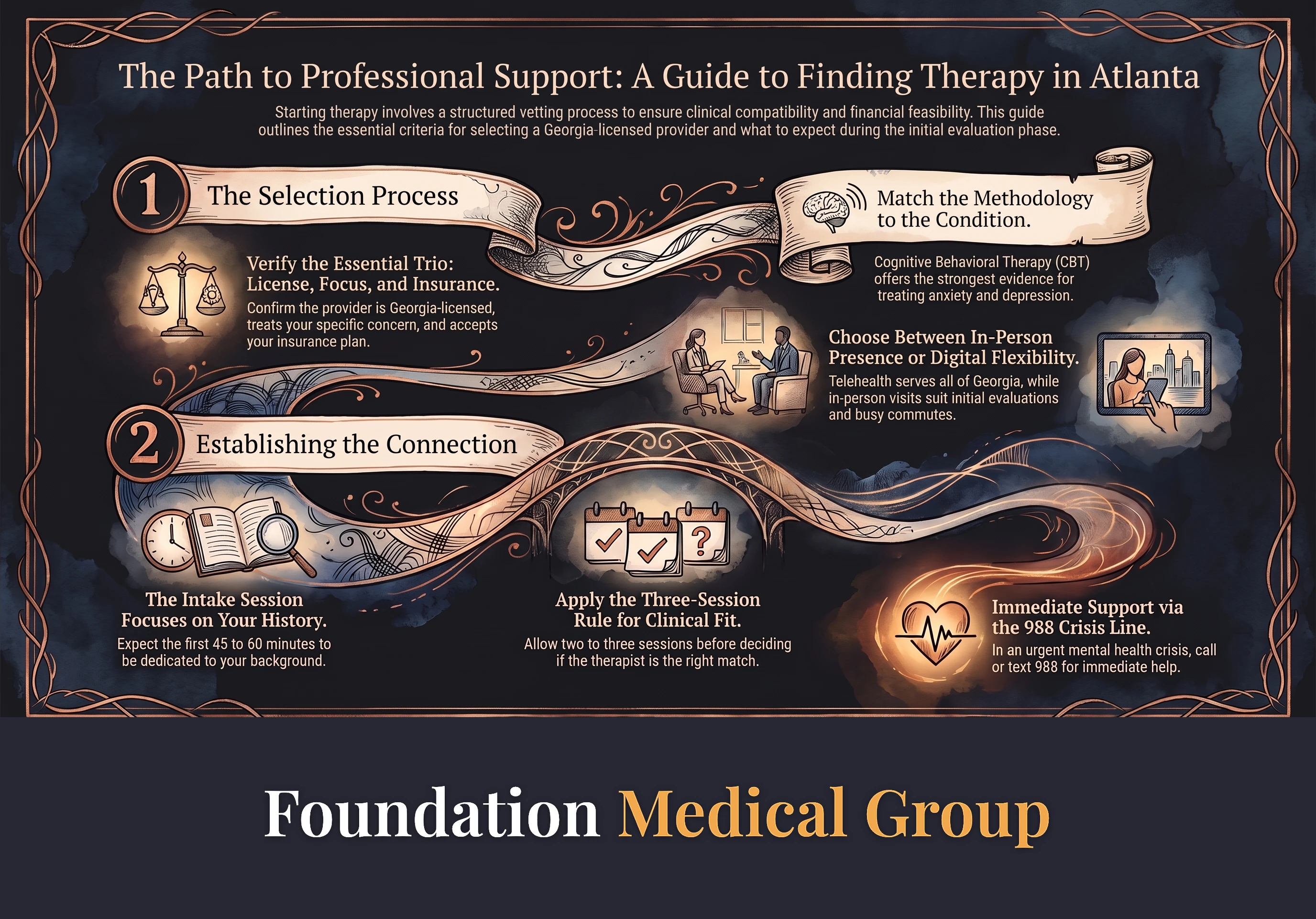
Key Takeaways
- A therapist provides therapy and doesn’t prescribe medicine; a psychiatrist handles medication, and many patients see both.
- A licensed professional counselor, a licensed clinical social worker, and a psychologist can all treat anxiety, depression, and trauma.
- Cognitive behavioral therapy has the strongest evidence for anxiety and depression, while DBT skills target emotional regulation.
- Call several offices and ask about openings, insurance, and the clinician’s experience with your concern.
- Give a new therapist two or three sessions, then switch if the fit still feels wrong.
- Video visits cover all of Georgia when a drive across metro Atlanta doesn’t fit your week.
- In a crisis, call or text 988, or reach the SAMHSA National Helpline at 1-800-662-4357.
If you’ve been meaning to call somebody, this is a fine week to do it. You don’t need tidy words or a clear diagnosis first. Foundation Medical Group’s Decatur office sits at 160 Clairemont Ave, near the MARTA station. Our physician-led team serves patients across metro Atlanta with psychiatric care and medication management, in person or by video. We’re adding talk therapy to the Georgia line-up as the team grows. We also see patients in Richmond, Virginia, Dallas, Texas, and American Fork, Utah. Call (706) 534-8574 when you’re ready, and we’ll walk you through the first step.
Sources
- National Institute of Mental Health, Depression: nimh.nih.gov.
- National Institute of Mental Health, Anxiety Disorders: nimh.nih.gov.
- American Psychological Association, Understanding psychotherapy and how it works: apa.org.
- SAMHSA National Helpline: samhsa.gov.