
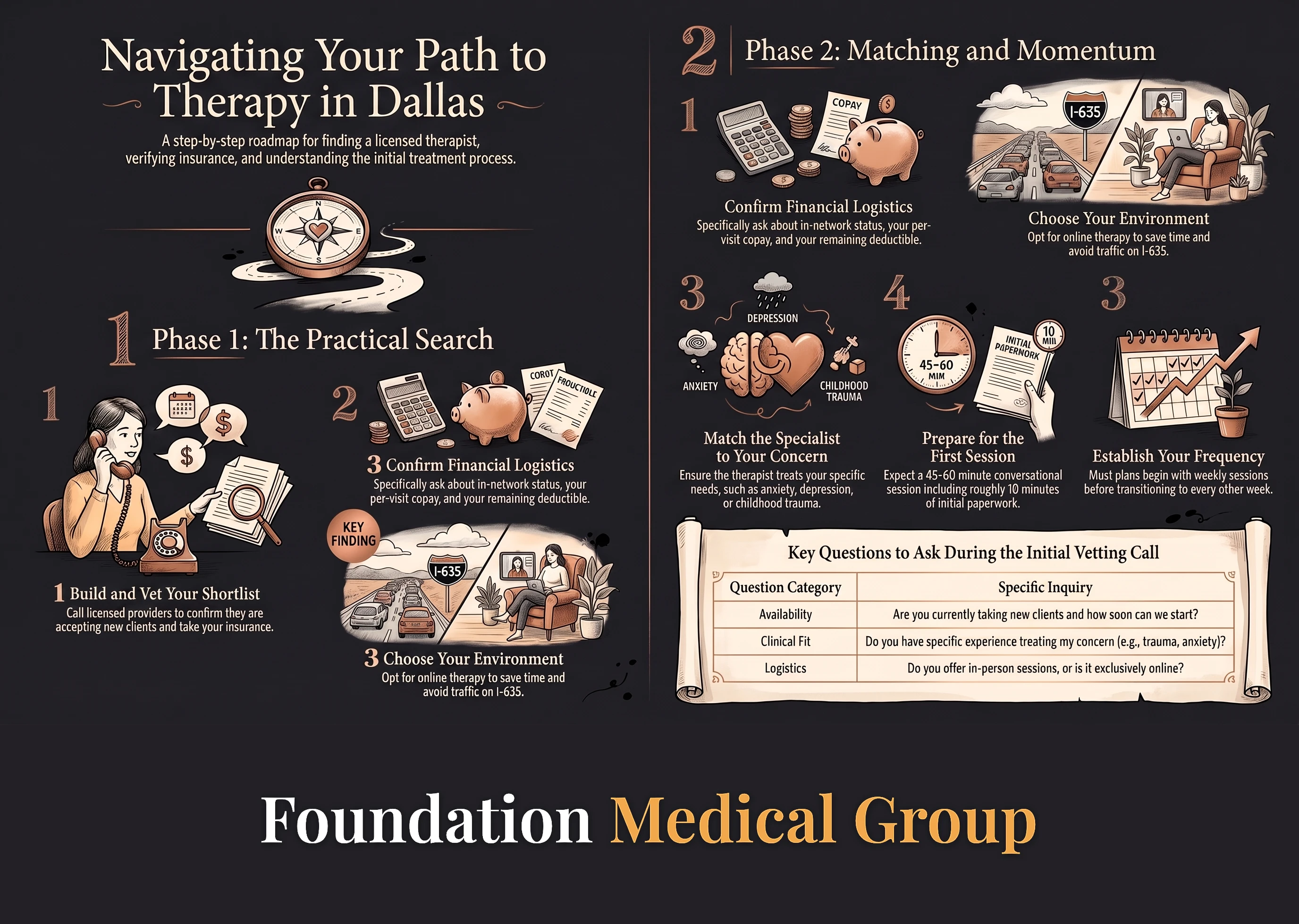
To find a therapist in Dallas, build a short list of licensed therapists near you. Then call each office and ask two questions: are you taking new clients, and do you accept my insurance? A good match treats your concern, whether that is anxiety, depression, or trauma. At Foundation Medical Group in North Dallas, our physician led team keeps that first step simple.
Reaching out takes nerve. Maybe you’ve been putting it off since spring, or maybe today was the day the worry got too loud to ignore. Either reason is good enough. What follows is a plain walkthrough of counseling in Dallas: who does what, what a session costs, and how to pick someone you can actually talk to.
What kind of therapist do I need in Dallas?
A therapist is a trained professional who provides talk therapy. You talk, they listen, and together you build skills that make daily life lighter. Dallas therapists carry different letters after their names, and those letters describe training rather than skill.
A licensed professional counselor, or LPC, holds a master’s degree in counseling plus thousands of supervised clinical hours. A licensed professional counselor associate is still finishing those hours under supervision, often at a lower fee. A licensed clinical social worker comes from a social work background, treats mental health concerns, and usually knows the community resources around Dallas. A family therapist works with parents, teens, and couples in the same room. A psychologist can run a psychological evaluation when a diagnosis is murky. That includes an ADHD psychological evaluation for adults who have struggled since school.
One difference matters more than the letters. A therapist does not prescribe medicine. That job belongs to a physician, so if medication may be part of your plan, a psychiatrist is the person to see. In our experience, patients often do best with counseling and medication management running side by side.
Adults walk into counseling for all sorts of reasons. Common ones include:
- Anxiety counseling for worry that will not switch off at night.
- Depression, flat mood, or burnout that has dragged on for months.
- Trauma counseling after a crash, a loss, or a rough childhood.
- Couples counseling, sometimes called marital counseling, and family counseling for strain at home.
- Teen therapy for a kid who has gone quiet, and family therapy when the whole house feels it.
- Individual therapy for stress, grief, and better coping skills.
According to the National Institute of Mental Health, anxiety disorders are among the most common mental health conditions in the United States. Depression affects millions of adults each year. If you have an anxiety disorder, you are in ordinary company, and the treatment for it is well studied.
How do I find a therapist in Dallas who takes my insurance?
Start with three to five names, not thirty. Ask your primary care doctor for a referral, check your insurer’s provider directory, or call a local clinic and ask which therapists they trust. Then pick up the phone. A five minute call tells you more than an hour of scrolling.
Ask each office the same short set of questions:
- Are you accepting new clients this month?
- Are you in network with my plan?
- How much experience do you have with my concern, such as trauma or an anxiety disorder?
- Do you offer in-person visits, online therapy, or both?
- How soon could I get a first appointment?
Insurance shapes what you pay more than the sticker fee does. Most Dallas plans cover outpatient mental health counseling services, including Blue Cross Blue Shield of Texas, Aetna, Cigna, United Healthcare, and many Medicare Advantage plans. Ask the office to verify your benefits before you book. Two therapists with the same hourly rate can leave you paying very different amounts once your deductible and copay are applied.
A search for “therapist Dallas” returns page after page of names, so two more questions help you narrow it down. Ask how long the wait is, because some therapists open a slot within a week while others run a month out. Then ask how you would meet, since a video visit can save you a run down I-635 at rush hour.
If calling around wears you out, one clinic that handles both sides saves steps. Our Dallas team on LBJ Freeway coordinates talk therapy with psychiatric care, in the office or by video. Your counselor and your prescriber read the same chart.
Which type of therapy helps with anxiety, depression, or trauma?

No single approach suits every person, which is why therapists train in several. Experience matters as much as method. Cognitive behavioral therapy, usually shortened to CBT, has the deepest research base for anxiety and depression. In cognitive behavioral therapy you learn to catch the thought behind the feeling, test it, then answer it with something steadier. For instance, “I will freeze in that meeting” becomes “I have prepared, and I can handle a pause.”
Other methods take different routes. Dialectical behavior therapy leans on skills for riding out intense emotion. Acceptance and commitment therapy teaches you to make room for a hard feeling instead of wrestling it, then act on what you value anyway. For trauma, EMDR and trauma focused cognitive behavioral therapy help the brain file a memory so it stops ambushing you at red lights. Healing from trauma tends to move slower than people expect. Somatic work targets the stress your body holds in the jaw, gut, and shoulders.
Here is how the common options compare:
| Therapy type | Often used for | What you actually do | Where you meet |
|---|---|---|---|
| Cognitive behavioral therapy | Anxiety, depression, panic | Catch a thought, test it, replace it | In person or online |
| Dialectical behavior therapy | Intense emotion, urges to self harm | Practice distress and emotion skills | In person or online |
| Acceptance and commitment therapy | Chronic worry, grief, chronic pain | Make room for the feeling, act on values | In person or online |
| Trauma focused therapy and EMDR | Trauma, PTSD, flashbacks | Process the memory so it loses its charge | In person, sometimes online |
| Couples and family therapy | Conflict, parenting, big changes | Talk it through with everyone in the room | In person or online |
| Group therapy | Isolation, shared struggles | Practice with people facing the same thing | In person or online |
Ask a prospective therapist which approach they use and why. A licensed professional counselor with extensive experience in trauma work will answer that in plain words instead of jargon. According to the American Psychological Association, psychotherapy works best when the therapist fits the method to the client, not the other way round.
What happens in a therapy session?
A therapy session usually runs 45 to 60 minutes. The first one is mostly conversation, plus new client paperwork that takes about ten minutes. Your therapist asks about your history, your symptoms, your sleep, and what you want out of counseling. Nothing gets pulled out of you before you’re ready. Most therapists start you weekly, then stretch visits to every other week as things steady.
After that, sessions turn practical. You review the week, look at what caused the most stress, and rehearse a skill. Homework is common, and it is usually small: track your stress for three days, or try one breathing exercise before bed. Healing rarely arrives as a single breakthrough. It shows up as a Tuesday that went better than the Tuesday before.
Progress deserves a check now and then. Around session six or eight, ask your counselor what has shifted and what still needs work. A good therapist welcomes that question, because the answer shapes the plan.
How much does therapy cost in Dallas?

Cost depends on the therapist, the setting, and your plan. A licensed therapist in private practice sets their own fee, while a group clinic bills your insurer at a negotiated rate. With coverage you usually pay a copay per visit. Without coverage you pay the full session fee.
Three questions prevent most surprise bills:
- Is this provider in network with my plan?
- What is my copay for each visit?
- Do I have a deductible to meet first, and how much of it is left?
Write down the answers, the date, and the name of the person you spoke with. Some therapists offer a sliding scale based on income. An associate level counselor with less experience generally charges less than a senior one. Asking about either is normal, and it is not rude. Cost keeps plenty of adults out of care far longer than the symptoms would.
Can I see a Dallas therapist online instead?
Yes. Online therapy is now a standard option rather than a backup. Texas licensing lets a therapist meet clients anywhere in the state by video. Telehealth counseling suits a packed week, a commute that adds stress, or a person who talks more freely from their own couch. Most Dallas therapists now offer both.
Video works well for anxiety counseling and most individual therapy. It fits less well for a young child who needs play based work, or for anyone in crisis who needs support in the room. Our Texas patients often mix the two: a first visit at the Dallas office, then online therapy for follow ups. For coverage questions, our guide to finding a therapist that takes Medicaid goes deeper. If worry is the main driver, the piece on choosing an anxiety therapist near me is a useful next read.
What if I need help right now?
A waitlist is no help in a crisis. If you are thinking about hurting yourself, call or text 988. The 988 Suicide and Crisis Lifeline is free and answers 24 hours a day, every day of the year. For help finding treatment, the SAMHSA National Helpline is free and confidential at 1-800-662-4357. If someone is in immediate danger, call 911 or go to the nearest emergency room.
How do I know a therapist is the right fit?
Give it two or three sessions before deciding. The first visit is intake, so it rarely feels like the real work. By the third, you should feel heard, and you should have a rough plan with something to work toward.
Good signs are easy to spot. Your therapist explains things in plain language. They remember what you said last time. They ask, now and then, whether the work is helping. Feeling tender after a hard session is normal, because healing is not always comfortable. That is different from feeling judged, rushed, or brushed off.
If the fit is wrong, you can switch. Every client has the right to ask for a better match, and most therapists take it in stride and offer a referral. Trust your read on this. A client who feels respected tends to stay in treatment long enough for it to work. The healing that follows is worth one awkward conversation.
Key Takeaways
- A therapist provides therapy but does not prescribe; a psychiatrist manages medication, and many patients need both.
- Licensed therapists in Texas include a licensed professional counselor, a licensed clinical social worker, and a psychologist.
- Call three to five offices and ask about openings, network status, and their experience with your concern.
- Cognitive behavioral therapy leads for anxiety and depression, while trauma counseling and EMDR target trauma.
- Online therapy and telehealth counseling reach the whole state, which removes the drive from the equation.
- Ask about the deductible and copay before the first visit, not after the bill lands.
- In a crisis, call or text 988, or reach the SAMHSA National Helpline at 1-800-662-4357.
Our Dallas clinic sits at 8390 Lyndon B Johnson Freeway, Suite 500, Dallas, TX 75243. That is right on LBJ, with easy access from US-75 and I-635, and parking is free on site. The office is open Monday through Friday, 8am to 5pm, and the team answers at 469-909-1312. Dr. Justin Thompson leads our Texas care, and patients drive in from Plano, Carrollton, Irving, and Fort Worth. We also serve Richmond, Virginia, American Fork, Utah, and Atlanta, Georgia, with telehealth across Texas.
If anxiety, low mood, or a hard year has been running the show, reach out to us. You do not need the right words or a finished plan. Our warm, physician led team at Foundation Medical Group is accepting new patients for therapy and mental health care in Dallas. We will help you take the first calm step.
Sources
- National Institute of Mental Health, Psychotherapies: nimh.nih.gov.
- National Institute of Mental Health, Anxiety Disorders: nimh.nih.gov.
- American Psychological Association, Understanding psychotherapy and how it works: apa.org.
- SAMHSA National Helpline: samhsa.gov.