
Yes, you can find a therapist near you that takes Medicaid. Every state covers mental health care under Medicaid, and that includes therapy. The fastest way is to call the number on your Medicaid card, or just ask the clinic if they take your plan. Foundation Medical Group in Richmond, Virginia can check your coverage before you book.
That’s the short answer. Finding the right fit can feel like one more hard thing on a long list, and you’re likely carrying enough already. We’re a physician-led clinic in central Virginia, and we help people take this step every week. Below, we walk through it in plain words. You’ll know what to do and what to expect.
How Do I Find a Therapist Near Me That Takes Medicaid?
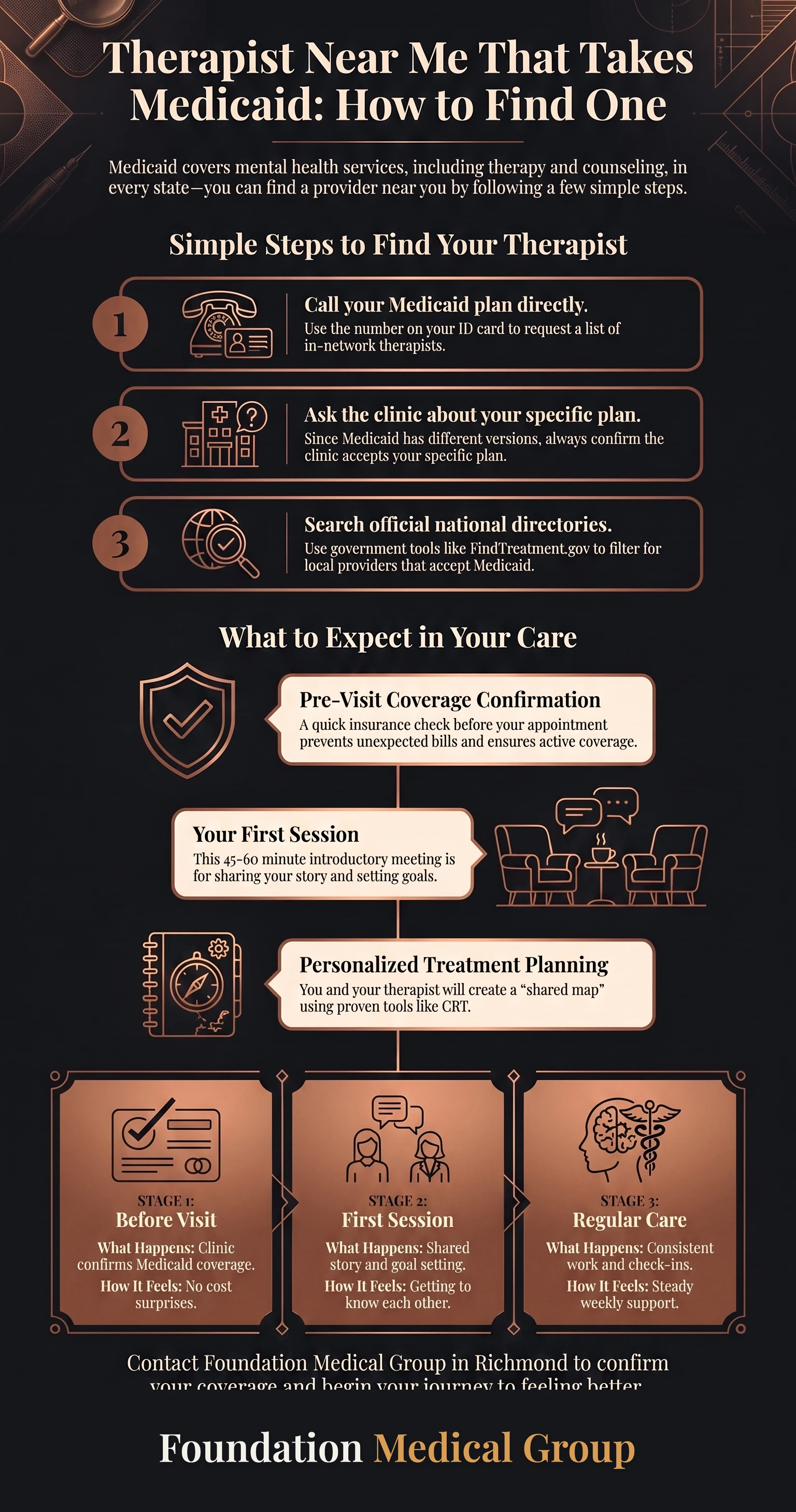
Start with two simple checks. First, look for a clinic near you that offers therapy and counseling and says it takes Medicaid. Second, make sure they take your exact plan. Plans differ from state to state, and sometimes inside one state too.
According to Medicaid.gov, Medicaid is the single largest payer for mental health care in the country. So the real question isn’t whether you’re covered. It’s which nearby therapist is in your network.
You’ve got a few good ways to search:
- Call your plan. The number on your card gets you a list of in-network therapists near you.
- Ask the clinic. One quick call tells you if they take your plan and have openings.
- Ask someone you trust. A friend, a doctor, or a loved one can point you to the right therapist faster.
- Search a national directory. The free tool FindTreatment.gov lets you filter for nearby help that takes Medicaid.
If you’d rather talk to someone right now, you can. According to SAMHSA, its national helpline is free, private, and open 24 hours a day, every day of the year.
At Foundation Medical Group, our care team can run your ID and confirm coverage before your first appointment. A two-minute call now saves you a surprise bill later. If you also carry private insurance, mention it. Some people have both, and we’ll bill the right one. We see patients across Richmond, Midlothian, and the rest of central Virginia, so a good option is often closer than you think.
What Kind of Therapy Will I Get?
Therapy isn’t one single thing. A good therapist matches the approach to you, so your plan fits your specific needs and not a template.
One common method is cognitive behavioral therapy, or CBT. It helps you spot the thoughts and behaviors that keep you stuck. Then you practice new ones. Your therapist gives you real support and small tools you can use between sessions. Say a worry keeps you up at night. Your therapist might hand you a short exercise to test that thought, instead of believing it right away.
Another approach is acceptance and commitment therapy. It helps you make room for hard feelings while you keep moving toward the life you want.
Talk therapy also leaves you with skills you keep for good, which medicine alone can’t do. Your therapist explains each step in plain words, so you always know why you’re doing the work.
Counseling helps with many of life’s challenges, such as:
- Everyday stress and worry that won’t switch off.
- Grief after the loss of a loved one.
- Big changes, like a move, a new job, or a divorce.
- Low mood and other mental health concerns.
- Difficulty with family, a partner, or a friend.
- Anxiety that gets in the way of sleep or work.
Research from the National Institute of Mental Health shows anxiety disorders are among the most common mental health conditions in the country. You’re in good company, in other words. Therapy can help with sleep, mood, and the worry you carry into work. And you don’t need a formal diagnosis to start counseling.
What Happens at My First Therapy Session?

The first appointment is calmer than most folks expect. People often picture something intense, and therapy is usually much quieter than that. It runs about 45 to 60 minutes. Mostly it’s a chance to get to know each other. You share what brought you in, a little history, and what you hope for.
One person came to us just to talk through the stress of caring for an aging parent. That’s a perfectly good reason. There’s no pressure to tell your whole story at once.
Some therapists call you a client instead of a patient. It means the same thing. You’re a person first, and the word doesn’t change the support you get. You can meet in person or by video, whichever feels easier.
By the end, you and your therapist sketch a simple treatment plan. Think of it as a shared map. It shows where you’re headed and how you’ll get there. You can change it any time your needs change.
Here’s what the therapy process looks like, from the first call to steady care.
| Stage | What happens | How it feels |
|---|---|---|
| Before your visit | The clinic confirms your Medicaid coverage | One quick call, no cost surprises |
| First session | You share your story and set goals | Getting to know each other |
| Building the plan | You and your therapist agree on a treatment approach | Clear next steps, in plain words |
| Regular counseling | You do the work and check in | Steady support, week to week |
| As you grow | Sessions space out as you feel stronger | More tools, more confidence |
Every person moves at their own pace. Some come for 4 to 6 sessions during a rough patch, then feel ready to move on. Others stay for months to work on deeper concerns, sometimes with an anxiety therapist who focuses on that area. Both paths are normal. Neither one is better.
A therapist is a person too, so the fit matters. If it isn’t right after a few sessions, say so. Asking for a different therapist is normal, and nobody will be offended.
Why Coverage Matters, and How to Confirm It

Cost is why a lot of folks wait too long to get help. In our Richmond clinic, the first thing new patients ask about is almost always price, not the therapy itself.
Medicaid takes most of that worry away. It covers counseling services for mental health, and your share is usually small or nothing when your therapist is in-network. Medicaid works differently from private insurance, but the goal is the same: you get care without wrecking your budget.
Before your first visit, our front desk checks two things. Is your plan active? Do we take it? Those two quick checks protect you from a bill you didn’t expect.
If you aren’t sure what your plan covers, just ask. One of our patients put it simply: “I wish I had called a year sooner.” A clear answer up front lets you focus on your care, not your paperwork.
Counseling isn’t only for a crisis, either. Many individuals use it as steady support during recovery from alcohol or drug use, and your plan covers that too.
One last tip. Keep your Medicaid details current. In our experience, an expired card or an old address is what holds up a claim most often. A short update now saves a headache later.
Key Takeaways
Here’s what to hold on to as you take this step.
- Medicaid covers mental health services, including therapy and counseling, in every state.
- To find a therapist near you, call your plan or ask a clinic if they take your Medicaid.
- Your first session is about getting to know each other and building a simple treatment plan.
- Cognitive behavioral therapy and acceptance and commitment therapy are matched to your specific needs.
- You don’t need a diagnosis to start. Stress, grief, and big life changes are reason enough.
- Confirm your coverage before you book, so there are no surprise costs.
Asking for help is a brave, healthy choice. It isn’t weakness. Whatever season of life you’re in, the right therapist can walk beside you.
If you’re in the Richmond, Virginia area and want a therapist who takes Medicaid, Foundation Medical Group is here for you. Call us to confirm your coverage and book your first counseling session. Our care team keeps the process simple, so you can focus on feeling better.
Sources
- Medicaid.gov, Behavioral Health Services
- Substance Abuse and Mental Health Services Administration (SAMHSA), National Helpline
- National Institute of Mental Health (NIMH), Psychotherapies