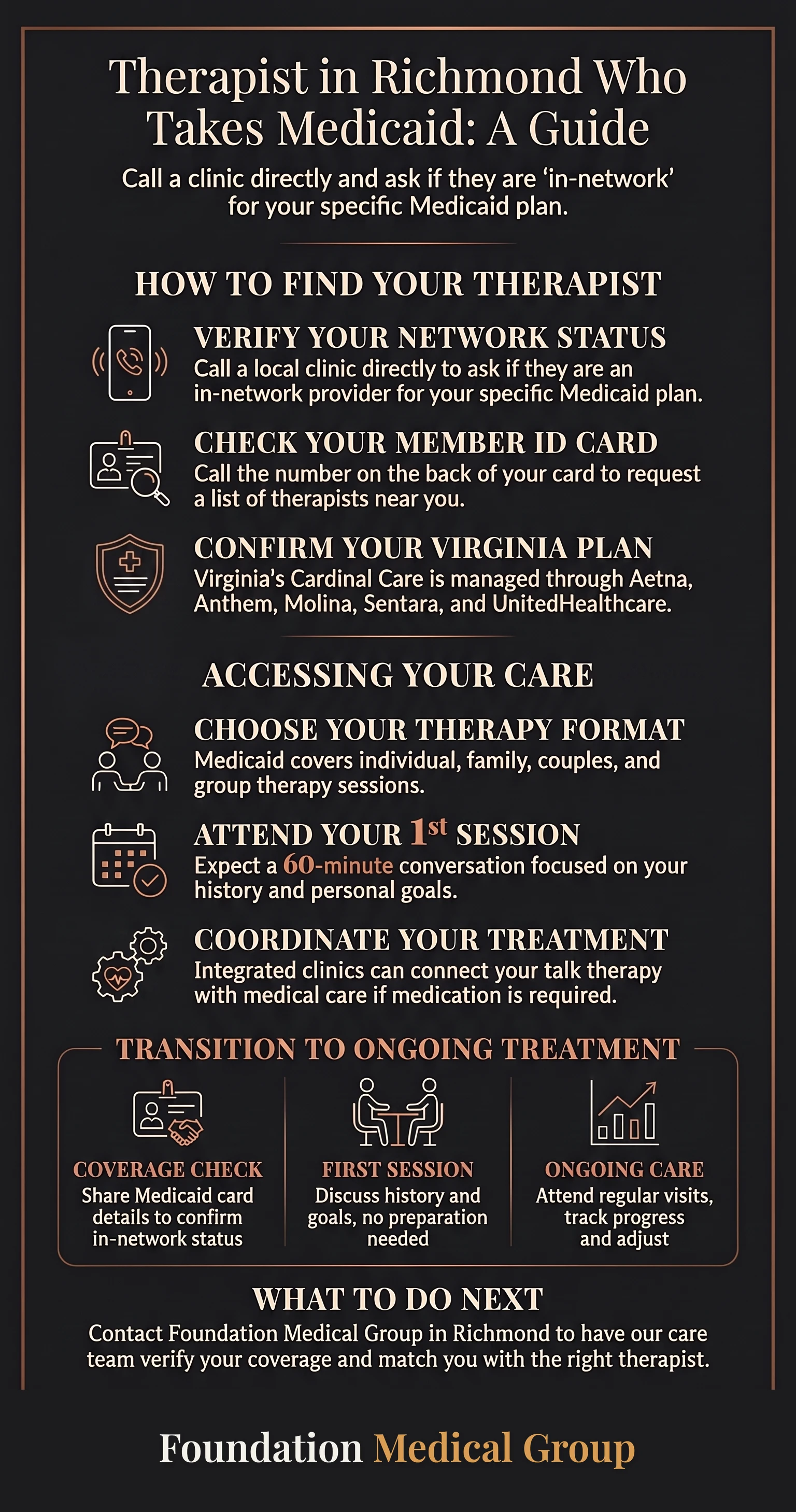
To find a therapist in Richmond who takes Medicaid, call the clinic and ask if they’re in network with your plan. You can also call the member number on your Medicaid card. Medicaid covers counseling in every state, so the real work is checking your own plan. At Foundation Medical Group in Richmond, our team checks your coverage for you.
How do I find a therapist in Richmond who takes Medicaid?
The fastest way is a phone call. Ask one plain question: do you take my Medicaid plan? A good front desk will check while you wait. You can also call the member number on the back of your Medicaid card and ask for a list of mental health providers near you.
Plenty of folks start by typing therapist Richmond Medicaid into a search bar. That works too. On a clinic page, look for words like in network, Medicaid therapist, or accepted insurance. In network means the clinic has an agreement with your insurance plan. That agreement keeps your cost low, and often at no cost at all.
Here in Richmond, VA, you have real choices. Foundation Medical Group is a physician-led clinic. Our team runs the insurance check for you, so you’re not stuck on hold. If you’d rather search wider first, our guide to a therapist near me that takes Medicaid walks through the same steps for any city.
Five questions make it easier to find the right therapist:
- Do you have an in network therapist taking new clients this month?
- How long is the wait for a first visit?
- Do you offer video visits as well as visits in person?
- Does the therapist have experience with what I’m facing, such as grief, panic, or trauma?
- What will I owe on the day of my visit?
Write the answers down. After three calls, they start to blur.
In our experience, the single biggest time saver is calling the clinic first rather than working through a long plan directory. Directories go stale. A front desk knows who has openings this week.
Does Medicaid cover therapy in Virginia?
Yes. Medicaid covers mental health care in every state, and Virginia is no exception. Here the program is called Cardinal Care. Your mental health coverage runs through a health plan such as Aetna, Anthem HealthKeepers, Molina, Sentara, or UnitedHealthcare.
What changes from plan to plan is the fine print. How many visits you get. Whether you owe a small copay. Which clinics count as in network. That’s why we check your insurance before your first visit rather than after it.
According to Medicaid.gov, state Medicaid programs cover a broad range of behavioral health services, and every state offers some mental health coverage. Per the Virginia Department of Medical Assistance Services, Cardinal Care members get their counseling benefits through their assigned health plan.
Your member handbook lists what your plan includes. If reading that handbook feels like homework, our staff will go through it with you. That’s part of our job, not a favor. Medicaid exists so you can access therapists close to home instead of paying out of pocket.
Medicaid may also pay for other mental health services when counseling alone isn’t enough. If medication ever becomes part of your care, we can line that up too. Therapists provide talk therapy, not medication.
How much will therapy cost with Medicaid?
Therapy costs under Medicaid are low by design, and for many members they’re zero. For example, one member may have a plan with no copay at all. Another may owe a few dollars each visit. Virginia caps cost sharing for Medicaid members at a small amount, and some groups, such as children and pregnant members, are exempt from copays entirely.
A two-minute insurance check answers this before you commit. Ask the clinic these three things:
- Is my insurance in network for outpatient counseling, and for a therapist in particular?
- Do I owe a copay, and how much is it?
- Does my plan limit how many mental health visits I get in a year?
Cost is not the only barrier, and money worries are rarely the whole story. Getting to the office matters too. Virginia Medicaid covers non-emergency medical transportation, which means your insurance plan may arrange a ride to a covered visit. Data from your plan’s member services line will confirm whether you qualify. Ask about it in the same call, because plenty of members never learn the benefit exists.
What kinds of therapy does Medicaid cover?
Counseling comes in several forms, and Medicaid plans commonly cover most of them. The right fit depends on what you’re carrying and who else is involved.
- Individual therapy. One on one time with your therapist, built around your own goals. This is person centered therapy at its simplest.
- Family therapy. Useful when the problem touches the whole household.
- Couples therapy. Support for two partners working on their relationship.
- Group therapy. A small group led by a licensed professional counselor, where members share and learn together.
Inside those formats, your clinician picks a therapeutic approach. Cognitive behavioral therapy helps you catch and change unhelpful thoughts. Solution focused therapy keeps the work on small, near term steps. Trauma informed care shapes each visit around safety when past trauma is part of your story.
You don’t need to know which one you want before you call. A qualified therapist will help you find the approach that fits once they hear your story. Every individual plan is different, so ask what your own plan covers.
Can my child get counseling with Medicaid?

Yes, and children have stronger protection than adults do. Under a federal Medicaid rule known as EPSDT, members under 21 are covered for services that are medically necessary, whereas adult benefits can carry tighter limits. For instance, a teen with anxiety that keeps them home from school can usually start counseling without a long approval fight.
School counselors, pediatricians, and our own clinicians can all make the referral. If you’re a parent reading this at midnight, worried and out of ideas, start with one phone call in the morning. You do not have to have the words ready.
Does therapy help?
Yes, for most people. According to the National Institute of Mental Health, psychotherapy is an effective treatment for depression and anxiety, on its own or alongside medicine. Research from NIMH also supports counseling for trauma and for grief that will not lift. NIMH reports that more than 1 in 5 U.S. adults live with a mental illness, so if you’re struggling, you are in very ordinary company.
Healing isn’t a straight line, though. Some weeks feel lighter. Others feel stuck, and that is normal. Most clients tell us the first change they notice is small. Sleeping a little better. Snapping less at the people they love. That counts, and it builds.
Counseling also helps when nothing feels wrong enough to have a name. You do not need a diagnosis of mental illness to deserve mental health support. Grief, a hard job, money stress, a new baby, a move: all of it is fair ground for counseling.
Each person’s experience of healing is a bit different. Some clients feel relief after 3 or 4 visits. Others need a season of steady work before depression lifts. Neither one means you’re doing it wrong.
How do you know counseling is working? Most clients notice function before feeling. You answer a text you’d been avoiding. You get through a workday without the afternoon crash. Ask your therapist to name 2 or 3 markers at the start, then check them together around week 6. If nothing has shifted by then, say so out loud. Changing the approach, or changing the therapist, is part of the work rather than a failure of it.
Is online therapy or visiting in person better?
Both work. For common concerns like depression and anxiety, studies reported by NIMH find online therapy can be as effective as in person therapy. The better option is the one you’ll actually keep doing.
| What matters | Online therapy | In person visits |
|---|---|---|
| Travel | None, you join from home | A drive or bus ride to the clinic |
| Privacy | You need one quiet room | Fully private at the office |
| Best for | Busy weeks, no car, mild depression | Trauma work, group therapy, first visits |
| What you need | A phone or laptop and internet | Nothing extra |
| Medicaid coverage | Commonly covered, check your plan | Commonly covered |
Many clients start online and switch to the office later. Some do both, week to week. Ask the clinic whether they offer both, because not every practice does.
One caution worth naming: video counseling is hard when you have no private space. If your home is full, tell your therapist. Clients have taken sessions from a parked car, a break room, or a library study booth, and none of that is unusual.
What if the clinic has a waitlist?
Waitlists happen, in particular in the weeks after a holiday. Do not let one no push you back into the fog. A few moves usually shorten the wait:
- Ask to go on the cancellation list. Clients drop appointments often, and a same-week slot opens more than you’d guess.
- Ask about group therapy. Groups usually have room sooner than individual slots, and for depression and social anxiety the evidence behind them is strong.
- Ask whether a nurse practitioner or a clinical social worker has openings, rather than holding out for one named clinician.
- Call your insurance plan and ask for two or three more in network names, then call each one yourself.
- Say plainly what you need. Clients carrying trauma often ask for a therapist with real experience in trauma care, and that request is fair to make on the first call.
Richmond also has a public option. The Richmond Behavioral Health Authority is the city’s community services board, and it serves Medicaid members and uninsured residents alike. Community services boards handle crisis work, substance use treatment, and mental health care for adults and children.
While you wait, keep the basics steady. Sleep, food, daylight, and one person you talk to honestly. None of that replaces counseling, and we would not pretend otherwise, but it holds ground until your first visit lands. If your mental health slides while you wait, call the clinic back. A worsening picture often moves you up the list, and our team would rather hear from you early than late.
What should I expect at my first visit?

Your first visit is mostly a conversation. It usually runs about 45 to 60 minutes, a little longer than the visits that follow. Your therapist asks what brought you in, a bit of your mental health history, and what you’d like to change. Nothing is rushed. You share only what you’re ready to share.
Bring your Medicaid card, a photo ID, and a list of any medication you take. If you have mental health goals in mind, jot them on your phone beforehand. One client told us, “I forgot everything I wanted to say the second I sat down.” That is common, and a written note fixes it.
Here’s how getting started with Medicaid usually goes.
| Step | What happens | What you do |
|---|---|---|
| Insurance check | The clinic confirms your plan is in network | Share your Medicaid card details |
| First therapy session | You talk through your history and your goals | Come as you are, no prep needed |
| Building your plan | Your therapist suggests a therapeutic approach | Ask questions, say what feels right |
| Ongoing care | Regular visits track your progress | Keep showing up, and speak up if something isn’t working |
By the end of that first hour, you and your therapist set a plan together. Affordable therapy through Medicaid means cost doesn’t have to end the work early.
How is a therapist different from a psychiatrist?
People mix these two up all the time, so let’s keep it simple. A therapist guides you through counseling. Many train in clinical social work, then practice as a licensed clinical social worker or a licensed professional counselor. They treat depression, anxiety, trauma, and everyday stress with conversation and proven skills.
A psychiatrist is a medical doctor. Psychiatrists prescribe and manage medicine, and they treat conditions such as bipolar disorder and schizophrenia. Plenty of our clients see both at once. Medicine can lift the weight of depression just enough that cognitive behavioral therapy starts to take hold.
That’s where one clinic under one roof helps. At Foundation Medical Group, our physician-led team ties your therapy services to your other health care services, so nothing falls through the cracks. Our talk therapy service page explains how we do it.
What if I’ve never met with a therapist before?
Then you’re in good company. Most first-time clients feel a knot before that first call. Some worry they’ll be judged. Some worry their problem is too small to bother anyone. Many grew up in homes where you just got on with it.
None of that disqualifies you. Counseling isn’t a sign you’ve failed. It’s a set of skills, taught by a trained person, for a load you were not meant to carry alone.
Your therapist has heard it before. Truly. Nothing you say will shock them, and nothing leaves that room except in the rare cases the law requires, such as when someone’s life is at risk. If privacy worries you, ask about it on the first call. It’s a fair question, and we answer it every week.
Finding the right therapist can take a try or two, and that’s fine. The right therapist is simply the one you can be honest with. If the fit feels off after a few visits, say so. A good clinician will help you switch without hard feelings, because your healing matters more than anyone’s schedule.
If you or someone you love is in crisis, call or text 988 for the Suicide and Crisis Lifeline. You can also reach the SAMHSA National Helpline at 1-800-662-4357. It’s free, confidential, and open 24 hours a day.
Key Takeaways
- Call the clinic and ask if they’re in network with your Medicaid plan. That one question saves the most time.
- Medicaid covers counseling and mental health care in every state, including Virginia, though visit limits and copays vary.
- Most plans cover individual therapy, family therapy, couples therapy, and group therapy.
- Video visits and in person therapy both work well. Pick the one you’ll keep doing.
- Members under 21 have wider coverage under EPSDT, so ask early about care for a child or teen.
- Therapists provide counseling, not medicine. Psychiatrists manage medicine. Many clients benefit from both.
- Foundation Medical Group in Richmond checks your insurance and matches you with the right therapist.
Talk With Our Richmond Team
Reaching out takes courage, and you’ve already started by reading this far. You don’t have to sort out the insurance side alone. Foundation Medical Group welcomes new clients across Richmond, Virginia. Our mental health team will confirm your Medicaid coverage, answer your questions, and match you with the right therapist for what you’re facing. Call us or use the form on our site today. The first step is smaller than it looks.
Sources
- National Institute of Mental Health: Psychotherapies
- SAMHSA National Helpline
- Medicaid.gov: Behavioral Health Services
- Virginia Department of Medical Assistance Services: Cardinal Care