If you’re asking whether TMS works for depression and how, here’s the short answer. Transcranial magnetic stimulation for depression, usually shortened to TMS, is an FDA-cleared treatment that sends gentle magnetic pulses to a mood-regulating part of the brain. It can ease depression symptoms, and it helps most when antidepressants haven’t been enough.
At Foundation Medical Group in Richmond, VA, our physician-led team helps you work out whether TMS therapy is a good fit for you. Below you’ll find how it works, who it helps, what a session feels like, and how it compares to other treatment options.
How Does TMS Work for Depression?
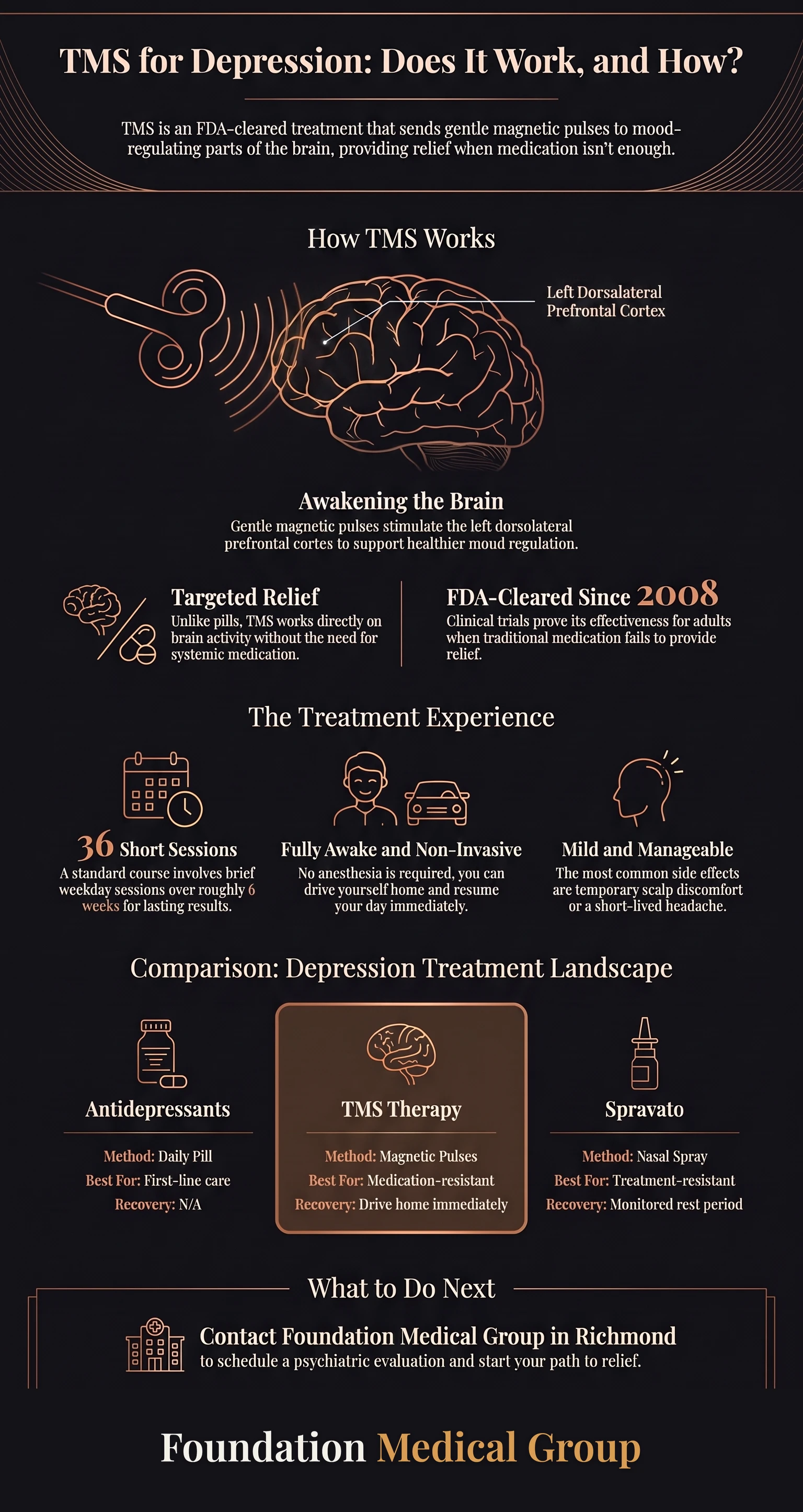
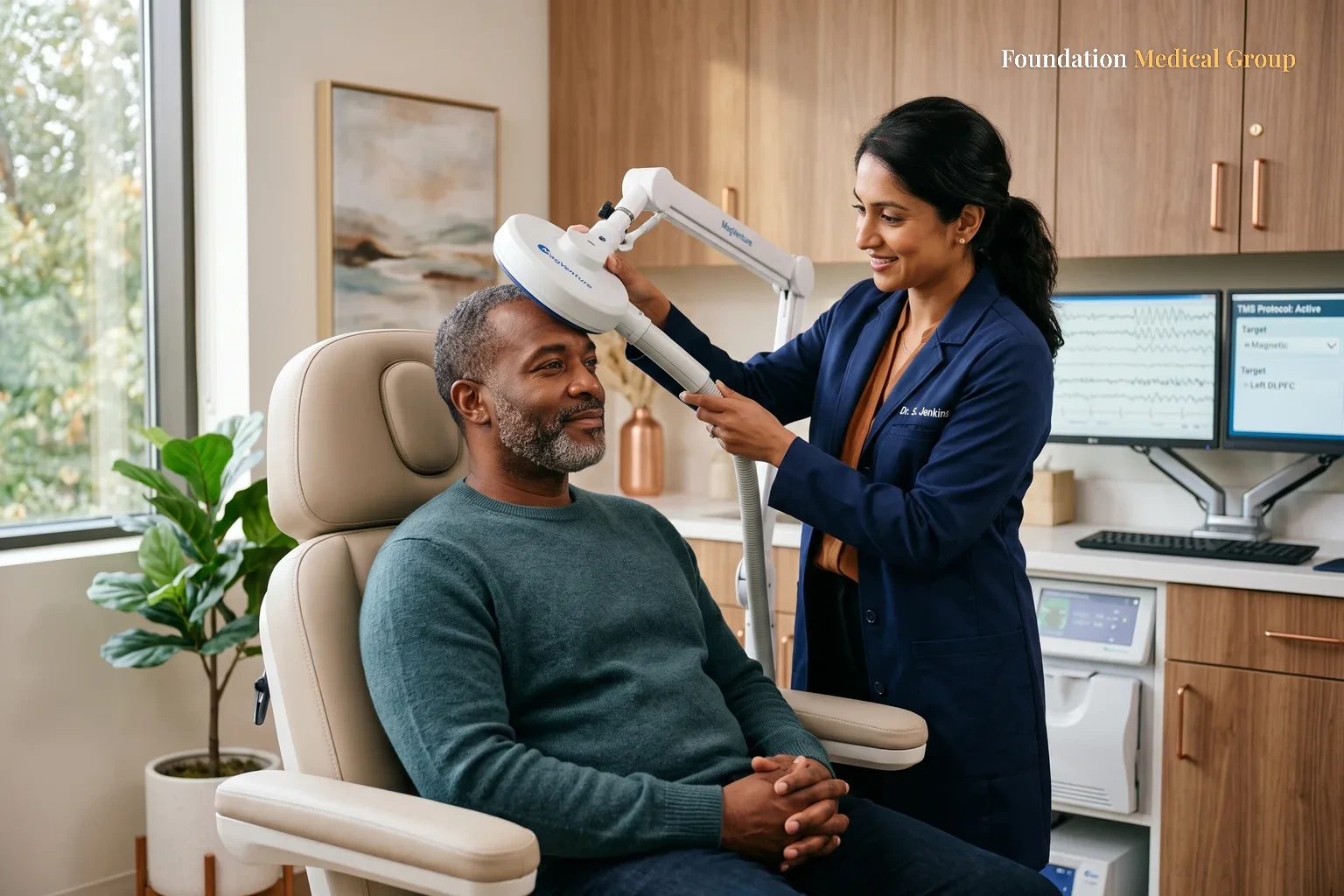
In depression, one part of the brain that helps manage mood is often less active than it should be. That area is called the left dorsolateral prefrontal cortex. TMS aims a magnetic field at this spot through a small device called a TMS coil. The coil rests gently against your head.
The pulses pass painlessly through the scalp. They stimulate the nerve cells sitting just below it. Over a full course, this repeated stimulation can wake up that quiet region and support healthier mood regulation. That’s why the treatment is also called rTMS, which is short for repetitive transcranial magnetic stimulation.
According to the FDA, TMS was first cleared for major depressive disorder in 2008. Clinical trials compared real stimulation with a sham treatment that looked and sounded the same. People who got the real thing had more relief from depressive symptoms. Because it works on brain activity instead of body chemistry, TMS counts as brain stimulation rather than a traditional treatment you swallow.
There isn’t just one kind of TMS anymore. Standard TMS uses a figure-eight coil aimed at a single spot. Deep TMS uses a different coil shape that reaches a wider area. A faster version called theta burst can deliver a treatment session in only a few minutes. Accelerated TMS packs many sessions into a handful of days, and it’s newer, so fewer clinics offer it.
Who Does TMS Help Most?
TMS usually isn’t the first step. Depression treatment often starts with talk therapy, antidepressants, or both. That works well for a lot of patients. But not everyone gets enough relief that way, and we regularly meet people who’ve tried 2 or 3 medicines without lasting improvement.
When depression hasn’t improved after one or more of those tries, doctors call it treatment resistant depression. That’s exactly where TMS therapy often shines. It gives you another route when medication management alone falls short, and it doesn’t add another daily pill.
TMS treatment is studied and cleared mainly for adults with major depressive disorder, including severe depression. Some TMS centers also use it for obsessive compulsive disorder. Researchers are still looking at other uses, such as postpartum depression, so those aren’t standard care yet.
A careful psychiatric evaluation always comes first. Your provider confirms the diagnosis, reviews your depression symptoms, and checks for anything that would make stimulation unsafe. Bipolar disorder needs extra care here, because stimulation can sometimes tip mood the other way. Sleep disorders, anxiety, and alcohol or drug use shape the plan too. This mental health condition looks different in every person, so the first visit really matters. Research from the National Institute of Mental Health explains how widely depression can show up.
What Happens During a TMS Session?
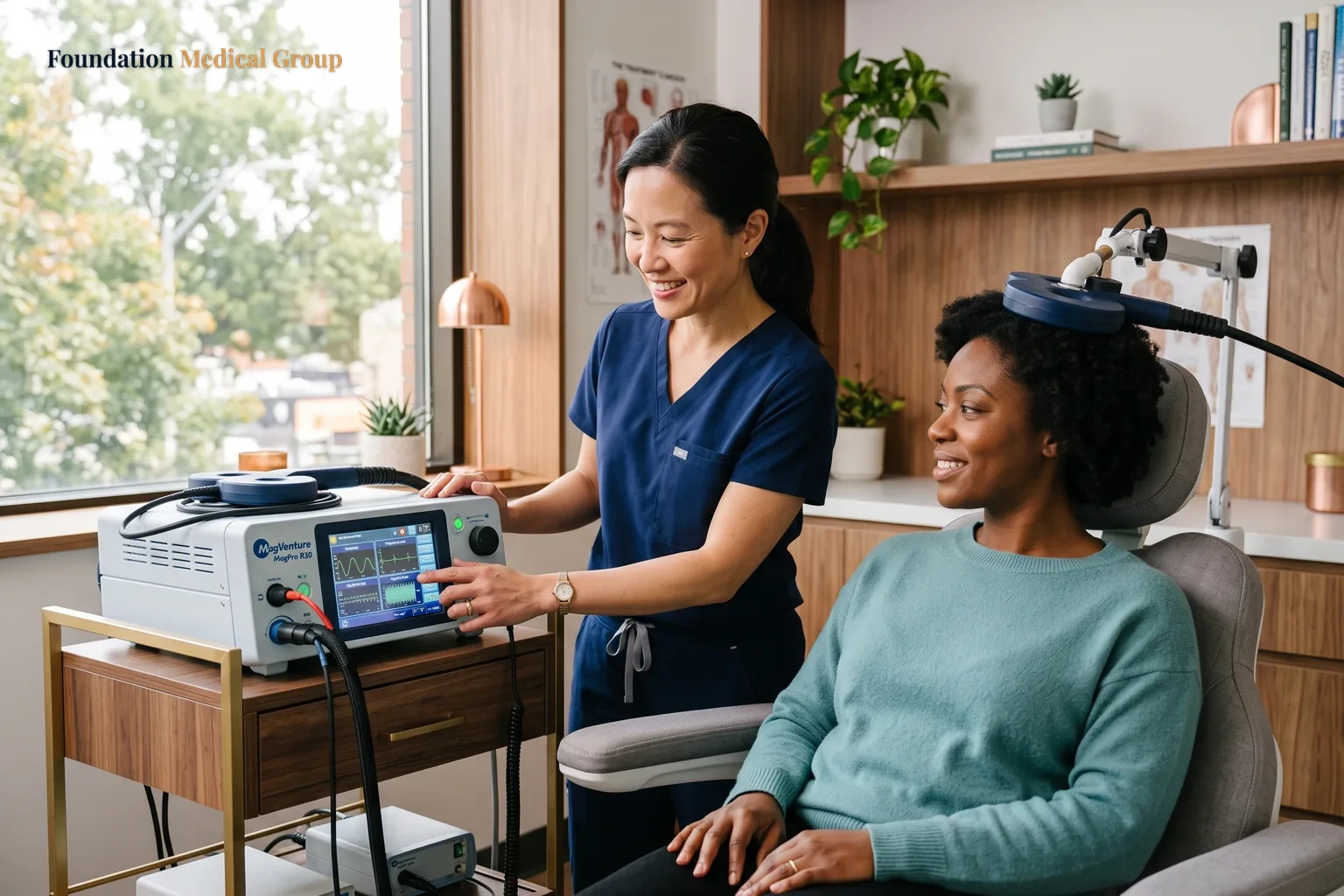
Your first visit takes longer than the rest. Your provider finds the right spot on your head and measures how much power you need. That step is called mapping, and it sets your stimulation dose for the whole course.
After that, a TMS session is simple and calm. You sit in a comfortable chair, fully awake. There’s no anesthesia and no need for a driver. The coil rests against your head, and you feel a light tapping while the pulses are delivered. Most patients read, listen to music, or just close their eyes and rest.
Each treatment session is short. A standard course runs about 30 to 36 sessions over roughly 6 weeks, so you come in on most weekdays for a while. Honestly, that rhythm is the hardest part for most people, not the treatment itself. Afterward you can drive yourself home and get on with work, school, or family life.
How Soon Does TMS Start Working?
Give it time. Most people don’t notice much in the first week or two. Small changes tend to show up around week 3 or 4. Sleep gets easier. Mornings feel less heavy. Friends and family sometimes notice before you do.
We track your progress with a short questionnaire at set points in the course. One common tool is the PHQ-9, which scores your depression symptoms week by week. Numbers on paper help a lot when your own memory of a rough month is fuzzy.
Be honest with your care team about what you feel. If nothing has shifted by the middle of your course, your provider can adjust things. Sometimes the coil position changes. Sometimes a different treatment option makes more sense. TMS doesn’t help everyone, and saying that out loud is part of good mental health treatment.
Is TMS Therapy Safe?
TMS has a strong safety record when a trained team runs it. The most common side effects are mild scalp discomfort where the coil sits and a short headache afterward. Both usually fade within the first week or two. Simple over-the-counter pain relief helps if you need it.
Seizures are the rare serious risk. They’re very uncommon, and careful screening lowers that chance even further. Nothing about TMS puts you to sleep, and nothing gets injected.
TMS isn’t right for everyone, though. Metal that can’t be removed in or near your head is the main blocker. That includes aneurysm clips, certain implants, and some nerve stimulators. Dental fillings and braces are fine.
Tell your provider before you start if any of these apply to you:
- You’ve ever had a seizure, a seizure disorder, a head injury, or a stroke.
- You have an implant, clip, or device in or near your head.
- You have bipolar disorder or a family history of mania.
- You take sleep aids, stimulants, or any medicine that can lower the seizure threshold.
- You’re pregnant, or you think you might be.
None of these automatically rules you out. They just change how your team plans your care.
How Is TMS Different From ECT?
People often mix up TMS and electroconvulsive therapy, usually shortened to ECT. They aren’t the same treatment at all.
ECT sends a controlled electrical current through the brain to cause a brief seizure on purpose. It’s done under general anesthesia, with a care team watching the whole time. ECT is a very effective treatment for severe depression, especially when someone is in real danger and needs relief fast. The trade-off is that it can cause memory trouble for a while, and you’ll need a ride home.
TMS uses magnetic pulses instead of an electrical current. There’s no seizure, no anesthesia, and no memory loss of the kind ECT can bring. You stay awake and go straight back to your day. Put simply, ECT is stronger and TMS is gentler. Which one fits depends on how severe your depression is and how quickly you need to feel better.
How Does TMS Compare to Medication and Spravato?

Depression care is not one size fits all. Pills, TMS, and Spravato all work in different ways, and the right choice depends on your history and your goals. Here’s a simple comparison to help you talk it through with your provider.
| What to know | Antidepressants | TMS | Spravato |
|---|---|---|---|
| How you take it | A daily pill you swallow | Magnetic pulses in the clinic | A nasal spray in the clinic |
| Best known for | First-line depression treatment | Depression that hasn’t improved on pills | Treatment resistant depression |
| In-clinic time | Fill a prescription, take at home | About 36 short sessions over ~6 weeks | Monitored visits, then a rest period |
| Anesthesia | None | None, you stay awake | None, but you’re watched after each dose |
| Common side effects | Varies by medicine | Mild scalp discomfort, short headache | Sedation, feeling detached for a while |
| Who tracks your progress | Your prescriber at follow-ups | Your TMS team at every visit | Your care team during and after each dose |
Pills are often the starting point, and they help a large share of patients. TMS is a strong choice when they haven’t worked well or the side effects are too much to live with. Spravato is another route for stubborn depression, using a nasal spray instead of magnetic pulses. Some people combine approaches over time, and that’s normal. Our behavioral health team will match the plan to you, not to a template.
What Happens After Your TMS Course Ends?
Finishing 36 sessions isn’t the end of your care. Many patients keep taking a medicine, keep seeing a therapist, or both. Talk therapy gives you tools for the days when your mood dips again, and that pairing tends to hold your gains better than TMS alone.
Depression can come back. If it does, a shorter round of TMS treatment is often an option, and people who responded the first time often respond again. Some clinics also offer occasional maintenance sessions to keep things steady.
Keep your follow-up visits even when you feel good. That’s how your team spots an early slide instead of a full relapse. Feeling better is worth protecting.
What About Cost and Insurance?
Cost is a fair question, and it shouldn’t be a surprise at the end. Most major insurance plans help pay for TMS when depression hasn’t improved on medicine, though every plan reads a little differently. Insurers usually ask for proof that you’ve tried a set number of antidepressants first.
Our team checks your benefits before you start anything. We can walk you through whether insurance covers TMS and explain the cost of TMS in plain language. You’ll know your share before you commit.
If you’d rather talk it through with a person, you can look for TMS therapy near you or read about TMS in Richmond. You don’t need every answer before you reach out. That’s what a first visit is for.
More TMS FAQs
Can I keep taking my antidepressant during TMS?
Usually, yes. Most patients stay on their current prescription while they go through a course of TMS. Your provider will tell you if anything needs to change.
Does TMS hurt?
Most people describe a tapping or knocking feeling on the scalp. It can feel strange on day one and much more familiar by day three.
Will TMS change who I am?
No. The goal is to lift the weight of a mood disorder so you feel more like yourself, not less like yourself.
Can I drive after a treatment session?
Yes. There’s no sedation, so you can drive yourself and head straight back to work or home.
Is depression my fault?
No. Depression is a mental illness, not a weakness or a character flaw, and treating it is no different from treating any other health condition.
Key Takeaways
- Transcranial magnetic stimulation for depression uses gentle magnetic pulses to stimulate an underactive, mood-regulating brain region.
- The FDA cleared it for major depressive disorder in 2008, and it’s used most often when medicine hasn’t been enough.
- You stay awake, there’s no anesthesia, and common side effects are mild scalp discomfort and a short headache.
- A full course runs about 36 sessions over roughly 6 weeks, and you can drive yourself home each time.
- Most people notice change around week 3 or 4, and your team tracks your symptoms the whole way.
- TMS is gentler than ECT, and it pairs well with therapy and ongoing mental health care.
Sources
- U.S. Food and Drug Administration (FDA) - clearance of transcranial magnetic stimulation devices for major depressive disorder.
- National Institute of Mental Health (NIMH) - depression symptoms, causes, and treatment overview.
- Mayo Clinic - what to expect from transcranial magnetic stimulation, including risks.
- American Psychiatric Association - patient guidance on depression and treatment choices.
Talk With Foundation Medical Group in Richmond
If depression has held on despite your best efforts, you still have options, and you’re not alone in this. We’ve watched TMS give real relief to patients who thought nothing else was left to try. Our physician-led mental health team at Foundation Medical Group in Richmond, VA is here to listen, answer your questions, and help you decide if TMS is right for you. Reach out today to book a psychiatric evaluation and take the next calm step toward feeling like yourself again.