
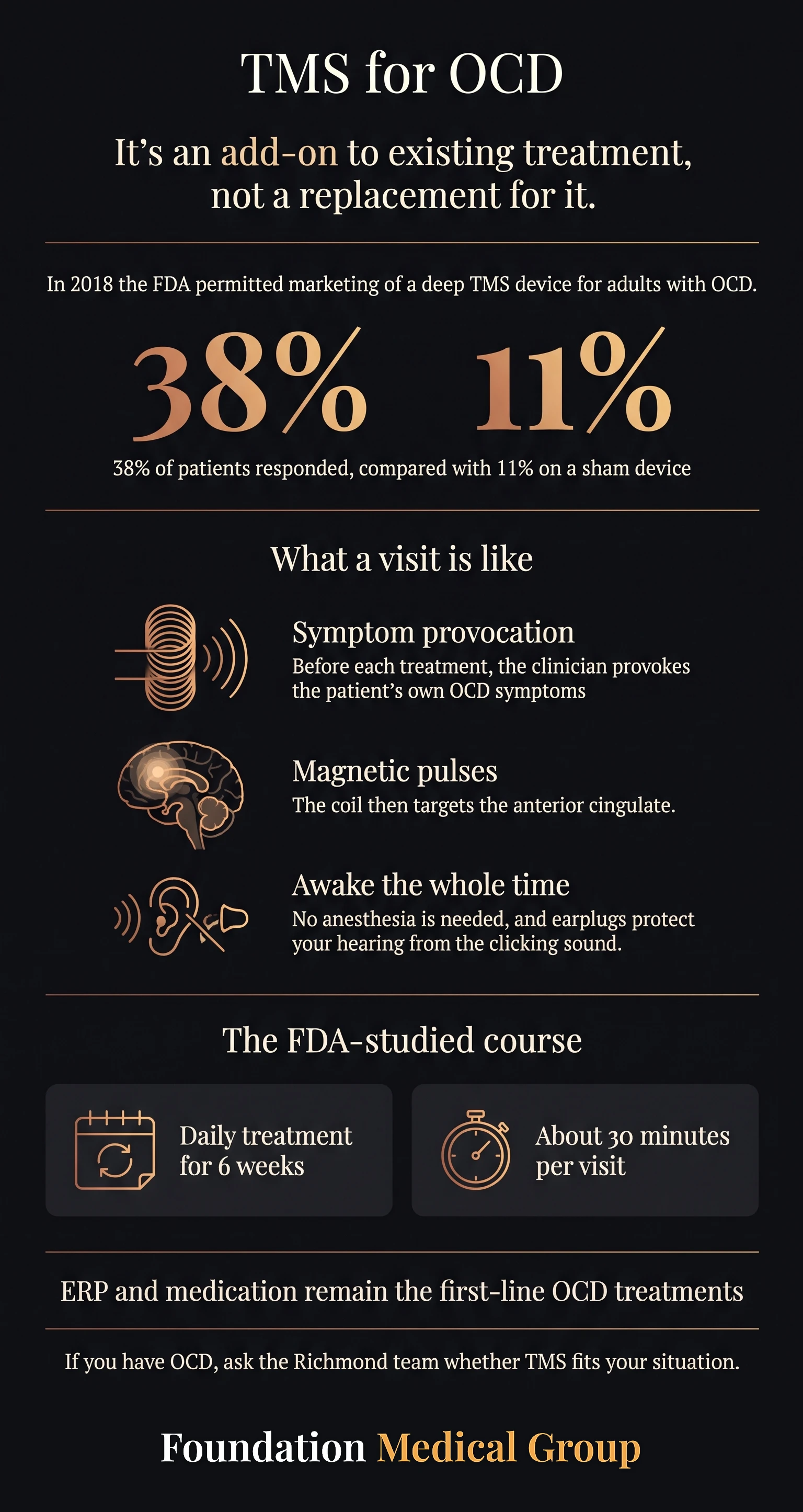
TMS for OCD is a non-invasive treatment that uses magnetic pulses to stimulate brain circuits linked to obsessive compulsive disorder. In 2018 the FDA permitted marketing of a deep TMS device for adults with OCD. It’s an add-on to existing treatment, not a replacement for it. In the study behind that decision, 38% of patients responded, compared with 11% on a sham device.
But exposure and response prevention therapy and medication remain the first-line care. TMS is one more option some adults discuss with their psychiatrist. We’ll say that plainly up front, because OCD is exhausting enough without a sales pitch on top of it.
What Is TMS for OCD?
TMS stands for transcranial magnetic stimulation. The FDA describes it as a procedure that uses magnetic fields to stimulate nerve cells in the brain. The FDA first permitted TMS for major depressive disorder in 2008, and it later added an OCD use.
The National Institute of Mental Health (NIMH) explains how the treatment works in practice. A coil held against the head sends short magnetic pulses through the skull. These create small electric currents that stimulate nerve cells in a targeted brain region. Unlike electroconvulsive therapy, TMS doesn’t need anesthesia and can take place in an office. Patients stay awake and usually feel a light tapping or knocking on the head.
For OCD, NIMH says the coil is placed near the dorsomedial prefrontal cortex or the anterior cingulate cortex, areas involved in mood regulation and cognitive control. Deep TMS, the type cleared for OCD, may use two coils to deliver more stimulation and reach larger structures deeper in the brain.
At Foundation Medical Group, TMS is offered at our Richmond, Virginia clinic, the flagship just off Midlothian Turnpike in Chesterfield, where TMS, Spravato, psychiatry, therapy and medication-assisted recovery sit under one roof. The TMS therapy in Richmond, VA service is for depression, though. If you live with OCD, ask our team in Richmond whether TMS fits your situation. That conversation usually starts with a psychiatric evaluation. It’s a full evaluation with a board-certified physician or psychiatric nurse practitioner, and you should walk out with a clear treatment plan, not a rushed script.
What Are OCD Symptoms? Obsessions, Compulsions and Types of OCD
OCD is more than liking things neat. MedlinePlus calls that idea a myth. Good. It’s a myth that wears people down, because it turns a serious illness into a punchline. Cleaning can be one symptom. But OCD more often means getting stuck on an action you feel driven to repeat.
The American Psychiatric Association describes two parts. Obsessions are persistent, recurring, unwanted thoughts and urges, often called intrusive thoughts. Compulsions are repeated behaviors or mental acts a person feels driven to do in response.
NIMH lists common obsessions:
- Fear of germs or contamination.
- Fear of forgetting, losing or misplacing something.
- Fear of losing control over one’s behavior.
- Aggressive thoughts toward others or oneself.
- Unwanted, forbidden or taboo thoughts involving sex, religion or harm.
- A desire to have things symmetrical or in perfect order.
And common compulsions:
- Excessive cleaning or handwashing.
- Ordering or arranging items in a precise way.
- Repeatedly checking things, such as whether the door is locked or the oven is off.
- Compulsive counting, or praying and repeating words silently.
What separates OCD from ordinary habits? According to NIMH, individuals with OCD can’t control these thoughts or behaviors, even when they know they’re excessive. They spend more than 1 hour a day on them. And they get no pleasure from compulsions, only brief relief from anxiety. That last part is the cruel bit, if you ask us. Many also have a mood or anxiety disorder.
OCD is common. NIMH estimates that 1.2% of U.S. adults had OCD in the past year, and 2.3% at some point in their lives. As for types, the American Psychiatric Association groups OCD with related conditions: hoarding disorder, body dysmorphic disorder, trichotillomania (hair pulling), excoriation (skin picking) and olfactory reference disorder.
Is Deep TMS FDA Approved for OCD?
Deep TMS is FDA cleared for OCD, though “approved” is not quite the right word. On August 17, 2018, the FDA permitted marketing of a deep TMS device as an adjunct, or add-on, treatment for adults with OCD. The FDA used its De Novo pathway, a route for some new low to moderate risk devices with no similar device already on the market.
The decision rested on a multi-center study of 100 patients. Of these, 49 received active treatment and 51 received treatment from a non-working (sham) device. Response meant an improvement of more than 30 percent on the Y-BOCS, the standard OCD severity scale. The FDA reported that 38 percent of patients responded to the device, compared with 11 percent on sham.
Two details matter for how you read that result. First, patients already receiving OCD treatment kept their medicines at their current doses throughout the study. The FDA decision summary also says patients should stay on their current treatment during deep TMS. Second, a 38 percent response rate means most patients in the study didn’t reach that threshold. That’s worth sitting with for a second. We’d rather you hear it from us now than feel let down a few weeks in. TMS for OCD is an option to add, not a guaranteed fix.
NIMH also lists OCD among the uses of rTMS, noting the FDA cleared it for severe OCD in 2018.
How Does TMS Therapy Work for OCD?

OCD is linked to brain circuits that run between the front of the brain and deeper structures. A 2024 umbrella review in CNS Spectrums notes that the medial prefrontal cortex and anterior cingulate cortex (mPFC/ACC) are hyperactive in people with OCD. A 2018 review in Neuropsychiatric Disease and Treatment lists the main TMS targets studied for OCD. They include the dorsolateral prefrontal cortex, the supplementary motor area, the orbitofrontal cortex and medial prefrontal cortex, and the anterior cingulate cortex.
The FDA-cleared protocol adds a step that sets it apart from TMS therapy for depression. Before each treatment, the clinician provokes the patient’s own OCD symptoms for up to 5 minutes. Yes, on purpose. We know that sounds like the last thing anyone with OCD would sign up for. According to the FDA decision summary, this is done to activate the relevant brain circuits. The patient’s stress level has to reach a set range before the magnetic pulses begin. The coil then targets the anterior cingulate.
Researchers are still working out the best approach. NIMH notes there’s no consensus yet on the best way to position the coil or deliver the pulses. It’s also unclear, NIMH adds, whether TMS works best alone or combined with psychotherapy, medication or both.
How Many Treatment Sessions Does TMS for OCD Need?
In the study the FDA reviewed, patients received daily treatment over a 6-week period, then had a follow-up visit at 10 weeks. Each visit lasted about 30 minutes, with about 20 minutes of stimulation, after the short symptom provocation step.
NIMH describes a similar pattern for rTMS in general: treatment sessions 5 days a week for 4 to 6 weeks. Sessions last anywhere from 3 to 40 minutes, depending on the protocol. Your own schedule usually depends on the device and on the plan your clinician sets.
What is a TMS treatment like for people who have it? You won’t be put to sleep, so you’re awake the whole time. You wear earplugs, because the device makes a loud clicking sound and the FDA requires hearing protection. You may feel tapping on your head and some twitching of the face or scalp muscles. With no sedation, our TMS patients in Richmond stay awake in the chair and usually drive themselves home after, which matters when home is out in Henrico or down in Chesterfield and the commute is part of the deal. Because no sedation is used, NIMH notes that TMS can be done in a clinical or office setting. If you want to know how long the benefit tends to last, see how long does TMS last.
TMS vs ERP vs Medication: OCD Treatment Comparison Table
TMS is an add-on. These are the main OCD treatment options and how they compare.
| Exposure and response prevention (ERP) | Medication (SSRIs) | Deep TMS | |
|---|---|---|---|
| What it is | A type of cognitive behavioral therapy (CBT) | Antidepressants that act on serotonin | Magnetic pulses to brain circuits linked to OCD |
| Role in OCD treatment | First line | First line | FDA-cleared add-on for adults |
| Time frame | Sessions with a trained therapist | 8 to 12 weeks before symptoms begin to improve | Daily on weekdays for about 6 weeks in the FDA study |
| Common downsides | Planned exposure to fears causes short-term distress | Side effects such as headache; OCD may need higher doses | Headache, scalp discomfort |
| At Foundation Medical Group | Talk therapy by video in all four states; in person in Richmond | Psychiatric care, which varies by clinic | TMS offered in Richmond, VA (service page is for depression) |
NIMH calls ERP, a specific type of CBT, an effective treatment for reducing compulsive behaviors, even for people who don’t respond well to medication. For many people, NIMH adds, CBT works as well as medication. MedlinePlus explains that ERP gradually exposes you to your fears or obsessions and teaches healthy ways to deal with the anxiety they cause.
That’s also the honest answer to a common question: how do you sit with anxiety in OCD? ERP teaches you to stay with the fear without doing the compulsion, a little at a time, with a therapist guiding the steps. Read more in our guide to cognitive behavioral therapy.
For medication, NIMH notes that SSRIs can take 8 to 12 weeks to help and that OCD may need higher doses than depression. Never stop or change an OCD medication without your prescriber.
What Does Research Say About TMS for OCD?
Honestly? The evidence is promising but mixed. That’s why TMS for OCD is treated as an add-on.
The 2024 umbrella review in CNS Spectrums pulled together 12 meta-analyses of TMS for OCD. Most consistently found that rTMS reduced OCD symptoms when aimed at the dorsolateral prefrontal cortex and the supplementary motor area. Results for deep TMS aimed at the mPFC/ACC were described as encouraging. But the authors found a high level of variation between studies in 9 of the 12 meta-analyses. With data that scattered, firm conclusions are harder to draw. Which, frankly, is a little maddening when you’re the one hoping for a clear yes.
In the FDA study, the decision summary reports that results seen at 6 weeks held up at the 10-week follow-up. NIMH cautions that long-term effects of rTMS have not been determined and that more research is needed on long-term safety.
For patients, this means TMS may bring relief for some people with OCD. No one can promise it’ll work for you, though, which is frustrating to hear. Whether to try it, and whether follow-up sessions make sense later, are decisions you make with your clinician.
TMS Therapy Side Effects and Safety

In the FDA study, the most common side effect was headache, reported by 37.5 percent of patients on the device and 35.3 percent on sham. The FDA said other side effects were mild or moderate, and there were no serious adverse reactions related to the device.
NIMH lists these possible side effects of rTMS:
- Discomfort where the coil sits on the head.
- Contraction or tingling of the scalp, jaw or face muscles during treatment.
- Mild headaches or brief lightheadedness.
- Dizziness.
Seizures are possible but rare, and NIMH says a comprehensive review found the risk is low. TMS isn’t for everyone. The FDA says it shouldn’t be used in people with metal or implants in or near the head, such as some aneurysm clips, stents or cochlear implants. People with a history of seizures should discuss it with their provider first. For more detail, see TMS therapy side effects.
How Is Obsessive Compulsive Disorder Diagnosed?
NIMH advises starting with a health care provider. They ask about your symptoms and health history and check that another condition isn’t causing them. A provider may then refer you to a mental health professional for further evaluation or treatment.
It helps to bring notes. Which thoughts keep coming back? What do you feel you have to do in response? How many hours a day does it take? And where does it cause difficulty, at work, at school or in family life? NIMH lists genetics and brain differences among the risk factors. Having a parent or sibling with OCD raises the chance of developing it, so mention any family history too. Scribble it on your phone in the parking lot if you have to. Messy notes beat no notes.
A psychiatric evaluation at Foundation Medical Group looks at OCD, and we review your history, symptoms and goals along the way. We check for the conditions that often come with it, too, so your treatment plan matches what’s really going on. In Richmond, our psychiatry team works closely with physicians like Dr. Jonathan Schaaf, so medical and behavioral health needs get planned together instead of in separate silos.
Does Insurance Cover TMS for OCD?
Coverage depends on your plan and on why TMS is being considered. Our Richmond, Virginia clinic works with common plans including Medicaid, Anthem, Aetna, Cigna, Blue Cross Blue Shield, UnitedHealthcare, Humana, TRICARE and Optum. Call to confirm coverage for each, since benefits vary from plan to plan. We know insurance calls are nobody’s idea of a fun afternoon. The Richmond clinic doesn’t accept Medicare.
For more information on how plans handle TMS, read does insurance cover TMS. Coverage depends on your specific plan, so call us at (800) 983-1974 before your visit.
TMS Therapy at Foundation Medical Group in Richmond, VA
Foundation Medical Group offers TMS therapy only at our Richmond clinic, 11600 Busy Street, Suite 203, Richmond, VA 23236. It’s our flagship clinic, led by Dr. Vincent Nardone, our Executive Medical Director, who has cared for Richmond-area patients for more than a decade. The TMS service there is for depression. We don’t claim an OCD TMS program, and we’d rather be upfront about that than oversell it. If you have OCD, ask the Richmond team whether TMS fits your situation and how it would sit alongside your current care.
No Utah, Georgia or Texas clinic offers TMS. Patients in those states can still ask about OCD through the psychiatric services offered at their clinic. And talk therapy is available by secure video in all four states, with in-person talk therapy in Richmond for anyone close enough to drive in, whether that’s from the Fan, Mechanicsville or out past Short Pump.
Key Takeaways
- TMS for OCD uses magnetic pulses to stimulate brain circuits linked to obsessions and compulsions, with no anesthesia.
- In 2018 the FDA permitted marketing of a deep TMS device as an add-on treatment for adults with OCD; in the study, 38% responded vs 11% on sham.
- The FDA-studied course was daily treatment for 6 weeks, about 30 minutes per visit, with a short symptom provocation step first.
- ERP and medication remain the first-line OCD treatments; TMS is added to them, not used instead of them.
- Foundation Medical Group offers TMS only in Richmond, VA, where the service is for depression; ask the team whether it fits.
Sources
- FDA, FDA permits marketing of transcranial magnetic stimulation for treatment of obsessive compulsive disorder.
- FDA, De Novo decision summary DEN170078.
- Neuropsychiatric Disease and Treatment, Transcranial magnetic stimulation in the treatment of obsessive-compulsive disorder: current perspectives.
- National Institute of Mental Health, Obsessive-Compulsive Disorder (OCD).
- National Institute of Mental Health, Obsessive-Compulsive Disorder: When Unwanted Thoughts or Repetitive Behaviors Take Over.
- American Psychiatric Association, What Are Obsessive-Compulsive and Related Disorders?.
- National Institute of Mental Health, Brain Stimulation Therapies.
- CNS Spectrums, The Efficacy of Transcranial Magnetic Stimulation in the Treatment of Obsessive-Compulsive Disorder: An Umbrella Review of Meta-Analyses.
- MedlinePlus, Obsessive-Compulsive Disorder.
- National Institute of Mental Health, Obsessive-Compulsive Disorder (OCD) statistics.