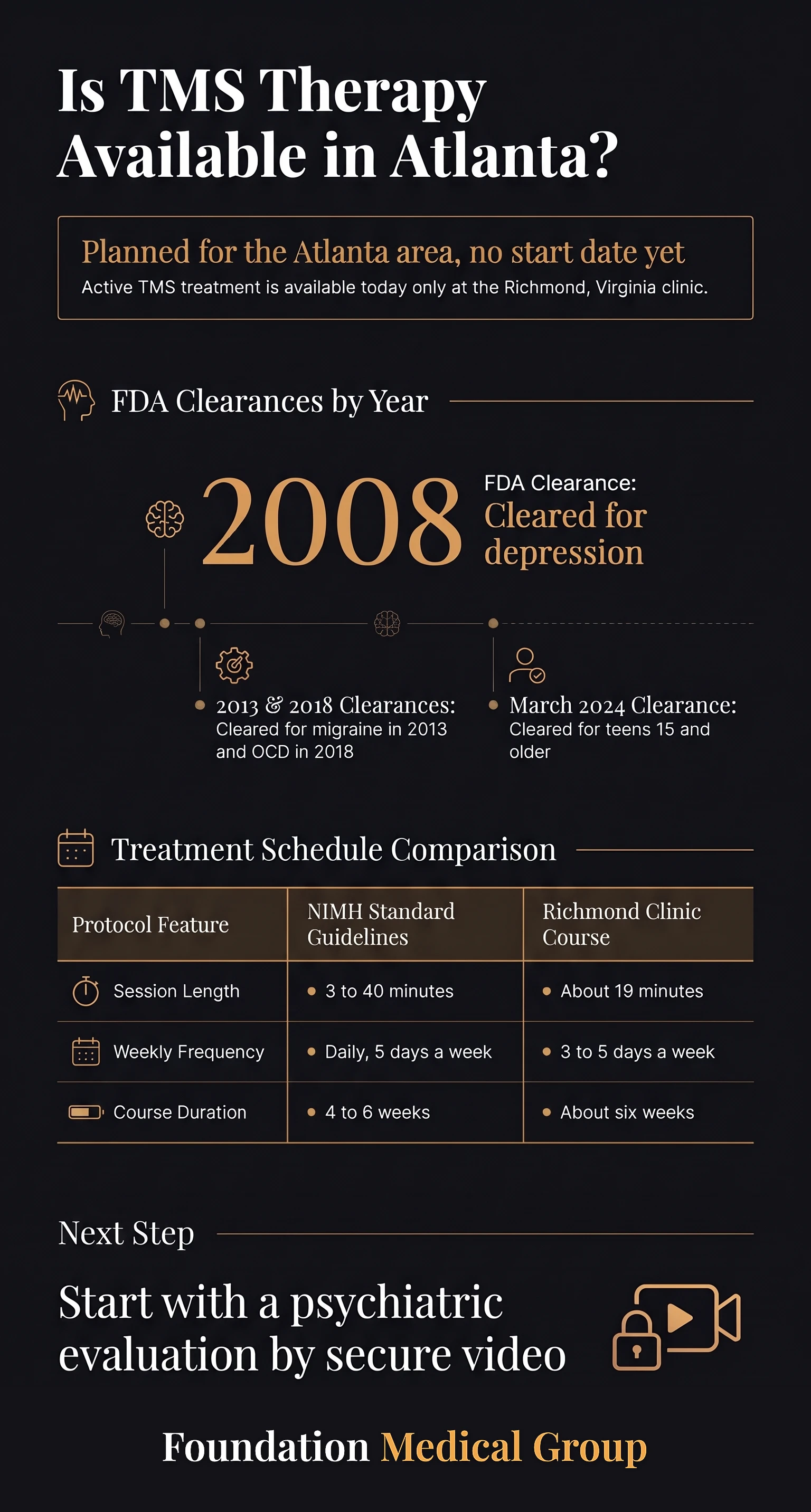
Foundation Medical Group plans to offer TMS therapy in the Atlanta area, but we don’t offer it there today, and there’s no start date yet. Our TMS treatment runs at our Richmond, Virginia clinic. Atlanta adults can start now with a psychiatrist by secure video, and our Decatur clinic treats opioid use disorder in person.
Is TMS Therapy Available in Atlanta at Foundation Medical Group?
Not yet. TMS is on our plan for the Atlanta area, and that’s as far as we can honestly go: no start date, no price, no way to book it here. If you were hoping for a short drive to a TMS chair, that’s disappointing. We’d rather you read it on this page than hear it on a phone call.
If you typed “TMS therapy Atlanta” into a search bar and ended up here, that’s the straight answer. Probably not the one you wanted.
So where does our TMS happen? At 11600 Busy Street, Suite 203, Richmond, VA. That clinic offers NeuroStar TMS therapy in Richmond for depression and is accepting new patients. Richmond is where we work as a TMS therapy provider today. Any TMS treatment options we can offer you start there, at least for now.
The rest of this page is for the Atlanta patient who wants to get moving anyway. What we do in Georgia now (there’s more on our Georgia clinic page), what TMS involves, and how the road to Richmond starts from home.
What Is TMS Therapy and How Does Repetitive TMS Work?
Repetitive TMS (rTMS) is a noninvasive treatment that uses an electromagnet to send repeated, low-intensity pulses to the brain. The magnetic field is roughly as strong as an MRI scanner’s, and because it switches on and off so fast, it induces weak electrical currents in the nerve cells under the coil.
That sounds more dramatic than it feels. It’s aimed at one area. No anesthesia. You stay awake in a clinic or office, which also means it isn’t something you can do by video from your couch in Atlanta. Our guide to TMS for depression goes deeper on the science.
What Does the Decatur Clinic Offer Atlanta Patients Today?
Our Decatur clinic is at 160 Clairemont Ave, Suite 200, Decatur, GA 30030, just east of Atlanta. In person, it treats opioid use disorder with Suboxone and Subutex, and new patients are usually seen within 48 hours. Read more about our Suboxone clinic in Decatur or our Suboxone doctor in Atlanta page. The clinic line, (706) 534-8574, is for that care.
Psychiatry works differently. Georgia adults see a psychiatrist in Atlanta by secure video for evaluation and medication management, through our telehealth service. Talk therapy is by video as well (therapist in Atlanta, talk therapy), so your mental health care doesn’t have to wait on a building.
What isn’t in Decatur yet? In-person psychiatric evaluation, medication management and talk therapy. Also TMS, Spravato, ketamine, Vivitrol, qEEG and GeneSight.
Dr. William Epps, our Medical Director for Georgia, leads the Decatur office. He treats opioid use disorder along with co-occurring mental health conditions. He isn’t a TMS provider.
Who Is a Good Candidate for TMS Treatment?
Usually, someone whose depression hasn’t eased with other care. NIMH describes brain stimulation as an option when other depression treatments haven’t worked, most often after psychotherapy and medication, which usually continue alongside it. The FDA permitted marketing of TMS for major depression in 2008, and that first device was for people who hadn’t responded to at least one antidepressant in the current episode.
That can feel discouraging if you’ve already tried a few. But major depressive disorder is very treatable: the American Psychiatric Association says between 70% and 90% of people with depression eventually respond well to treatment.
A few limits. rTMS isn’t approved for anyone under 15. And if you take buprenorphine for opioid use disorder, say so at your evaluation; a clinician decides whether TMS fits, case by case. Our page on treatment resistant depression covers the bigger picture.
Which Mental Health Conditions Is TMS FDA-Cleared For?
It’s a short list of psychiatric conditions, plus a couple of surprises. NIMH says rTMS is FDA-cleared for treatment-resistant depression, OCD, migraines, anxiety with depression, and smoking dependence. The FDA’s own timeline runs depression in 2008, pain from certain migraine headaches in 2013, and OCD in 2018. In March 2024, the FDA cleared it as an add-on treatment for depression in teens 15 and older.
Two caveats. Bipolar depression got a breakthrough device designation in 2020, and that isn’t a clearance. Anxiety on its own isn’t on the list either, so generalized anxiety disorder and other anxiety disorders don’t qualify by themselves (the wording is anxiety with depression). Our TMS for anxiety page explains more. At Richmond, our TMS is for depression.
What Is the Difference Between Standard TMS, Deep TMS and Accelerated TMS?
Short version. Standard TMS (also called traditional TMS) is one session a day, five days a week, for several weeks. Deep TMS can use two coils to reach larger structures deeper in the brain. Accelerated TMS packs several sessions into one day with short breaks, and often works within a week.
Which is better? A 2025 consensus review endorsed by three professional groups found newer forms of TMS faster and potentially more effective than conventional repetitive TMS, while calling for more study of accelerated protocols. So: promising, not settled. Our Richmond clinic uses NeuroStar TMS on a standard course.
How Many TMS Sessions Does a Course Take, and What Does a Session Feel Like?
According to NIMH, a typical rTMS session lasts 3 to 40 minutes, and a course runs daily, 5 days a week, for 4 to 6 weeks. Our Richmond clinic runs a little differently. NeuroStar sessions there take about 19 minutes, 3 to 5 days a week, over a standard course of about six weeks, and our team checks progress with validated depression scales along the way. The first treatment visit includes mapping: the team measures and calibrates the device to target the part of your brain that regulates mood. After that, you sit in a reclining chair, fully awake, and feel a light tapping on the scalp that fades after the first few pulses. Plenty of patients read or listen to music. With no anesthesia involved, most patients head straight back to work or errands.
Side effects can include discomfort where the magnet sits, contraction or tingling of scalp, jaw or face muscles, mild headaches or brief lightheadedness, and dizziness. See TMS therapy side effects and how long TMS lasts.
Here’s the honest catch for Atlanta: that’s weeks of TMS sessions in Richmond, and Richmond isn’t a day trip. Plan the logistics before you start, not halfway through.
Does Insurance Cover TMS Therapy in Georgia?

It depends on your plan. Frustrating, we know, but it’s the true answer.
Because we don’t offer TMS in Georgia, there’s no Georgia TMS price and no Georgia TMS billing from us. Here’s what we can tell you:
- For our Georgia care today, Cigna is the plan we list (call to confirm coverage). Medicare, Medicaid, Georgia Medicaid, Aetna, Anthem, Blue Cross Blue Shield, UnitedHealthcare, Humana, TRICARE and Optum Behavioral Health aren’t accepted at Decatur yet.
- At Richmond, the TMS clinic works with Medicaid, Aetna, Cigna, Anthem, Blue Cross Blue Shield, UnitedHealthcare, Humana, TRICARE and Optum Behavioral Health, each one call to confirm coverage. Medicare isn’t accepted there. Our TMS coordinators file the prior authorization for you.
- A Georgia plan might not pay for care in Virginia, so call your plan, ask about TMS out of state, and ask what it needs first. When our Richmond coordinators build that request, plans usually want to see a diagnosis of major depression, antidepressant trials that didn’t help enough, and often a course of talk therapy.
- On Georgia Medicaid? Check your plan details with Georgia Medicaid.
Coverage varies by plan and state. Our pages on whether insurance covers TMS and TMS cost go further.
How Does TMS Compare With Medication and Electroconvulsive Therapy?
Medication and talk therapy usually come first, and TMS tends to enter the picture later. Here’s how it lines up against those traditional treatments, and against ECT.
| TMS (rTMS) | Electroconvulsive therapy (ECT) | Antidepressant medication | |
|---|---|---|---|
| How it works | Low-intensity magnetic pulses aimed at one brain area | Electric current that causes a brief seizure | Daily medicine |
| Anesthesia | None | Yes, with a muscle relaxant | None |
| Setting | Clinic or office | Treatment room with a medical team | At home |
| Typical time frame | Daily, 5 days a week, 4 to 6 weeks | Three times a week, usually 6 to 12 treatments | Usually 4 to 8 weeks to work |
| When it’s used | After other treatment hasn’t worked | Gold standard for treatment-resistant depression | Often a first step, with talk therapy |
Antidepressants usually take 4 to 8 weeks to work, per NIMH, and sleep or appetite often improve before mood does. ECT is still considered the gold standard for treatment-resistant depression, and rTMS doesn’t match its effects. A psychiatrist weighs these treatment options with you.
How Can Someone in Atlanta Start on the Path to TMS Now?
- Book a psychiatric evaluation by secure video. Call (706) 534-8574 or (800) 983-1974 and ask for telehealth psychiatry in Georgia. The visit runs up to 60 minutes, and the front desk checks your benefits first.
- Write down your history. Which antidepressants, for how long, what talk therapy you’ve had. Tedious? A little. It’s also what a psychiatrist looks at when deciding whether TMS makes sense, and our Richmond TMS page says the team will “review your full history, not just a checklist.”
- If TMS may fit, the next stop is our Richmond team. The TMS consultation can happen in person or by video, so you don’t have to travel just to ask questions. It usually takes place within 3 to 5 business days, and you don’t need a referral. Read about TMS in Richmond; the coordinators there handle prior authorization.
- Plan for weeks of visits in Virginia (work, family, where you’ll stay) before you commit.
- Keep care going at home: medication management and talk therapy by video, and Suboxone or Subutex in Decatur if you’re in recovery from opioid use. Waiting on a service is hard when you’re living with depression or another mental illness, so don’t put everything on hold.
Comparing TMS providers or TMS clinics in other places? Our TMS near me guide helps. And if you’re in crisis, call or text 988. We aren’t a 24/7 service.
Key Takeaways
- TMS therapy is planned for the Atlanta area, with no start date yet.
- Our NeuroStar TMS runs today in Richmond, VA.
- A standard course is daily sessions, 5 days a week, for 4 to 6 weeks.
- Start with a video psychiatric evaluation in Georgia.
- Call your plan first, and note that Richmond doesn’t accept Medicare.
FAQ
Does Foundation Medical Group offer TMS in Atlanta?
Not yet. TMS is planned for the Atlanta area, but there’s no start date. Today our TMS center is the Richmond, Virginia clinic, which treats depression with NeuroStar TMS.
Can TMS be done by telehealth?
No. rTMS happens in person, in a clinic or office. What Georgia adults can do by secure video is psychiatry and talk therapy with our team.
Does the Decatur clinic offer psychiatry in person?
Not yet. In person, Decatur treats opioid use disorder with Suboxone and Subutex. Psychiatric evaluation and medication management for Georgia adults happen by secure video.
Will my Georgia insurance pay for TMS in Virginia?
It depends on your plan, so call your plan before you start. Our Richmond clinic doesn’t accept Medicare, and every other plan there is call to confirm coverage.
Sources
- National Institute of Mental Health, Brain Stimulation Therapies.
- National Institute of Mental Health, Depression (publication).
- U.S. Food and Drug Administration, FDA permits marketing of transcranial magnetic stimulation for treatment of obsessive compulsive disorder.
- Trapp NT et al., Consensus review and considerations on TMS to treat depression: A comprehensive update, Clin Neurophysiol, 2025.
- American Psychiatric Association, What Is Depression?.
- Georgia Department of Community Health, Georgia Medicaid.
- SAMHSA, 988 Suicide & Crisis Lifeline.