
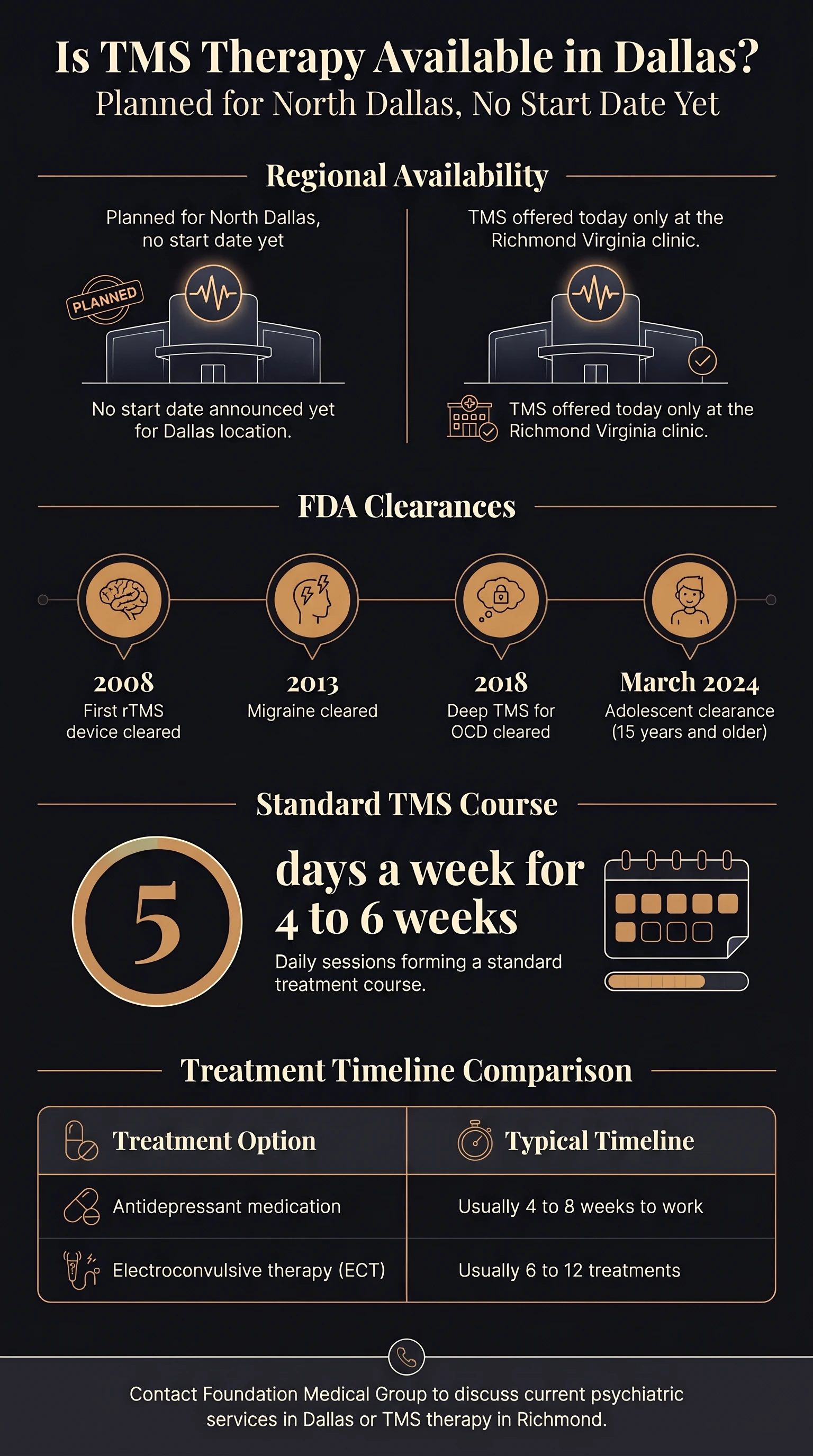
Foundation Medical Group plans to bring TMS therapy to its North Dallas clinic, but we don’t offer it in Dallas today, and there’s no start date yet. That’s frustrating if you came here ready to book. Our TMS treatment runs at our Richmond, Virginia clinic. In Dallas, adults can get psychiatry, medication management, Suboxone, Vivitrol and qEEG brain mapping right now.
Is TMS Therapy Available in Dallas at Foundation Medical Group?
Not yet. TMS is on the plan for our office at 8390 Lyndon B Johnson Freeway, Suite 500, but we can’t give you a start date, a price or a way to book it in Dallas. Honestly, we’d rather tell you that here than have you find out on the phone.
If you need TMS now, it’s offered at our Richmond clinic, 11600 Busy Street, Suite 203, Richmond, VA 23236. You can read how TMS therapy in Richmond works, from the consultation to the daily sessions.
The Dallas line, (469) 909-1312, is for the care the clinic gives today. More on that below, and on our Texas clinic page.
What Is TMS Therapy and How Does It Work?
Repetitive transcranial magnetic stimulation (rTMS) is a noninvasive treatment that uses an electromagnet to stimulate the brain with repeated, low-intensity pulses. The magnetic field is about as strong as an MRI scanner’s. Strong, yes. It sits in a branch of care sometimes called interventional psychiatry.
Unlike ECT, the magnetic stimulation is aimed at one brain site. And there’s no anesthesia; it’s done in a clinic or office. Our guide to TMS for depression goes deeper.
Who Is a Good Candidate for TMS Therapy?

Usually, someone whose depression symptoms haven’t eased enough with other care. NIMH calls brain stimulation an option when other depression treatments have not worked, and it’s used less often than talk therapy and medication.
The FDA cleared the first rTMS device in 2008, for people whose depression didn’t respond to at least one antidepressant in the current depressive episode. It isn’t approved for anyone under 15. And whether it works best alone or with medication and therapy is still being studied. A prescriber decides fit after an evaluation.
Is TMS Treatment FDA-Cleared, and for Which Mental Health Conditions?
Yes, for several, and not all of them are psychiatric conditions. NIMH lists treatment-resistant depression, OCD, migraines, anxiety with depression, and smoking dependence. That wording is worth reading twice: anxiety with depression, not generalized anxiety disorder by itself.
The FDA permitted TMS for major depression in 2008, for migraine pain in 2013, and a deep TMS system for obsessive compulsive disorder in 2018. In March 2024, the FDA cleared rTMS as an add-on treatment for depression in adolescents 15 years and older. For bipolar depression, the FDA granted rTMS a breakthrough device designation in 2020. But that isn’t a clearance, and the two are easy to mix up.
How Many TMS Sessions Does a Course of Treatment Take?
A lot. A standard course is daily sessions, 5 days a week, for 4 to 6 weeks, and one session lasts anywhere from 3 to 40 minutes. For someone in Dallas, that’s the honest catch with Richmond: it’s weeks of near-daily visits, a long way from home. Here’s how long TMS lasts once a course ends.
What Is Accelerated TMS, and How Is It Different From Standard TMS?
Accelerated TMS packs several sessions into each day. NIMH says these protocols often work within a week and show similar effectiveness to standard TMS.
In one small trial of 29 participants, depression scores fell 52.5% with active accelerated treatment versus 11.1% with sham, measured 4 weeks after treatment. That’s promising. But it was a small trial, and how long the benefit lasts isn’t settled. Foundation Medical Group doesn’t offer accelerated TMS at any clinic.
How Much Does TMS Therapy Cost in Dallas, and Does Insurance Cover It?
We don’t have a Dallas price, because we don’t offer TMS in Texas yet. We know that’s not much help when cost is the first thing you want to plan around. What you’d pay depends on how many sessions you need and on your health plan. Call your plan, or its behavioral health line, and ask whether it covers TMS and what it needs first. Our page on whether insurance covers TMS goes through the questions to ask.
At our Richmond clinic, common plans include Medicaid, Aetna, Cigna and Anthem. Coverage depends on your plan, so call to confirm coverage before you start. Richmond doesn’t accept Medicare.
How Does TMS Compare With Electroconvulsive Therapy and Medication?

Each works differently and asks different things of you.
| TMS (rTMS) | Electroconvulsive therapy (ECT) | Antidepressant medication | |
|---|---|---|---|
| How it works | Magnetic pulses aimed at one brain site | Electric current, general stimulation | Daily medicine |
| Anesthesia | None | Short-acting general anesthetic and a muscle relaxant | None |
| Setting | Clinic or office | Done by a doctor, under anesthesia | At home |
| Typical time frame | Daily, 5 days a week, 4 to 6 weeks | Three times a week, usually 6 to 12 treatments | Usually 4 to 8 weeks to work |
| When it’s used | After other treatment hasn’t worked | Gold standard for treatment-resistant depression | Often early, with talk therapy |
NIMH notes that antidepressants usually take 4 to 8 weeks to work. ECT is still the gold standard for treatment-resistant depression, and rTMS doesn’t match its effects. Which one fits is a conversation with your prescriber, not a table.
What Can Dallas Patients With Depression Do While TMS Is Planned There?
Quite a bit, actually. For depression care now, adults can see our team at the North Dallas clinic, Monday to Friday, 8am to 5pm, for a psychiatric evaluation and medication management (see psychiatrist in Dallas). The clinic also offers Suboxone, Vivitrol and qEEG brain mapping in Dallas.
Anywhere in Texas, you can use telehealth psychiatry and talk therapy by secure video. In-person talk therapy in Dallas is planned, not offered yet. Spravato and ketamine aren’t offered in Dallas either. For TMS today, Richmond is the place.
If you’re in crisis, call or text 988. We’re not a 24/7 service.
Key Takeaways
- TMS is planned for our North Dallas clinic, with no start date yet.
- Foundation Medical Group offers TMS today only in Richmond, VA.
- A standard course is daily sessions, 5 days a week, for 4 to 6 weeks.
- TMS is usually used after medication and talk therapy haven’t helped enough.
- Dallas offers psychiatry, MAT and brain mapping now.
FAQ
Does Foundation Medical Group offer TMS in Dallas?
Not yet. TMS is planned for our North Dallas clinic, but there’s no start date. Today, Foundation Medical Group offers TMS only at its Richmond, Virginia clinic.
Can TMS be done by telehealth?
No. rTMS is done in person, in a clinic or office. What you can do by secure video anywhere in Texas is psychiatry and talk therapy with our team.
Does TMS need anesthesia?
No. Unlike ECT, rTMS needs no anesthesia. Possible side effects include discomfort where the magnet sits, tingling of scalp, jaw or face muscles, and mild headaches or brief lightheadedness.
Where is the nearest Foundation Medical Group TMS clinic to Dallas?
Our only TMS clinic is in Richmond, Virginia, at 11600 Busy Street, Suite 203. Call that clinic to ask about a consultation and to confirm your insurance.
Sources
- National Institute of Mental Health, Brain Stimulation Therapies
- National Institute of Mental Health, Depression (publication)
- National Institute of Mental Health, Depression (health topic)
- U.S. Food and Drug Administration, FDA permits marketing of transcranial magnetic stimulation for treatment of obsessive compulsive disorder
- Cole EJ et al., Stanford Neuromodulation Therapy (SNT): A Double-Blind Randomized Controlled Trial, Am J Psychiatry, 2022
- American Psychiatric Association, What Is Depression?
- SAMHSA, 988 Suicide & Crisis Lifeline