
Here’s the honest answer up front. TMS therapy for anxiety is not FDA cleared the way it is for depression. Doctors use it off label when anxiety stands alone. One deep TMS system is cleared for anxious depression, which means depression carrying anxiety symptoms with it. So what you actually have shapes what TMS treatment can do for you.
At Foundation Medical Group in Richmond, VA, our physician-led team walks patients through this difference every week. Below you’ll find how the stimulation works. You’ll also see where the proof is solid, where it’s thin, and how TMS therapy sits beside talk therapy and medication.
What Is Transcranial Magnetic Stimulation TMS Therapy?
TMS stands for transcranial magnetic stimulation. A small coil rests against your head. It sends magnetic pulses through the scalp into the nerve cells sitting just below. Nothing gets injected and you swallow nothing. That’s why doctors call it a non invasive treatment.
The pulses land on a spot called the left dorsolateral prefrontal cortex. That patch of brain sits behind your forehead. It does a lot of the work in mood and anxiety regulation. In a depressive disorder it often runs quiet. Repeated stimulation across several weeks can nudge that circuit back toward a steadier rhythm.
Because it acts on brain activity rather than body chemistry, TMS therapy counts as brain stimulation instead of a drug. You stay awake the whole time. There’s no anesthesia and no sedation. You can drive yourself home after a TMS session and get on with your day.
Is TMS Therapy for Anxiety FDA Cleared?
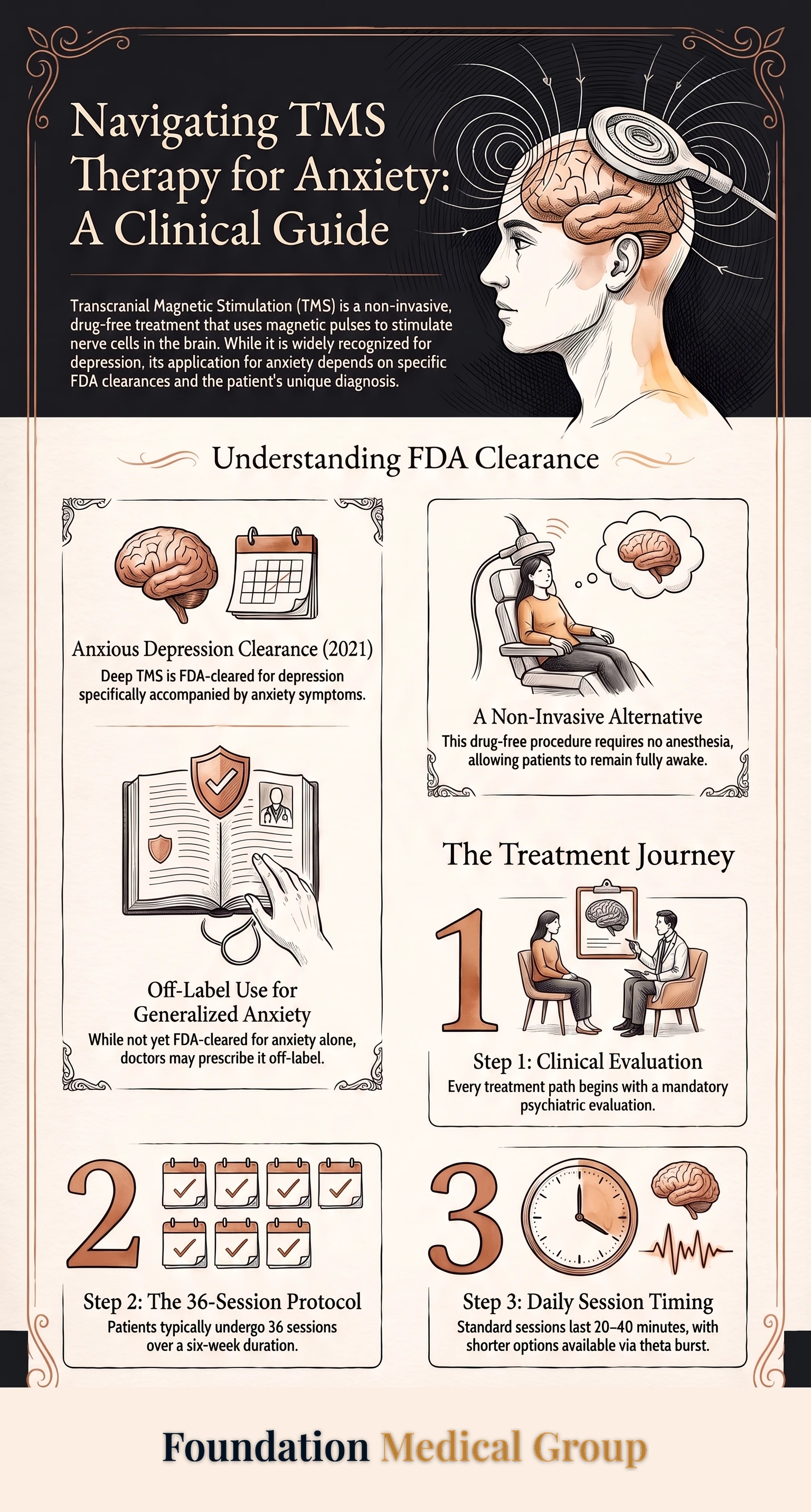
Here honesty matters more than marketing. According to the FDA, TMS was first cleared for major depressive disorder in 2008. Clearance for obsessive compulsive disorder followed in 2018. That one is an add-on, not a stand-alone fix. Then in 2021 the agency cleared a deep TMS system for anxious depression. That means adults living with depression plus anxiety symptoms.
Notice what is missing from that list. Generalized anxiety disorder on its own has no FDA clearance for TMS therapy. Neither does panic disorder, and neither does social anxiety disorder. When a clinic treats those with stimulation, the doctor is prescribing off label. That’s legal and it happens across medicine. It still isn’t the same thing as cleared.
| Condition | FDA status for TMS | What that means for you |
|---|---|---|
| Major depressive disorder | Cleared since 2008 | Well studied, and usually the diagnosis insurance pays on |
| Anxious depression, meaning depression with anxiety | Deep TMS cleared in 2021 | The clearest route when anxiety rides on top of depression |
| Obsessive compulsive disorder | Cleared in 2018 as an add-on | Different coil position and a different TMS protocol |
| Generalized anxiety disorder alone | Not cleared, used off label | Ask about evidence, cost, and coverage before you start |
| Panic disorder, social anxiety, post traumatic stress disorder | Not cleared, still research stage | Treat any promise of a cure as a warning sign |
Ask any clinic which clearance they are treating you under. A clear answer is a good sign. A vague one tells you plenty too.
Who Might Consider TMS Therapy for Anxiety?
Our patients who ask about this tend to fall into three groups. Seeing which one fits you makes the conversation with your provider much easier.
- Anxious depression. Depression and anxiety travel together often. This is the group with the strongest case for deep TMS, and the 2021 clearance was written for exactly this pattern.
- Treatment resistant anxiety. You’ve done cognitive behavioral therapy. You’ve tried a medicine or two. Chronic anxiety still runs your week, so TMS becomes worth discussing.
- Medication side effects you can’t live with. Some patients feel foggy or flat on anxiety medication. Stimulation adds no daily pill and no drug interactions.
Anxiety disorders are common, so this comes up a lot. The National Institute of Mental Health estimates that roughly 19 percent of US adults had an anxiety disorder in the past year. An anxiety disorder is a treatable mental health condition, not a flaw in your character. Different anxiety disorders behave differently, though, and a careful psychiatric evaluation comes first every time.
How Is Deep TMS Different From Standard TMS?

Standard TMS uses a figure-eight coil aimed at one small area near the surface of the brain. Deep TMS uses a helmet-shaped coil that spreads the magnetic field wider and reaches further in. For anxious depression, the deep version is the one holding clearance. It’s fair to ask a clinic which machine it runs.
Session length differs as well. A classic session takes about 20 to 40 minutes in the chair. A newer pattern called theta burst packs the same stimulation into a few minutes. That makes a daily schedule far easier to keep.
What Happens During a TMS Session?
Your first appointment is the long one. Your provider maps the right spot on your head and measures how much power you need. That measurement sets your dose for the whole course. After that, visits get short and routine.
You sit in a chair, awake, with the coil resting against your head. Most patients describe a tapping or knocking feeling on the scalp. People read, listen to music, or close their eyes. A full course runs about 36 sessions over roughly 6 weeks. You come in on most weekdays for a while. When we asked our patients in Richmond what the hardest part was, the answer was the calendar, not the pulses.
We tracked progress with short questionnaires rather than guesswork. A GAD-7 measures anxiety symptoms and a PHQ-9 measures depression symptoms. Both get repeated at set points. When the numbers stall by mid-course, your provider changes the plan instead of waiting it out.
Does TMS Work Better Than Therapy or Medication?
That framing tempts everyone, and it’s the wrong question. These treatment options do different jobs, and a lot of patients end up combining them. Here’s how they compare in plain terms.
| What to compare | Cognitive behavioral therapy | Antidepressant medication | TMS therapy |
|---|---|---|---|
| How it works | Skills and practice for anxious thinking | Adjusts brain chemistry daily | Magnetic pulses to a mood circuit |
| Evidence in anxiety | Strongest, first-line for most anxiety disorders | Strong, widely used | Solid for anxious depression, thinner for anxiety alone |
| Time commitment | Weekly sessions for a few months | A daily dose you take at home | About 36 visits across roughly 6 weeks |
| Common side effects | Short-term discomfort discussing hard topics | Nausea, weight change, low libido, fatigue | Scalp discomfort, brief headache |
| Insurance | Usually covered | Usually covered | Usually tied to a depression diagnosis |
| Best paired with | Medication or TMS | Therapy | Therapy, which holds the gains |
Traditional treatments earn their place. For generalized anxiety, traditional therapy plus medication is still the first stop. For a lot of patients that pairing is effective treatment on its own. Anxiety treatment moves toward brain stimulation therapy when those routes fall short. That’s much the same logic behind TMS for depression.
What Are the Risks and Side Effects?

TMS treatment has a strong safety record when a trained team runs it, but no treatment is risk free. Here’s what to know before you agree to anything.
- Mild scalp discomfort where the coil sits, plus a short headache afterward. Both usually settle within a week or two.
- Seizure, the rare serious risk. Screening for seizure history, head injury, and certain medicines lowers that chance.
- Metal in or near your head that can’t be removed, such as aneurysm clips or some implants. Dental fillings and braces are fine.
- A shift toward mania in people with bipolar disorder, which is why diagnosis matters so much.
- A short rise in anxiety during the first week for some patients. Tell your team, because your TMS protocol can be adjusted.
None of these rule you out on their own. They shape how the plan gets built.
More Questions About TMS Therapy for Anxiety
Does TMS therapy work for generalized anxiety disorder?
Sometimes, and the evidence is thinner than for depression. Research from academic centers has looked at generalized anxiety with encouraging but small results. Honestly, if any clinic promises a fixed outcome here, that’s a reason to slow down.
Can TMS therapy help panic disorder or social anxiety?
Both are still research stage. Panic disorder and social anxiety have no clearance, and treating them is off label. Some patients do report fewer panic episodes, though the strongest support remains cognitive behavioral therapy for that symptom pattern.
Will insurance cover TMS therapy for anxiety?
Coverage follows the depression diagnosis in nearly every plan. If you have anxious depression and have tried antidepressant medication already, approval is realistic. We check benefits first, and you can read more about whether insurance covers TMS.
How soon might I feel calmer?
Give it three or four weeks before you judge anything. Sleep often improves first, then mornings get lighter. Family sometimes notices the change before you do.
Is TMS therapy right for me if I already see a therapist?
Yes, and staying in therapy is usually the better plan. Talk therapy gives you tools for the dips, and pairing it with stimulation tends to hold your gains longer than either one alone.
Key Takeaways
- TMS therapy for anxiety is off label when anxiety stands alone, and cleared only in the form of deep TMS for anxious depression since 2021.
- FDA clearance covers major depressive disorder from 2008 and obsessive compulsive disorder from 2018, not generalized anxiety.
- The best candidates are adults whose anxiety sits on top of depression, or whose anxiety symptoms resisted therapy and medication.
- A course is roughly 36 sessions over 6 weeks, you stay awake, and you can drive yourself home.
- Side effects are usually scalp discomfort and a brief headache, with seizure a rare risk that screening reduces.
- Insurance decisions almost always hinge on the depression diagnosis, so get your benefits checked before you commit.
Sources
- U.S. Food and Drug Administration (FDA) - clearances for transcranial magnetic stimulation devices, including major depressive disorder, obsessive compulsive disorder, and anxious depression.
- National Institute of Mental Health (NIMH) - prevalence of any anxiety disorder among US adults.
- American Psychiatric Association - patient guidance on anxiety disorders and their treatment.
- Mayo Clinic - what to expect from a TMS session, including risks.
Talk With Foundation Medical Group in Richmond
If anxiety has held on through therapy and medication, you still have options worth exploring, and you deserve a straight explanation of each one. Our physician-led mental health team in Richmond, VA will tell you honestly whether TMS therapy is a fit for your diagnosis or whether something else serves you better. You can also see what to expect from TMS therapy near you or start with an anxiety therapist near you. Reach out today and let’s work out the next calm step together.