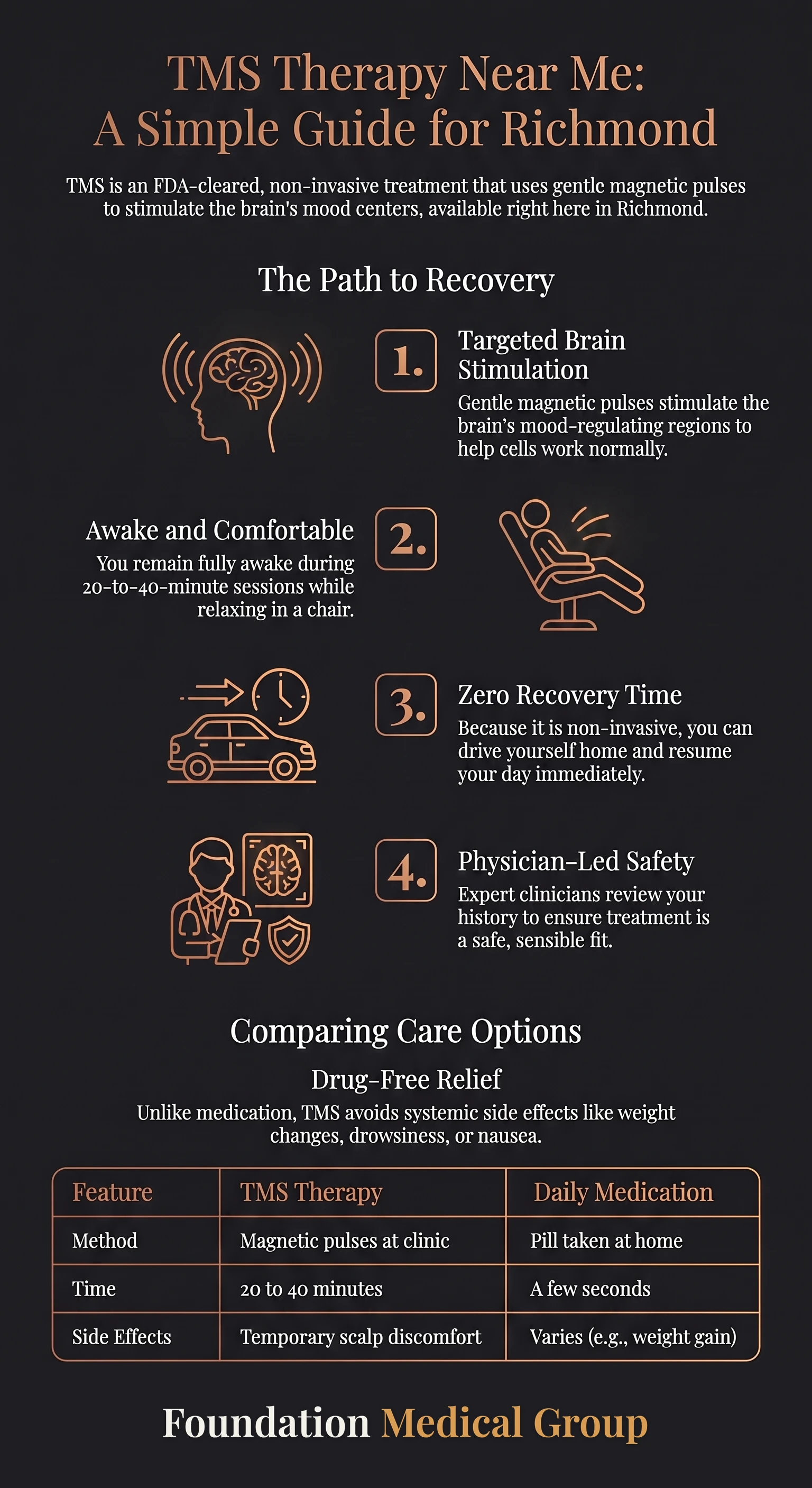
If you’re searching for transcranial magnetic stimulation near me, here’s the short answer. TMS, the short name for that treatment, is FDA-cleared and noninvasive. It uses gentle magnetic pulses to reach mood-related parts of the brain. Doctors use it most often for depression, including depression that hasn’t eased with medicine.
At Foundation Medical Group in Richmond, VA, our physician-led team helps you work out whether TMS is a good fit. This guide covers how it works, what a session feels like, and how to find a TMS provider close to you.
What Is TMS Therapy and How Does It Work?
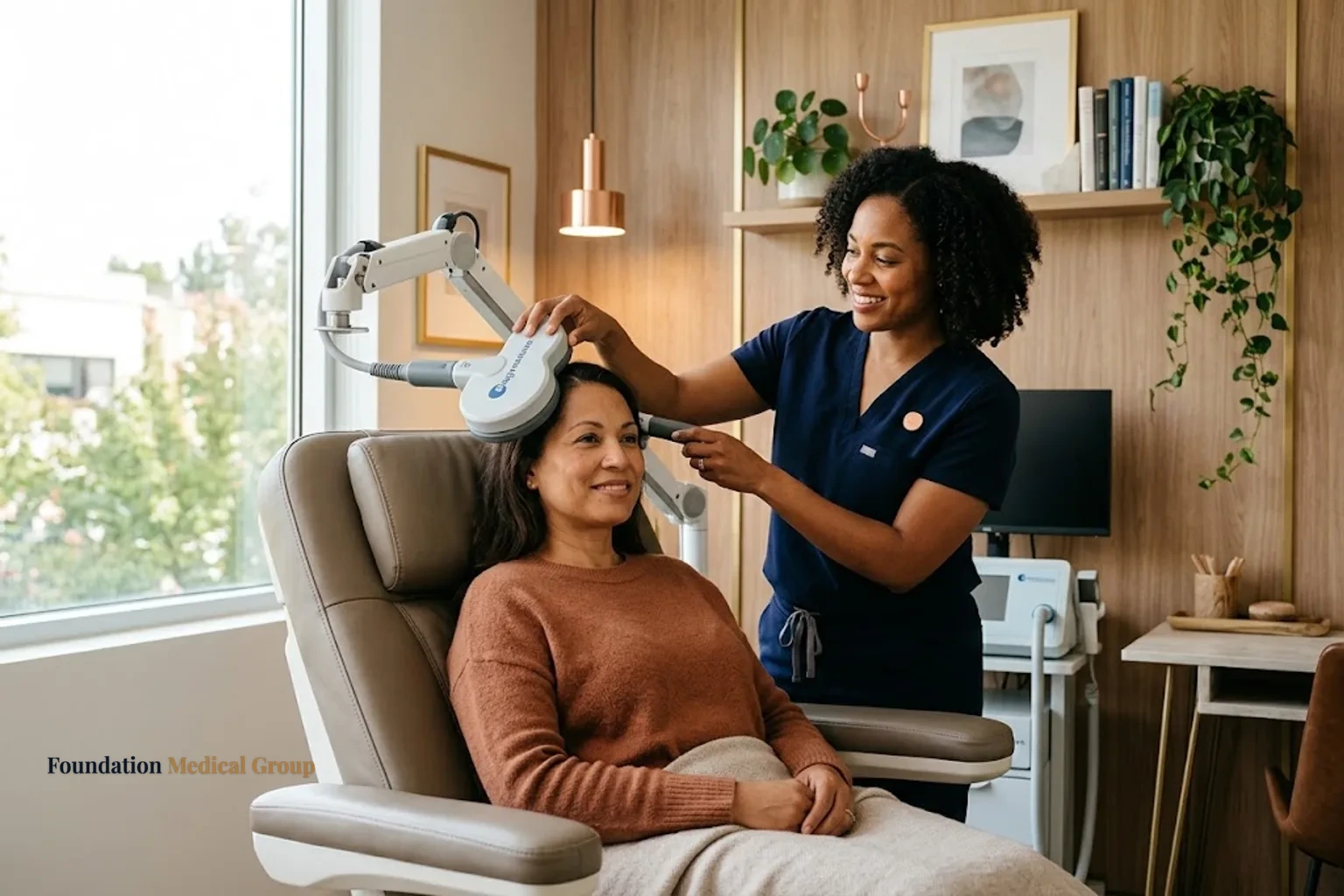
TMS is a form of magnetic stimulation. A small coil rests against your head. The coil sends short magnetic pulses to the dorsolateral prefrontal cortex. That’s a region on the left front of the brain that helps steer mood. Over a course of care, those pulses are thought to help brain cells in that region work more normally again.
The treatment is noninvasive. No surgery. No needles. No anesthesia. You sit in a chair, stay awake the whole time, and go back to your day right after. TMS doesn’t travel through the whole body the way a swallowed pill does. So it skips the weight changes, drowsiness, and sexual side effects that can come with antidepressant medicine.
You may also see the term deep TMS. Standard TMS uses a figure-8 coil, whereas deep TMS uses an H-shaped coil that reaches a slightly wider area of the brain. A common protocol fires pulses at roughly 10 per second, in short bursts with rest breaks in between. There’s also a faster form called theta burst, which can finish in under 10 minutes instead of the usual 20 to 40.
According to the U.S. Food and Drug Administration, TMS was first cleared for major depressive disorder in 2008, and then for obsessive compulsive disorder in 2018. NeuroStar TMS therapy was among the first systems cleared for depression, and it’s still widely used today.
Who Is TMS Therapy For?
TMS is best known as a depression treatment. Most patients who ask us about it have already tried 1 or 2 antidepressants without enough relief. When symptoms hang on after medicine and therapy, clinicians call it treatment resistant depression. That label can feel heavy. It doesn’t mean you’re out of options. It means the first path didn’t work, and there’s another road to try.
In our experience, the first question people ask is whether TMS is a last resort. It isn’t. It’s simply a different way in, and many people get there after 1 or 2 medicines rather than 5.
Research from the National Institute of Mental Health groups TMS with other brain stimulation therapies for depression. The FDA has cleared it for major depressive disorder and for obsessive compulsive disorder. Work continues on anxiety disorders and post traumatic stress disorder. Your care team can explain what the evidence supports today, and what it doesn’t.
TMS may be worth discussing if you:
- Have a depressive disorder that hasn’t improved with antidepressant medicine.
- Had hard side effects from medicine for mood or anxiety.
- Want a treatment option that is noninvasive and drug-free.
- Prefer to stay awake and keep your normal routine during care.
A full psychiatric evaluation is the first step. Your provider reviews your history, your current symptoms, and any other mental health condition. Then you build a plan together.
What Happens During a TMS Session?
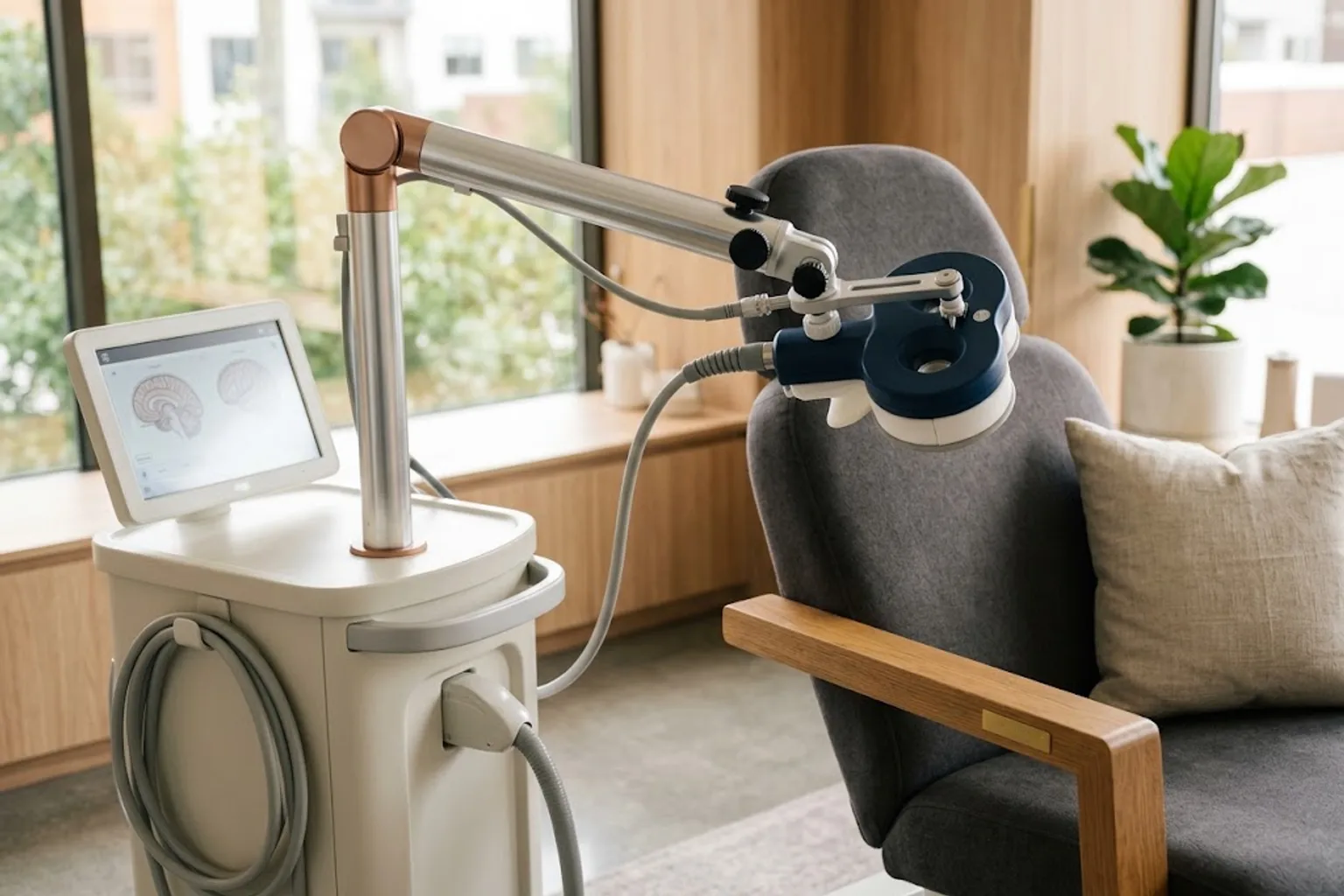
Your first visit is a mapping visit, and it runs longer than the rest, often close to 60 minutes. The clinician finds the right spot on your head. They also set the pulse strength that fits you, which is why the first appointment feels more like measuring than treating. Every session after that follows the same simple routine.
Here’s a plain look at TMS compared with taking daily medicine.
| What to expect | TMS therapy | Antidepressant medication |
|---|---|---|
| How it is given | Magnetic pulses at a TMS clinic | Pill taken at home |
| Time needed | About 20 to 40 minutes per session | A few seconds daily |
| Typical schedule | 5 days a week for 4 to 6 weeks | Ongoing, often long term |
| Sedation | None, you stay awake | None |
| Common side effects | Scalp discomfort, short headache | Varies by medicine |
| After treatment | Drive yourself home, resume your day | Continue normal routine |
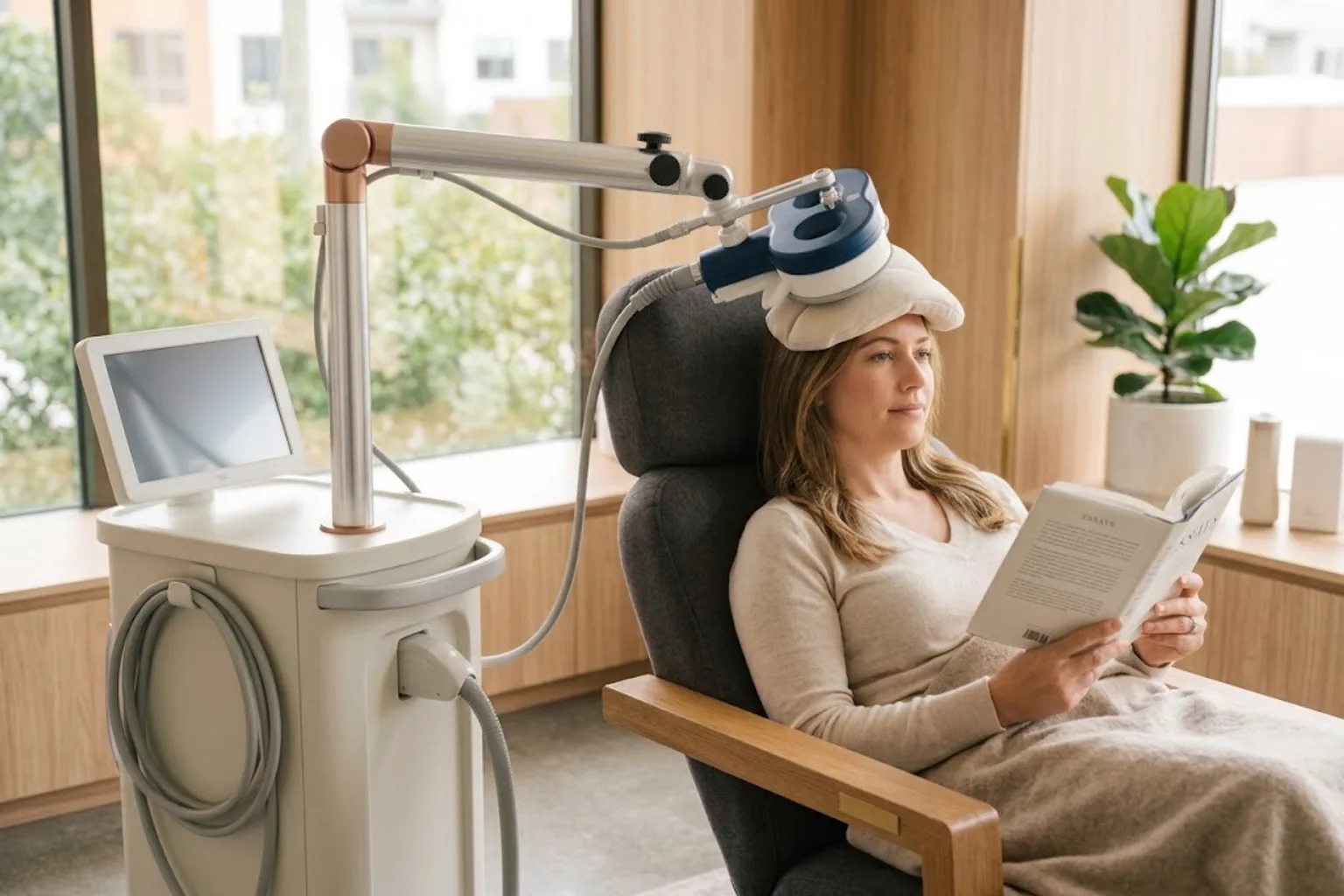
During a session you sit back in a comfortable chair. You feel a light tapping on your scalp. There’s a clicking sound as the pulses fire, then a short pause, then another burst. Bring something to fill the time, for example a podcast, a playlist, or a book. When the timer ends, you’re free to leave. Most people head straight back to work, school, or family that same afternoon, specifically because there’s no sedation to sleep off.
What Does a Full Course of TMS Look Like?
One session won’t change how you feel. TMS works over a course of care, and that course takes time.
Most plans run 5 days a week for 4 to 6 weeks in a row. Many courses land near 36 sessions, then step down over a short taper of about 3 weeks. Your provider sets your exact number after your evaluation.
The daily rhythm is what surprises people. Coming in every weekday is a real commitment, on top of work and family. Booking the same time slot each day helps, and so does picking a clinic near your job or your home. Telling one trusted person what you’re doing helps too, because they can cheer you on through the slow middle weeks.
Relief tends to build gradually. Some people notice small shifts in sleep, appetite, or energy in the first 1 to 2 weeks. For others the change shows up later in the course, in particular around the halfway mark. A few don’t respond at all, and that’s worth knowing before you start. Your team should track your symptoms with a short rating scale such as the PHQ-9, so progress gets measured rather than guessed.
Is TMS Safe and What Are the Side Effects?
For most patients, TMS is well tolerated. The two most common complaints are mild scalp soreness at the treatment spot and a short headache. Both often settle inside the first 2 weeks. Unlike a pill that travels through your bloodstream, TMS acts on one target area, so it skips the whole-body effects that medicine can bring, such as nausea or weight gain.
Serious risks are rare. The one clinicians watch most closely is a seizure, which is uncommon when standard protocols are followed.
Careful screening is how our team keeps it that way. Before your first session, our clinicians go through your health history. We ask about past seizures. We ask about metal implants in or near your head. We ask about any other condition that could change the plan. Some implants rule TMS out, whereas others don’t matter at all. That’s a conversation, not a checkbox.
TMS is one part of good mental health care, not a replacement for it. In our Richmond clinic, many patients keep up therapy or medication management alongside TMS. Your team coordinates the whole plan, so nothing works against your recovery.
What If TMS Isn’t the Right Fit?
Sometimes an evaluation points somewhere else. That isn’t a dead end.
If TMS doesn’t suit you, or you try it and the response is small, other paths stay open. Spravato for depression is one FDA-approved option for adults with treatment resistant depression, approved in 2019. A fresh look at your medication management is another. Everyday drivers matter too, for instance sleep, alcohol use, thyroid problems, chronic pain, and grief, and each one deserves attention rather than a shrug.
The point is simple. You deserve a plan built around your life, not one tool handed to everybody.
How Do I Find TMS Therapy Near Me in Richmond?
When you look for a TMS clinic close to home, a few things matter more than distance. Look for a provider who offers a real psychiatric evaluation. Look for plain answers to your questions. Look for a team that stays with you over months, not just weeks. Ask early about TMS cost, and check insurance coverage for TMS, so there are no surprises once you begin. You can also read more about TMS in Richmond.
Good questions to ask a TMS therapy provider include:
- Is the clinic physician-led, and who oversees my care?
- Which FDA-cleared device do you use?
- How many treatment sessions will my plan include?
- How do you track my depression symptoms during care?
- What happens if I have to miss a day?
- Do you also offer therapy, psychiatry, and medication management?
Foundation Medical Group brings these mental health services together under one roof in Richmond. You’re not sent from place to place to build a plan.
Key Takeaways
- TMS is an FDA-cleared, noninvasive brain stimulation treatment for depression and OCD.
- It uses gentle magnetic pulses, so there’s no surgery, no sedation, and no hospital stay.
- TMS is often chosen for treatment resistant depression when medicine hasn’t helped enough.
- Sessions are short, and you can drive yourself home and get on with your day.
- A course runs five days a week for several weeks, so plan for the schedule.
- A physician-led evaluation confirms whether TMS is a safe, sensible option for you.
Sources
- U.S. Food and Drug Administration (FDA), Transcranial Magnetic Stimulation Devices and Clearances.
- National Institute of Mental Health (NIMH), Brain Stimulation Therapies.
- Mayo Clinic, Transcranial Magnetic Stimulation, Patient Care and Health Information.
- American Psychiatric Association (APA), What Is Depression?
Talk With Foundation Medical Group
You don’t have to sort through this alone. If depression has held on despite your best efforts, TMS may open a new door. Our team is here to explain it clearly and calmly, with no pressure. Reach out to Foundation Medical Group in Richmond, Virginia to ask about an evaluation and find the care that fits your life.