
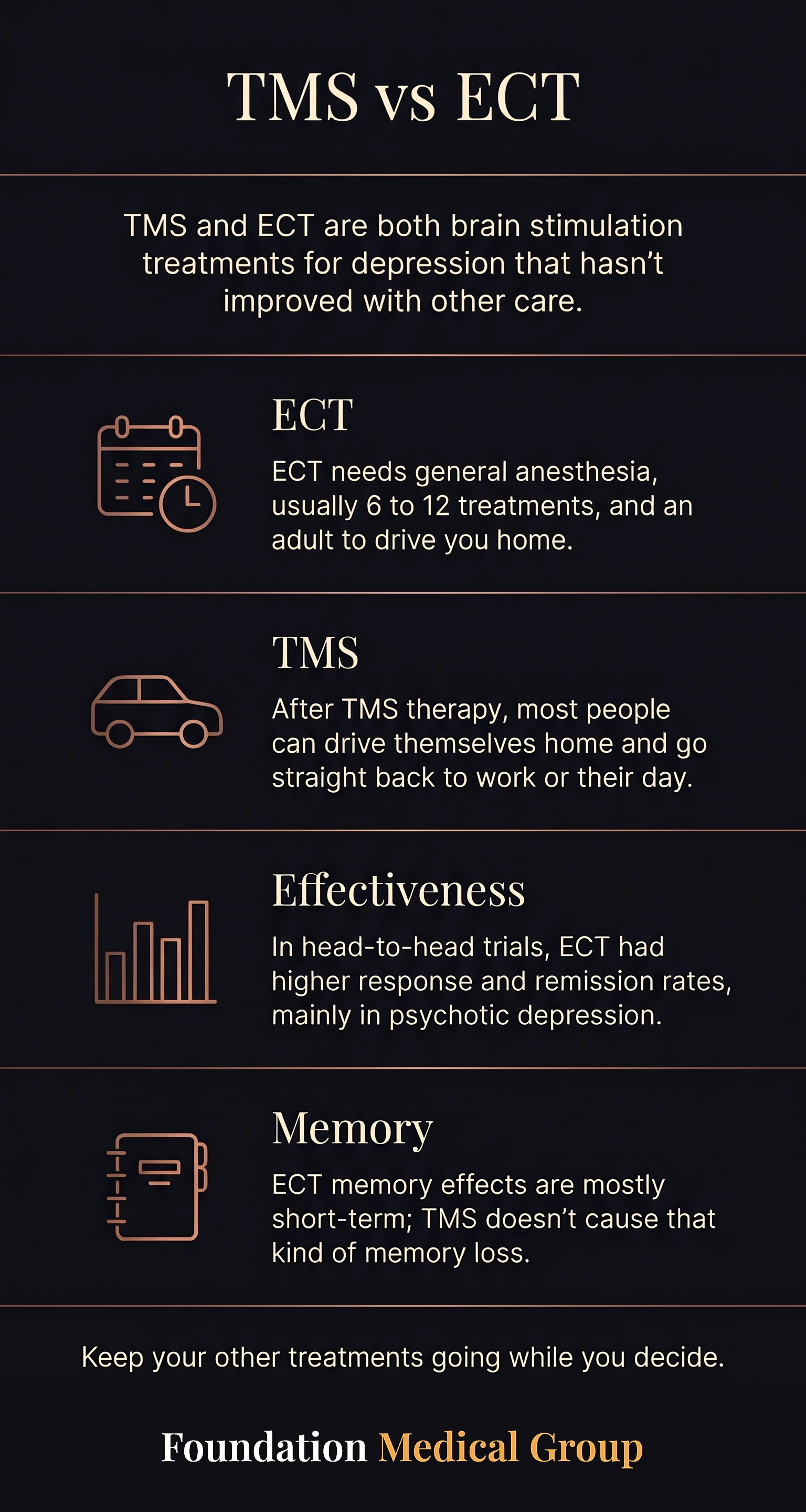
TMS and ECT are both brain stimulation treatments for depression that hasn’t improved with other care. The TMS vs ECT choice comes down to strength, speed and what each asks of you. ECT uses an electrical current to cause a brief seizure under general anesthesia and works faster and more strongly short term. TMS sends magnetic pulses while you’re awake, with no anesthesia and no ECT-type memory loss. We offer TMS in Richmond, Virginia. We don’t offer ECT.
What Is the Difference Between TMS and ECT Treatment?
ECT treatment (electroconvulsive therapy) sends an electric current through electrodes on the scalp to cause seizure activity in the brain that lasts under a minute. You are asleep under anesthesia and given a muscle relaxant, so you don’t feel it.
TMS treatment (repetitive transcranial magnetic stimulation, or rTMS) uses an electromagnetic coil held against the head. The coil sends repeated, low-intensity magnetic pulses to one area of the brain. There’s no anesthesia, no seizure, and it’s done in an office.
Both are authorized by the FDA. ECT is cleared for severe depressive episodes in people 13 and older with depression or bipolar disorder. The FDA cleared the first rTMS device in 2008, for depression in people who did not respond to at least one antidepressant in the current episode.
So the two are cousins in the brain stimulation family, but they ask very different things of you. ECT is the stronger, faster treatment, and it’s more demanding: anesthesia, a hospital setting, a driver, and memory side effects to plan around. TMS is gentler, with fewer side effects, and fits around your day, but it works more slowly and, on average, less strongly.
One plain fact before we go on: Foundation Medical Group offers TMS therapy in Richmond, and we don’t offer ECT at any clinic. You can read more about how we use TMS in our guide to TMS for depression.
How Does ECT Therapy Work?
ECT therapy is done most often in a hospital, by a trained team that includes a psychiatrist, an anesthesia professional and nursing staff. Before each session, you’ll be asked not to eat or drink, because general anesthesia is used. You’ll also remove jewelry and other metal objects.
Here’s what happens during a session:
- You get a short-acting anesthetic that puts you briefly to sleep, plus a muscle relaxant through an IV. Muscle relaxants keep your body from moving during the seizure.
- Electrodes are placed at set points on your head. Some monitor your brain activity, and others deliver the current.
- A brief, controlled electrical current causes seizure activity in the brain. It lasts about 40 seconds. Because of the muscle relaxant, your hands or feet move only slightly.
- You wake up within several minutes and are taken to a recovery area, where the team watches you closely.
Your heart rate, blood pressure and oxygen are checked during treatment. Oddly enough, it still isn’t fully clear why the seizure helps. The leading idea is that it may promote neuroplasticity, the brain’s ability to adapt, in networks involved in mood, thinking and behavior.
How ECT is given matters too. Electrodes can go on both sides of the head (bilateral ECT) or mainly on one side, usually the right (unilateral ECT). Modern devices can also use brief or ultra-brief electrical pulses. These choices change both how fast it works and the risk to memory, which we come back to below.
How Does TMS Therapy Work?

TMS therapy uses magnetic fields instead of electricity applied straight to the head. For depression, the coil sits over the left prefrontal cortex, a part of the brain involved in mood regulation and cognitive control.
The magnetic field is about as strong as an MRI scanner’s. It switches on and off very fast, and each magnetic pulse passes through the skull and induces small electrical currents that stimulate nerve cells in the target area. Unlike ECT, where the stimulation spreads across many brain regions, rTMS aims its magnetic stimulation at one brain site.
You stay awake and alert the whole time. Most people feel a light knocking or tapping on the head as the pulses come. There’s no anesthesia and no seizure is meant to happen.
At our Richmond clinic we use FDA-cleared NeuroStar TMS. You sit in a reclining chair, fully awake, for about 19 minutes. You can listen to music, meditate or chat with our clinician during the session.
TMS keeps improving. A 2025 consensus review backed by depression and TMS groups found that TMS continues to show broad evidence for safety and efficacy in depression. It also found that newer forms of TMS are faster and possibly more effective than conventional rTMS. Researchers are still working out which brain targets work best and how to keep the gains going after a course. Open questions, in other words.
TMS vs ECT Side by Side
Here’s how transcranial magnetic stimulation and ECT compare on the questions people ask most. ECT facts come from NIMH, MedlinePlus and the American Psychiatric Association; TMS schedule facts come from NIMH and our Richmond clinic.
| Question | TMS | ECT |
|---|---|---|
| How it works | Magnetic pulses to one brain area | Electrical current causes a brief seizure |
| Anesthesia | None, you stay awake | General anesthesia and a muscle relaxant |
| Where | Office or clinic | Most often a hospital, or a specialized clinical setting |
| Usual schedule | 5 days a week for 4 to 6 weeks (our clinic: about 19 minutes, 3 to 5 days a week, about 6 weeks) | 2 or 3 times a week, often 6 to 12 treatments |
| Common side effects | Scalp discomfort, tingling of scalp, jaw or face muscles, mild headache, lightheadedness | Headache, upset stomach, muscle aches, confusion, memory loss |
| Memory | No ECT-type memory loss | Memory gaps around the treatment period, usually improving over days and weeks |
| Driving after | Yes, the same day | No, an adult drives you home |
| Strongest use | Treatment-resistant depression outside a crisis | Severe, urgent or psychotic depression |
| Offered at Foundation Medical Group | Yes, Richmond, VA only | No |
A psychiatrist matches the option to your history, your symptoms and how urgent things are. The table is a starting point for that talk, not a substitute for it.
Is ECT More Effective Than TMS Treatment?
Yes, in the short term. ECT is still considered the gold standard for treatment-resistant depression, and NIMH notes that rTMS does not match its effects. Still, strong clinical evidence supports TMS treatment for reducing depressive symptoms.
The best head-to-head numbers come from a meta-analysis of 9 trials with 425 patients. In those trials, ECT beat high-frequency rTMS on response (64.4% vs 48.7%) and remission (52.9% vs 33.6%). Drop-out rates were about the same. But two details matter for you:
- The gap was clearest in people with psychotic depression. In non-psychotic depression, high-frequency rTMS was as effective as ECT.
- The trials were small and short. There wasn’t enough data to say how the two compare months later.
A larger 2019 BMJ review pulled together 113 trials with 6,750 patients across many kinds of non-surgical brain stimulation. When active treatments were compared with each other, bitemporal ECT and high-dose right unilateral ECT were linked with more response. Every treatment in the review was at least as acceptable to patients as sham treatment, though the precision of the results varied a lot from one comparison to another.
Speed differs too. ECT usually starts working within the first week. Many of our TMS patients feel a first lift in mood or energy within 2 to 3 weeks, though some take longer, and relief tends to build over the full course.
So effectiveness isn’t the only question. How urgent your symptoms are, whether you can have anesthesia, how you feel about memory effects, and how much time you can give each week all shape the right choice.
What Is the Most Serious Side Effect of ECT Treatment?
Memory problems are the side effect people worry about most with ECT treatment, and they’re part of why ECT has had bad press. It’s an understandable fear, honestly, since memory feels like part of who you are. Some patients have trouble forming new memories during the treatment period, or gaps in recall for events around that time. These effects often improve after treatment ends. Permanent long-term memory loss is uncommon, though the APA notes some people have longer-lasting gaps in personal memories.
Other ECT side effects include:
- Headache.
- Upset stomach or nausea.
- Muscle aches or soreness.
- Short-lived confusion or disorientation.
- Changes in heart rate and blood pressure during treatment.
Because ECT uses anesthesia, your medical and anesthesia risks are checked before you start, and you’re watched closely at each session. Serious complications are uncommon.
TMS side effects look different. NIMH lists discomfort where the coil sits, tingling or twitching of the scalp, jaw or face muscles during the session, mild headaches, brief lightheadedness and dizziness. A seizure is the most serious possible risk of TMS, and international expert safety guidelines found that this risk is low with standard settings. Most effects are mild and short-term when guidelines are followed, which is why TMS is often described as a treatment with minimal side effects. Long-term effects of TMS therapy are still being studied.
Does TMS Therapy Cause Memory Loss Like ECT?
No. TMS therapy doesn’t use anesthesia and doesn’t set out to cause a seizure, so it doesn’t bring the kind of memory loss ECT can.
With electroconvulsive therapy, memory effects are real but usually short. NIMH says they’re mostly about memories from around the time of treatment and usually improve over the days and weeks after the course ends. Research backs that up. A meta-analysis of 84 studies and 2,981 patients found that thinking and memory changes after ECT were mainly limited to the first 3 days, with people back to their pretreatment levels after that. After 15 days, some areas, such as processing speed and working memory, tested better than before treatment.
A 2023 trial of people referred for ECT saw the same pattern: a drop in delayed recall after 3 weeks of ECT, with gradual recovery during follow-up.
How ECT is given changes the risk. Memory problems are more common with bilateral ECT. Right unilateral ECT and brief or ultra-brief pulses lower the risk, and the shorter pulses work as well as the traditional form. If you’re considering ECT, ask the team which electrode placement and pulse width they plan to use, and how they’ll check your memory along the way.
How Many TMS Sessions and ECT Sessions Does Treatment Take?
ECT sessions are fewer but bigger. MedlinePlus says ECT is usually given once every 2 to 5 days for a total of 6 to 12 sessions, and sometimes more are needed. NIMH describes a typical course as three times a week until symptoms improve, usually within 6 to 12 treatments.
After a course of ECT, most people need follow-up treatment to keep the gains: antidepressant medication, maintenance ECT, or both. Maintenance ECT can range from one session a week to one every few months.
TMS sessions are shorter but more frequent. NIMH says a typical rTMS session lasts anywhere from 3 to 40 minutes, with daily sessions 5 days a week for 4 to 6 weeks. Accelerated protocols fit several sessions into one day, with short breaks, and often finish within a week.
At our Richmond clinic, NeuroStar TMS sessions last about 19 minutes, 3 to 5 days a week, and most patients finish in about 6 weeks. Our team tracks your progress with validated depression scales along the way, so you’re not guessing whether it’s working. For what happens after a course, read how long TMS lasts.
Can You Drive Home After ECT or TMS Therapy?
Not after ECT. Because you get general anesthesia, you’ll need an adult to drive you home, so arrange it ahead of time. You may feel groggy at first, though most patients are alert after about an hour. Your ECT team will also tell you how long to avoid driving, work, operating machinery and big decisions during the course.
After TMS therapy, most people can drive themselves home and go straight back to work or their day. There’s no anesthesia to wear off, since TMS works through magnetic fields while you’re awake for the whole session.
For a patient who works full time, cares for children, or lives alone, this one difference can matter as much as anything else in the comparison. It sounds like a small thing. It isn’t.
Who Should Consider ECT Instead of TMS Treatment?

ECT is usually kept for severe cases, when depression is dangerous or other options can’t be used. Doctors most often consider it for people who:
- Have delusions or other psychotic symptoms with their depression.
- Are at high risk of suicide or need a rapid response.
- Aren’t eating or drinking enough, or have catatonia.
- Are pregnant and severely depressed.
- Can’t take antidepressant medicines, or haven’t responded fully to them.
- Did well with ECT in the past.
TMS treatment usually fits people with depression that hasn’t improved after at least one antidepressant, who aren’t in a crisis and want to stay awake, drive and keep up with work during care. NIMH notes rTMS is used for moderate to severe depression when medications haven’t worked or couldn’t be tolerated.
Both treatments are part of mental health care, not a replacement for it. Brain stimulation plans usually include talk therapy (psychotherapy), medication or both. To see where TMS and ECT sit next to other treatment options, read our guide to treatment-resistant depression.
If you or someone you know is in danger or thinking about suicide, call or text the 988 Suicide and Crisis Lifeline at 988. In a life-threatening situation, call 911. Decisions about ECT in a crisis are made with a hospital team.
Which Is Better for Bipolar Depression, ECT or TMS Treatment?
The FDA has cleared ECT to treat severe depressive episodes in people with depression or bipolar disorder. ECT is also used, less often, for mania.
TMS is in a different place. In 2020, the FDA granted rTMS breakthrough device designation for bipolar depression. That label is for devices with early evidence of benefit; it isn’t a clearance for that use. A subtle difference, but it matters.
The 2019 BMJ review mentioned above included people with major depressive disorder or bipolar depression, but it doesn’t give separate bipolar results. So for bipolar depression, ECT has the regulatory clearance and TMS doesn’t yet. Bipolar depression needs a full plan from a psychiatrist, which often includes mood-stabilizing medication.
Is Electroconvulsive Therapy Still Used?
Yes. Electroconvulsive therapy has the longest history of use for depression and is still one of the most widely used brain stimulation therapies.
It’s also changed a lot. Since ECT was introduced in the 1930s, the dose of electricity has come down a great deal, and unilateral ECT is now an option. These changes have greatly reduced side effects, including memory loss. Modern ECT happens under general anesthesia with careful monitoring, which is very different from older images of “shock therapy.” If your only picture of ECT comes from old films, that’s worth knowing.
Researchers are also testing a related therapy called magnetic seizure therapy. It uses strong magnetic pulses, like a more powerful TMS, to cause a seizure under anesthesia, with the goal of keeping ECT’s benefit with fewer memory effects. In the United States it’s available only in research studies, and we don’t offer it.
Can TMS Therapy Help Other Mental Health Conditions?
Depression is the main use, but not the only one. NIMH says rTMS is FDA-cleared for treatment-resistant depression, obsessive compulsive disorder, migraines, anxiety with depression and smoking dependence. The OCD clearance, for severe obsessive compulsive disorder, came in 2018. In March 2024, the FDA also cleared NeuroStar Advanced Therapy as an add-on treatment for major depressive disorder in patients ages 15 to 21. TMS is not approved for youth under 15.
At our Richmond clinic, our team uses TMS therapy for depression. If you have another one of these mental health conditions, ask your psychiatrist whether TMS has a place in your plan.
Does Foundation Medical Group Offer TMS or ECT Treatment?
We offer FDA-cleared NeuroStar TMS for depression at our Richmond, Virginia clinic, 11600 Busy Street, Suite 203. It’s the only Foundation Medical Group clinic that offers TMS treatment.
We don’t offer ECT treatment at any of our clinics. If your psychiatrist thinks ECT may be the better fit, for example because of psychotic symptoms or a need for fast relief, ask them about a referral to a hospital or ECT service.
TMS is one part of the care we provide. We also offer a psychiatric evaluation and medication management, so your TMS course and your medicines are planned together. If you live near Richmond, our team can tell you what a first TMS visit in Richmond looks like.
Coverage depends on your plan, so call to confirm coverage before you start. Our Richmond clinic doesn’t accept Medicare at this time. For more detail, read what TMS costs, or call us at (800) 983-1974.
What to Ask Your Psychiatrist About Brain Stimulation Therapy
Bring these questions to your next visit. They help you and your doctor decide whether either brain stimulation therapy fits:
- How severe is my depression right now, and is this urgent?
- Which medicines and therapy have I tried, at what doses, and for how long?
- Do I have psychotic symptoms, or could this be bipolar depression?
- Can I have general anesthesia safely?
- Could I arrange a driver and time off for ECT, or come in most weekdays for TMS?
- If ECT, which electrode placement and pulse width would you use, and how will you check my memory?
- What happens after the course: medication management, maintenance treatment, or both?
Keep your other treatments going while you decide. NIMH advises patients not to stop a treatment unless their provider tells them to.
Key Takeaways
- TMS vs ECT: both treat depression that hasn’t improved with other care. ECT is stronger and faster; TMS is gentler and fits around daily life.
- In head-to-head trials, ECT had higher response and remission rates, mainly in psychotic depression.
- ECT needs general anesthesia, usually 6 to 12 treatments, and an adult to drive you home.
- ECT memory effects are mostly short-term; TMS doesn’t cause that kind of memory loss.
- We offer TMS in Richmond, VA only, and we don’t offer ECT.
Sources
- National Institute of Mental Health, Brain Stimulation Therapies.
- MedlinePlus (National Library of Medicine), Electroconvulsive therapy.
- American Psychiatric Association, What is Electroconvulsive Therapy (ECT)?.
- Repetitive transcranial magnetic stimulation versus electroconvulsive therapy for major depression: a systematic review and meta-analysis, Progress in Neuro-Psychopharmacology and Biological Psychiatry, 2014.
- Comparative efficacy and acceptability of non-surgical brain stimulation for the acute treatment of major depressive episodes in adults, BMJ, 2019.
- Objective cognitive performance associated with electroconvulsive therapy for depression, Biological Psychiatry, 2010.
- Ketamine versus ECT for nonpsychotic treatment-resistant major depression, New England Journal of Medicine, 2023.
- Safety and recommendations for TMS use in healthy subjects and patient populations: expert guidelines, Clinical Neurophysiology, 2021.
- Consensus review and considerations on TMS to treat depression: a comprehensive update, Clinical Neurophysiology, 2025.
- U.S. Food and Drug Administration, 510(k) K231926: NeuroStar Advanced Therapy System, 2024.