
Vivitrol and Suboxone both treat opioid use disorder, but they work in opposite ways. Vivitrol is a monthly shot that blocks opioids and needs you to be opioid-free first. Suboxone is a daily film you can start in early withdrawal. The right medication for you depends on where you are in treatment.
What Is the Difference Between Vivitrol and Suboxone?
Vivitrol is extended-release naltrexone, an opioid antagonist. It isn’t an opioid at all, and SAMHSA notes that it’s not addictive. Suboxone combines buprenorphine, which SAMHSA describes as a partial opioid agonist, with naloxone in a film that melts under your tongue.
Both are real treatment options. According to the National Institute on Drug Abuse (NIDA), methadone, buprenorphine and naltrexone are the three FDA-approved medications for opioid use disorder. So if you’re weighing Vivitrol treatment against Suboxone treatment, you’re choosing between two proven paths, not between a good one and a weak one.
The everyday difference is easy to picture. Vivitrol is an injection you get at a clinic once a month. Suboxone is a prescription medication you take at home, usually once a day.
The bigger difference sits inside your body, in how each medicine acts on the opioid system. That decides how and when patients can start treatment, which is often the deciding point.
How Does Each Medication Act on Opioid Receptors?

Your brain has opioid receptors, small docking sites that opioid drugs attach to. How a medication treats those receptors explains almost everything about how it feels and how it’s started.
Naltrexone is an opioid blocker. NIDA says it works solely by blocking opioid receptors. SAMHSA adds that it binds to the receptors and blocks them, and that it also reduces cravings. If someone uses opioids while the blocker is in place, the drug has little effect, because the receptor is already taken. Think of it as a key that fits the lock but doesn’t turn.
Buprenorphine works differently. It partly switches those same receptors on. SAMHSA explains that its effects, such as euphoria or slowed breathing, are weaker than those of full opioid agonists like heroin. MedlinePlus says this is how Suboxone prevents withdrawal: it produces effects similar to opioids, but milder, which eases withdrawal and cravings.
So why is naloxone in Suboxone? According to SAMHSA, naloxone is added to buprenorphine to decrease misuse and diversion. In plain words, it’s there to make misuse of the film less likely.
If you want the deeper science of how the film works, our guide on how Suboxone works walks through it step by step.
Do You Need Detox Before Vivitrol or Suboxone Treatment?
This is the biggest practical difference between the two medications.
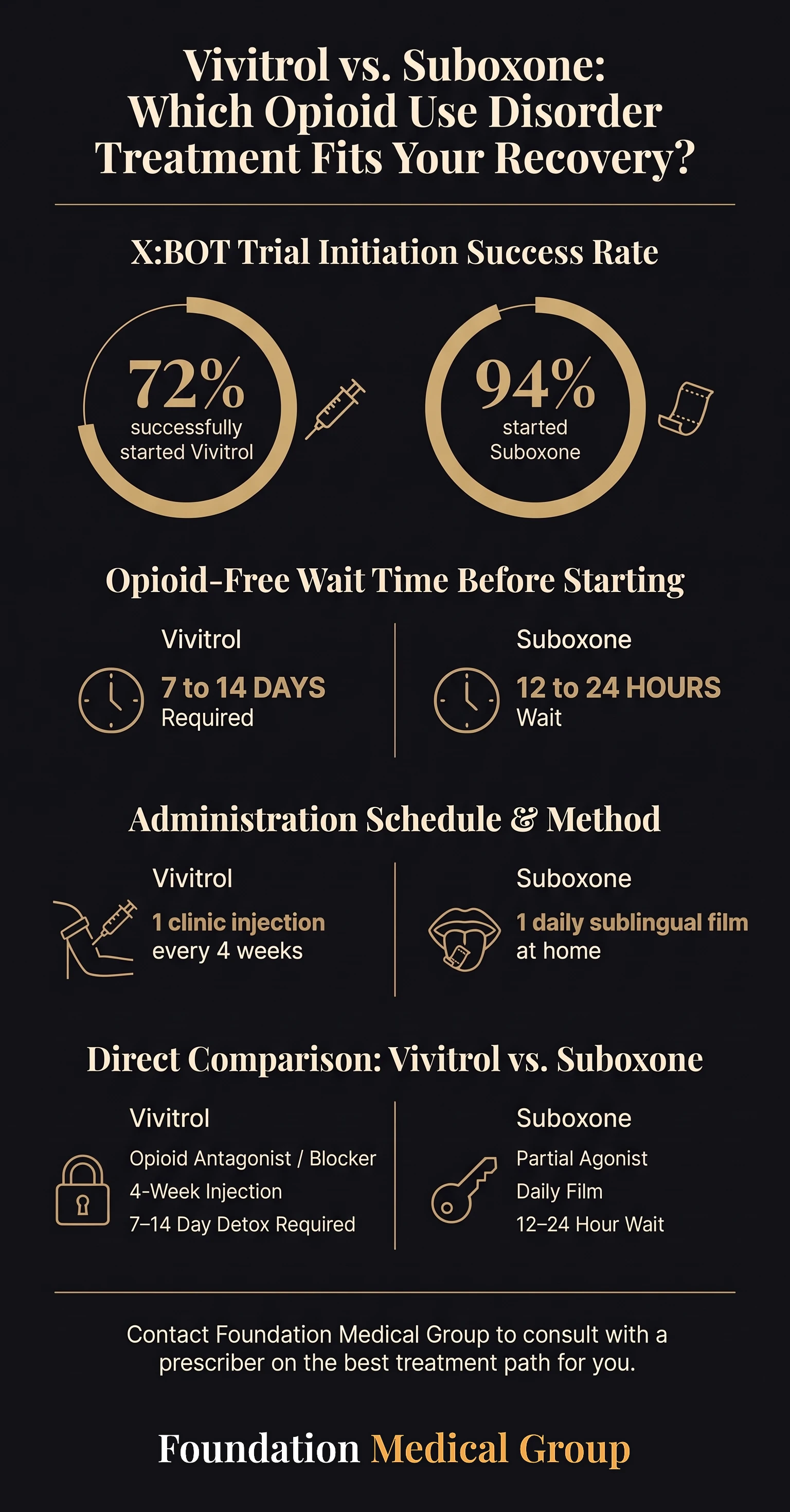
For Vivitrol, the answer is usually yes. SAMHSA says to wait at least 7 days after your last use of short-acting opioids, and 10 to 14 days after long-acting opioids, before you start this medicine. SAMHSA also says not to take it while you’re dependent on opioids or in opioid withdrawal. That means most people need to finish withdrawal, often called detox or opioid detoxification, before the first shot. MedlinePlus also asks you to tell your doctor if you’ve used opiates, methadone or buprenorphine in the last 7 to 10 days. Honestly, that waiting period is where a lot of people get stuck, as the trial results further down show.
For Suboxone, there’s no detox step first. SAMHSA says buprenorphine can be started after about 12 to 24 hours without opioids, once you’re in early withdrawal. If opioids are still in your bloodstream, this medication can bring on sudden, acute withdrawal. This is called precipitated withdrawal, and our page on precipitated withdrawal explains why your prescriber plans the first dose carefully.
Tell your prescriber about every drug you’ve taken, including illicit opioids. Dependence is a medical condition, and honest answers keep your start safe. At FMG, our clinicians review your history before either medicine starts, and for Vivitrol they confirm you’ve been opioid-free long enough.
One note about Foundation Medical Group: FMG does not offer detox at any clinic. If you need withdrawal management before Vivitrol, you would complete it elsewhere first.
Monthly Injection or Daily Medication: How Is Each One Given?

Vivitrol is a monthly injection. MedlinePlus says a healthcare provider gives the shot into the muscle of your buttocks once every 4 weeks. Patients don’t give Vivitrol injections at home, so each dose is a short clinic visit.
The medication in Vivitrol also comes as a pill, sold under the brand name Revia. SAMHSA describes oral naltrexone as a pill taken daily and discusses it for alcohol use disorder. The extended-release injectable is the form approved for opioid use disorder, given every four weeks by a practitioner.
Suboxone is a daily medication. MedlinePlus says you place the film under your tongue or between your gum and cheek, usually once a day. It helps to take it at about the same time each day so it becomes part of your routine.
Which format feels better is personal. Some patients like that one Vivitrol injection covers the whole month. Others prefer the steady routine of a daily film and the chance to start treatment sooner. Neither preference is wrong.
Vivitrol vs Suboxone Side by Side
Here’s the Vivitrol vs Suboxone comparison in one place, from the SAMHSA, MedlinePlus and NIDA pages in Sources and FMG’s clinic list.
| Vivitrol | Suboxone | |
|---|---|---|
| Active ingredient | Extended-release naltrexone | Buprenorphine plus naloxone |
| Drug type | Opioid antagonist (blocker), not an opioid | Partial opioid agonist |
| How it is given | Injection into the buttock by a provider | Film under the tongue or in the cheek |
| How often | Once every 4 weeks | Usually once a day |
| When you can start | At least 7 days (short-acting) or 10 to 14 days (long-acting) opioid-free | After 12 to 24 hours without opioids, in early withdrawal |
| Detox first? | Usually yes; FMG does not offer detox | No |
| Key safety point | Lower opioid tolerance after stopping raises overdose risk | Do not mix with alcohol or sedatives |
| Also approved for | Alcohol use disorder | Opioid use disorder |
| FMG clinics listing it | American Fork, UT and Dallas, TX | American Fork, UT; Decatur, GA; Dallas, TX (Richmond, VA lists MAT) |
For most people, the start row decides it. If you can get through a full opioid-free period, Vivitrol is an option. If you need to start soon, Suboxone is usually the more practical fit. The alcohol row is general information only; FMG does not treat alcohol use disorder.
Is Vivitrol Better Than Suboxone for Opioid Use?
Neither medicine is better for everyone. The right match depends on two things: whether you can get fully opioid-free first, and whether you’d rather have a monthly shot or a daily film. Your history and your daily life shape that choice.
The clearest evidence here is the X:BOT trial, published in The Lancet in 2018, which compared extended-release naltrexone with buprenorphine-naloxone. Fewer people managed to start treatment with the shot than with the daily medication: 72% compared with 94%. But among the people who did start, the two medicines were about equally safe and effective.
So is one of these medications really better than the other? Once treatment is underway, the trial found them similar. The start step is the main hurdle for Vivitrol, not how well it works afterward. That’s good news if you’re leaning toward the shot and can get through the wait.
Whichever medicine you choose, it works best inside a full addiction treatment plan. MedlinePlus says the shot is used as part of a program that includes counseling. Good addiction treatment looks at the whole person, including any other substance use and the stress that often sits underneath opioid abuse.
And the stakes are real. NIDA says medications for opioid use disorder reduce the risk of overdose deaths. In addiction medicine, the key step is getting started on a medication that fits you, then staying with your care team.
How Do Vivitrol, Suboxone and Methadone Compare?
Methadone is the third FDA-approved option, so it helps to see all three side by side. NIDA explains that the drug binds to and activates mu-opioid receptors, the same receptors that heroin and fentanyl act on. It’s been used for more than 50 years.
Here’s the simple version:
- Methadone is a full opioid agonist. It turns the receptors fully on.
- Buprenorphine (in Suboxone) is a partial opioid agonist. SAMHSA says its effects are weaker than those of full agonists such as heroin.
- Naltrexone (in Vivitrol) is an opioid antagonist. It blocks the receptors and does not turn them on at all.
All three medications are used in opioid addiction treatment, helping patients step away from opioid misuse and other substance use and rebuild stability. FMG’s clinics list Suboxone, Vivitrol and medication assisted treatment, not methadone, which is described here only for comparison.
What Are the Common Side Effects and Risks of Each Medication?
Here’s a short summary for each medication. Your prescriber will go over the full list.
Vivitrol. The most talked-about side effects happen where the shot goes in. MedlinePlus lists injection site reactions such as tenderness, redness, bruising and itching. Some site reactions can be serious, so call your doctor if the area becomes very painful or swollen.
There’s also a risk after you stop, and it’s a scary one. SAMHSA warns that after stopping this medication, your tolerance to opioids is lower than before. Using the amount you used to take, or even a smaller amount, can be life-threatening. If you ever stop Vivitrol, talk with your prescriber about this risk first.
Suboxone. SAMHSA says not to drink alcohol or take sedatives or other drugs that slow breathing while you take buprenorphine. Mixing alcohol with this medication can be dangerous.
Common side effects differ between medications, so patients should share a full medicine list at every visit, and never stop or change a dose on your own.
Where Can You Get Vivitrol or Suboxone Treatment at FMG?
Foundation Medical Group offers medication assisted treatment (MAT) for opioid use disorder in all 4 states where it has a clinic: Virginia, Utah, Georgia and Texas. Each clinic lists slightly different medicines.
- Dallas, TX: Vivitrol and Suboxone. 8390 Lyndon B Johnson Freeway, Suite 500, Dallas, TX 75243. See the Texas clinic page.
- American Fork, UT: Vivitrol and Suboxone. 456 E State Street, Suite 1400, American Fork, UT 84003. See the Utah clinic page.
- Decatur, GA: Suboxone and Subutex. 160 Clairemont Ave, Suite 200, Decatur, GA 30030.
- Richmond, VA: MAT. 11600 Busy Street, Suite 203, Richmond, VA 23236.
Vivitrol treatment is listed only at the Dallas and American Fork clinics. It isn’t listed at Richmond or Decatur.
Remember that FMG does not offer detox. Patients who still need withdrawal management before Vivitrol finish it elsewhere first, or can ask about Suboxone instead.
Insurance varies by plan and state. Common plans by state include:
- Texas: Texas Medicaid, Aetna, Cigna, Blue Cross Blue Shield and UnitedHealthcare (call to confirm coverage).
- Utah: Blue Cross Blue Shield, SelectHealth and Aetna (call to confirm coverage).
- Georgia: Cigna (call to confirm coverage).
- Virginia: Virginia Medicaid (called Cardinal Care), Aetna, Anthem, Cigna and UnitedHealthcare (call to confirm coverage). Medicare is not accepted in Virginia.
To learn how addiction treatment with MAT works at FMG, visit the Suboxone and MAT service page, then call the clinic nearest you to ask which medication might fit.
Key Takeaways
- Vivitrol blocks opioids, while Suboxone partly activates opioid receptors.
- Vivitrol needs 7 to 14 days opioid-free first; you can start Suboxone in early withdrawal.
- Vivitrol is a monthly shot from a provider; Suboxone is a film usually taken once a day.
- In the X:BOT trial, fewer people started Vivitrol, but once started, both worked about as well.
- FMG offers MAT in VA, UT, GA and TX, with Vivitrol at American Fork, UT and Dallas, TX, and no detox at any clinic.
FAQ
Is Vivitrol the same as Suboxone?
No. Vivitrol is extended-release naltrexone, and Suboxone is buprenorphine plus naloxone. Naltrexone blocks opioid receptors, while buprenorphine partly activates them, so the two medicines work in opposite ways. They also have very different start rules for patients.
Can you take Vivitrol and Suboxone together?
No, they are not used together. Naltrexone blocks opioid receptors, and buprenorphine is an opioid. MedlinePlus says to tell your doctor if you have taken buprenorphine in the last 7 to 10 days before a naltrexone shot. Any switch between them is planned by your prescriber.
Is the Vivitrol shot better than daily Suboxone?
Not for everyone. The shot means no daily dose to remember. But you must be fully opioid-free before the first injection, while Suboxone can start sooner, in early withdrawal. Which one fits you is a decision you make with a licensed prescriber who knows your history.
Is naltrexone better than buprenorphine for opioid use disorder?
Once people had started, the X:BOT trial found the two medicines about equally safe and effective. The hard part with naltrexone is getting started, because you need a full opioid-free period first. So the better choice often depends on where you are right now in treatment.
Sources
- SAMHSA, Naltrexone.
- SAMHSA, Buprenorphine.
- MedlinePlus (NIH), Naltrexone Injection.
- MedlinePlus (NIH), Buprenorphine Sublingual and Buccal (opioid dependence).
- National Institute on Drug Abuse, How effective are medications to treat opioid use disorder?.
- The Lancet, Comparative effectiveness of extended-release naltrexone versus buprenorphine-naloxone (X:BOT).