
Buprenorphine is a prescription medicine that treats opioid addiction. It eases withdrawal, quiets cravings, and helps your brain heal. Doctors use it in a plan called medication for opioid use disorder, or MAT. You might know it by brand names like Suboxone or Subutex. It’s medicine, plain and simple, not a shortcut and not a weakness.
If addiction feels like a wall you keep hitting, this medicine can help you climb over it. Below we explain what buprenorphine is in everyday words. We’ll cover how it works, the names people know, why it’s safe for the long run, and what a treatment journey looks like. No jargon, no judgment, just a clear guide.
What Buprenorphine Is, in Plain Words
Opioids like heroin or oxycodone lock onto spots in your brain called receptors. Over time your brain leans on them just to feel normal. When you stop, withdrawal hits hard, and cravings pull you back.
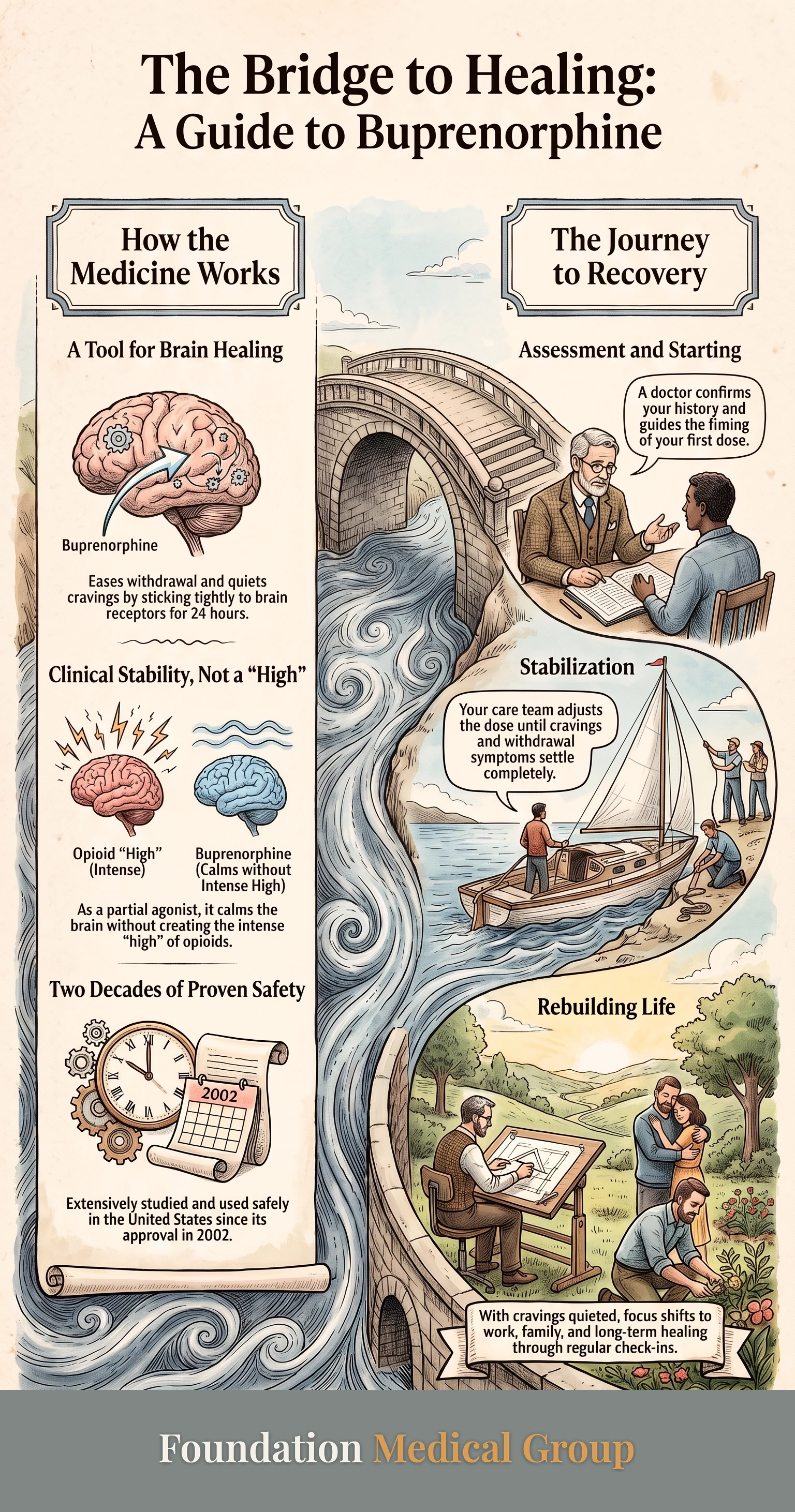
Buprenorphine works on those same brain spots, but gently. It’s called a partial agonist. That means it turns the switch part of the way, not all the way. It’s enough to stop withdrawal and calm cravings. It’s not enough to cause the big high that full opioids bring.
It also hangs around. The Suboxone label puts buprenorphine’s mean elimination half-life at 24 to 42 hours, compared with 2 to 12 hours for the naloxone that rides along with it. That long tail is why one dose a day usually holds you, instead of the every-few-hours chase that oxycodone or heroin demands.
So you feel steady, not stoned. You can work, think, drive, and care for your family. According to the Substance Abuse and Mental Health Services Administration (SAMHSA), medicines like this are the standard of care for opioid use disorder. In plain words, this is what good medicine looks like.
And the gap between what works and who gets it is wide. NIDA reports that fewer than 20 percent of people with opioid use disorder actually receive any of these medicines. That gap bothers us more than any other number here.
How a Partial Agonist Calms Cravings Without a Big High

Here’s the part that surprises people. Buprenorphine is strong, but it has a built-in limit. Take more of it, and past a point, nothing extra happens. Experts call this the ceiling effect.
That ceiling does 2 helpful things. It lowers the chance of misuse, because more pills don’t mean more high. And it lowers the risk of a dangerous overdose compared with full opioids.
It also sticks to those brain spots tightly and stays a long time. Most patients take it just once a day, over a full 24 hours. So the pull of cravings fades into the background. You stop chasing the next dose. Your mind gets quiet enough to focus on healing.
The mortality figures are the part worth sitting with. A 2017 meta-analysis in The BMJ pooled 19 cohorts covering 15,831 people on buprenorphine and found 4.3 deaths per 1,000 person-years while patients stayed in treatment, versus 9.5 per 1,000 once they left it. For overdose deaths specifically, the split was 1.4 versus 4.6 per 1,000. Roughly half the risk, for staying on the medicine.
The Brand Names People Know: Suboxone and Subutex
You may have heard the brand names before the medicine name. That’s normal. 2 names come up most often, and they’re both built on buprenorphine.
| At a glance | Suboxone | Subutex |
|---|---|---|
| Main ingredient | Buprenorphine plus naloxone | Buprenorphine only |
| What the second part does | Naloxone helps prevent misuse | No second ingredient |
| Common form | Film or tablet you place in the mouth | Tablet you place in the mouth |
| Who it may suit | Most people in treatment | Some pregnant patients or those sensitive to naloxone |
Both work through the same partial agonist action. Suboxone adds a second ingredient called naloxone as a safety layer against misuse. Subutex is buprenorphine on its own. Your doctor picks the right one for your body and your situation.
The film comes in 4 strengths: 2 mg/0.5 mg, 4 mg/1 mg, 8 mg/2 mg, and 12 mg/3 mg. The first number is the buprenorphine, the second is the naloxone. For patients starting on methadone or another long-acting opioid, the label specifically recommends buprenorphine on its own for the first 2 days, rather than the combination, because the naloxone can make precipitated withdrawal worse. To find a provider, our guide on online Subutex doctors that take insurance is a good place to start.
Why It’s Medicine, Not a Moral Failing
Let’s clear up an old, harmful myth. Addiction is not about weak willpower. It’s a medical condition that changes how the brain works.
Nobody says a person with diabetes is failing because they take insulin. The same logic applies here. Buprenorphine helps a sick brain get back to balance. Using medicine to recover is a sign of strength, not shame.
Some people worry they’re just swapping one drug for another. That’s a fair question, so here’s the honest answer. This medicine doesn’t get you high at the right dose. It steadies you so you can live your life. That’s the whole point, and it’s exactly what treatment is for.
What a Typical Treatment Journey Looks Like

Every person is different, but most journeys share a simple shape. Knowing the steps takes away the fear of the unknown.
- Your first visit. The doctor learns your history and confirms the diagnosis. Together you build a plan.
- Starting the medicine. You begin buprenorphine when your body is ready, which the label defines as no sooner than 6 hours after your last short-acting opioid and only once clear withdrawal signs show up. Clinicians usually score that with the Clinical Opioid Withdrawal Scale, an 11-item checklist where 5 to 12 counts as mild and 13 to 24 as moderate.
- Finding your dose. Day 1 tops out at 8 mg/2 mg, split into smaller doses roughly 2 hours apart. Day 2 can go to a single 16 mg/4 mg dose. From there, maintenance usually lands somewhere between 4 mg/1 mg and 24 mg/6 mg a day. This is called stabilizing.
- Regular check-ins. Visits are more frequent at first, then spread out. Many can happen by video.
- Life, rebuilt. With cravings quiet, you focus on work, family, sleep, and healing.
Along the way, counseling and support often go hand in hand with the medicine. You don’t walk this road alone. If you’re just getting started, our page for Subutex doctors near me accepting new patients can connect you with care.
Is Buprenorphine Safe and Effective Long-Term?
Yes. This is one of the most studied treatments in addiction medicine. It has been used safely for many years, since it was approved in the United States in 2002.
There’s no set finish line you must hit. Some people take buprenorphine for months. Others take it for years, and that’s fine. Here’s the evidence on stopping, though, and it’s blunt. In the POATS trial, 653 patients across 10 US sites were treated for prescription opioid dependence. While they stayed on buprenorphine-naloxone, 49.2 percent had a good outcome at week 12. Eight weeks after tapering off, that fell to 8.6 percent. Adding counseling on top didn’t change either number.
So staying on it longer often means a lower risk of relapse. Your doctor helps you decide what’s right for your life.
Side effects are usually mild, like headache or constipation, and your care team can help manage them. The bigger picture is clear. Staying in treatment keeps people alive and helps them rebuild. If you’re in Utah, our Suboxone clinic in Utah page explains what local care looks like.
Infographic: Buprenorphine at a Glance
Frequently Asked Questions
What is buprenorphine used for?
Buprenorphine treats opioid use disorder. It eases withdrawal symptoms and calms cravings so you can function normally. It’s a core part of medication-assisted treatment, and it helps your brain recover over time.
Does buprenorphine get you high?
No, not when taken as prescribed. It has a ceiling effect, so it steadies you without the big high full opioids cause. You can work, drive, and care for your family while taking it.
Is buprenorphine the same as Suboxone?
Almost. Buprenorphine is the active medicine, and Suboxone is a brand that combines buprenorphine with naloxone. Subutex is buprenorphine on its own. Your doctor chooses the version that fits you best.
How long do people stay on buprenorphine?
There’s no single answer. Some people take it for months, and others for years. Longer treatment often lowers the risk of relapse, so your doctor helps you decide the right length for you.
Is buprenorphine safe to take?
Yes, when a doctor guides your care. It has been used safely since 2002 and is well studied. Side effects are usually mild, and your care team helps you manage anything that comes up.
Key Takeaways and Next Steps
Here’s what to hold on to. Buprenorphine is a safe, proven medicine for opioid addiction. It quiets cravings and withdrawal without a big high, thanks to its partial agonist action. You may know it as Suboxone or Subutex. It’s medicine, not a moral failing, and it works well for the long run.
- Buprenorphine calms cravings so you can live a full, steady life.
- Suboxone and Subutex are both built on buprenorphine, and your doctor picks the right one.
- There’s no shame in using medicine to heal a medical condition.
- Staying in treatment, even for years, is safe and lowers the risk of relapse.
Ready to take the first step? Reach out to Foundation Medical Group and ask what treatment could look like for you. One call can turn a scary unknown into a clear, caring plan.
Sources
- Suboxone (buprenorphine and naloxone) sublingual film prescribing information, DailyMed, National Library of Medicine.
- Sordo L, et al. Mortality risk during and after opioid substitution treatment. BMJ 2017;357:j1550.
- Weiss RD, et al. Adjunctive counseling during brief and extended buprenorphine-naloxone treatment for prescription opioid dependence. Arch Gen Psychiatry 2011;68(12):1238-46.
- Opioid Withdrawal, StatPearls, NCBI Bookshelf (Clinical Opioid Withdrawal Scale scoring).
- National Institute on Drug Abuse, Medications for Opioid Use Disorder.
- Substance Abuse and Mental Health Services Administration, Buprenorphine.